Showing posts with label George Washington. Show all posts

Thursday, June 16, 2016

Treasure Chest Thursday: Jean La Forêt's Diary, fourth section


This Thursday we continue on with Jean La Forêt's diary.  Since only a small portion of the next page was needed to finish the last entry translated, I'm counting this week's first page (above) as a complete one.  Remember, as of last week's episode, Jean is no longer in the U.S. Army but has joined the Marines.


-- >< -- >< -- >< -- >< --

Janvier 15 – 92

Changeons de quartier – Caserne nouvelle bâtie trés confortablement.

Avril 5 – 1897

Pars de Sitka et d'Alaska avec "Topeka" – Arrive a Victoria Avril 11 – 97  Seattle – Avril 11 – 12 – 13/97  Retourne a Victoria 13/97  Arrive à San Francisco Avril 18 – 97 – a Vallejo même jour

A Mare Island Avril 20 – 97 – 3h. P. M.

A l'"Independence" Mai 24 – 1897 ——

May 25 – 99 – Quitte Independence and report for duty at Mare Island.

Juillet 1 – 99 – Prend charge de l'office de Quartier Maître.

Août 31 – Prend in[s]cription pour Gunner – Passe examen Sept. 1 – 99;

Sept. 1st 1900 – Décharge

Oct. 3 – " – Prend saloon à San Francisco.

Nov. 19 – " – revends

Nov. 30 – " – Rentre dans Marine Corps.  Congé 6 semains.

Jan. 15 – 01  Report for duty at Mare Island, Cal.

Febr. 4 – 01  U.S.S. "Wisconsin" put in commission – Reported aboard as 1st sergt of Marine Guard — In commission at 2 P.M.

March 9 – 01  Left at noon for Magdalena Bay (Mexico)

March 15 – 01  Passed "Philadelphia" off Guadaloupe Island

March 17 – 01  Arrived in Magdalena Bay

March 28 – 01  Arrival of "Mohican"

April 11 – 01  Left about 4 P.M. for San Francisco

April 15 – 01  Arrived in San Francisco Bay 1 P.M.

May 28 – 01  Left San Francisco Bay for Puget Sound, Wash.

June 1 – 01 – Bremerton at 5 AM.

June 12 – 1901 – San Francisco.

June 29 – Port Angeles, Wash.

July 2 – 01 – New – Whatcom –

July 23 – 01 – Bremerton

Oct. 23 – 01 – Honolulu

Nov. 1 – 01 – Passe l'équateur.

Nov. 5 – 01 – Tutuila Island

Nov. 20 – 01 – Pago-Pago – Apia – Samoa

Dec. 1 – 01 – Honolulu

Dec. 25 – 01 – Noel – Acapulco Mexico —

Jan. 3 – 02 – Passed under Equator again

Jan – 7 – 02 – Callao, Peru

Jan. 9 – 02 – A Lima

Jan. 20 – 02 – Valparaiso Chile

-- >< -- >< -- >< -- >< --

January 15, 1892

We change quarters – new barracks built very comfortably.

April 5, 1897

Leave Sitka and Alaska with the Topeka – Arrive in Victoria April 11, 1897  Seattle April 11-12-13, 1897  Return to Victoria [April] 13, 1897  Arrive in San Francisco April 18, 1897 – in Vallejo the same day

In Mare Island April 20, 1897  3:00 p.m.

On the Independence May 24, 1897 ——

May 25, 1899 – Leave the Independence and report for duty at Mare Island.

July 1, 1899 – Take charge of the Quartermaster's office.

August 31 – Apply for Gunner – Pass exam September 1, 1899;

September 1, 1900 – Discharged

October 3 " – Buy a saloon in San Francisco.

November 19 " – Resell it

November 30 " – Return to the Marine Corp.  Six weeks leave.

January 15, 1901  Report for duty at Mare Island.

February 4, 1901  U.S.S. Wisconsin put in commission – Reported aboard as 1st Sergeant of Marine Guard – in commission at 2:00 p.m.

March 9, 1901  Left at noon for Magdalena Bay (Mexico)

March 15, 1901  Passed Philadelphia off Guadaloupe Island

March 17, 1901  Arrived in Magdalena Bay

March 28, 1901  Arrival of Mohican

April 11, 1901  Left about 4:00 p.m. for San Francisco

April 15, 1901  Arrived in San Francisco Bay 1:00 p.m.

May 28, 1901  Left San Francisco Bay for Puget Sound, Washington

June 1, 1901 – Bremerton at 5:00 a.m.

June 12, 1901 – San Francisco.

June 29 – Port Angeles, Washington

July 2, 1901 – New Whatcom –

July 23, 1901 – Bremerton

October 23, 1901 – Honolulu

November 1, 1901 – Pass the Equator.

November 5, 1901 – Tutuila Island

November 20, 1901 – Pago-Pago – Apia – Samoa

December 1, 1901 – Honolulu

December 25, 1901 – Christmas – Acapulco Mexico —

January 3, 1902 – Passed under Equator again

January 7, 1902 – Callao, Peru

January 9, 1902 – To Lima

January 20, 1902 – Valparaiso, Chile

-- >< -- >< -- >< -- >< --

This man surprised me again.  He enlisted in the Marines on August 26, 1890.  He was discharged on September 1, 1900, one year after he passed the Gunnery Sergeant exam and with a little more than ten years service.  He didn't stay out even three months before he re-upped (but at least he had six weeks leave before reporting again).  I'm sorry, but I just don't understand.  He had the saloon in San Francisco for only a month and a half before selling it.  Maybe he just had a love-hate relationship with the military and couldn't stay out.

He seemed to be pretty successful in the Marines.  He was in charge of the Quartermaster's office; he passed the Gunnery Sergeant exam.

Jean apparently became more comfortable with English during this period, because about half the entries are in that language.  He still goes back and forth, though.

He definitely saw a lot of the world while he was in the Marines.  Up and down the Pacific coast, around the Pacific Ocean — that's a nice travelogue.

I was very disappointed to see the gaps in dates in these pages.  Whatever the reason, Jean did not write between November 1890 (from last week's installment) and January 1892, January 1892 and April 1897, and May 1897 and May 1899.  That's eight years we don't know what he was doing, the bulk of this tour in the Marines.  Who knows where else he went during that time?  Maybe he was on classified missions and couldn't write.  I hope those periods are documented in his service file.

Thinking again about Emma La Forêt's 1917 emergency passport application, where she said that Jean had lived uninterruptedly in San Francisco from 1884 to 1909, we now have more data.  Based on these diary entries, Jean appears to have been in Sitka from 1890–1897.  He wasn't in San Francisco an entire day before he went to Vallejo.  The longest he might have been in San Francisco was while he owned the saloon, not even a month and a half.  Emma was certainly stretching things when she filled out that application.  Or maybe she really meant "the San Francisco Bay area."

Friday, April 22, 2016

"Who Do You Think You Are?" - Scott Foley

So far it looks as though I'll probably stay behind on my Who Do You Think You Are? posts.  I think I'll set a goal of posting about an episode before the second one after it airs.  Maybe I can stick to that.  This one took extra time because I worked hard at tracking down online links to some of the information presented in the episode.

The Scott Foley episode of Who Do You Think You Are? introduced me to another celebrity I hadn't heard of previously.  The teaser told us that Foley would discover his family had an impact on critical events in U.S. history and that a relative put his life on the line for one of America's founding fathers.  He would also learn about an ancestor who suffered unspeakably during one of America's darkest times.

Scott Foley is an actor whose first breakthrough role came on the Felicity series (never seen it).  According to the hyped-up intro, he has become one of television's most sought-after stars.  Other series on which he has appeared are Scrubs (I actually used to watch that in syndication), The Unit (nope), True Blood (nope), and Scandal (and nope).  Foley lives in Los Angeles with his wife, actress Marike Domińczyk, and their three children.  In one of the family shots, the Foleys' younger son takes his first steps, and Foley calls out to the cameraman, "Tell me you got that!"  The camerman confirms, "Got it!"  Nice to know that this program can serve a greater good.

Foley opens by telling us that the older he gets, the more important family is to him.  His wife is from Poland; they know and see her family regularly, and she speaks in Polish to the children.  He is proud of being American, but his wife knows her background and he doesn't.  It's important for him to learn what he brings to the relationship and where he comes from.

Foley says his father "was" Hugh Henry Foley (which made me think he had passed away, but he shows up later, so it was just a poor choice of wording) and his mother was Constance Jean Foley (whoops!  look at that disappearing maiden name).  Foley is the oldest of three brothers.  Hugh Foley worked in banking, and the family moved a lot.  They didn't really know any cousins, aunts, or uncles; life was just the immediate family.

When Foley was 15 his mother passed away from ovarian cancer, from which she had suffred for three to four years.  This of course affected the whole family.  They didn't talk much about family history.  Foley only knew one of his grandparents, his paternal grandfather, Earl Hugh Foley.  He knows his paternal grandmother was Evelyn Fogg, and his father has said that they can trace their family back to the American Revolution through her.  Foley himself, however, doesn't know anything.

To embark on this genealogical journey, Foley gets together with his father to talk, probably at Foley's home, because it looks as though his father is the one arriving.  He starts out asking about Evelyn Fogg and the story that her family could go back to the American Revolution.  His father confirms that and says maybe it could go further.  He was told that if he had any daughters, they would be eligible for DAR, the Daughters of the American Revolution (I guess no one was enthusiastic about having the sons join Sons of the American Revolution?; maybe they need better marketing).  Foley asks what DAR does, and his father says they trace families back to the Revolution (isn't that enough?).  Throughout this segment Hugh tends to mumble and keep his eyes looking down; he obviously was not comfortable with the camera around.

Then Hugh shows Foley a photo of his grandfather Harry Fogg — Evelyn's father and Foley's great-grandfather — and says it was through his wife that the Revolution lineage came.  He doesn't know her name, however.  (The back of the photo has "Harry Fogg Grandfather on mother's side @ 1910-1915" in pencil.)  He has a vague recollection that her maiden name might have been something like Wadworth.

Foley comes up with a brilliant idea:  Maybe DAR has a Web site they can search?  His father says he doesn't know anything about computers, so he can't help.  Foley quickly finds the site and searches for Wadworth, with no results.  He asks his father whether it could have been Wadsworth and searches for that.  Whoops, that gives 50 results, too many to figure out.  After commenting how little they know about their family, Foley decides that maybe he should go to DAR to start his research.  He looks on the site and learns that it's in Washington, D.C., so that's where he's headed.  (He's never heard of a research plan, has he?)  He tells his father, "I will do all the research I can" (which must be the opposite of the royal we).

With the 50 Wadsworths on the DAR site, Foley didn't know what to look for.  He's excited about learning his family's ties to history and thinks that maybe he'll find something.

In Washington Foley is being driven around (maybe even celebrities and big-budget television shows have trouble finding parking there).  At the DAR library he meets professional genealogist Kyle Betit (who posted recently in one of my Facebook groups), whom he has previously told everything he knows about his family (which couldn't have taken long).  And of course, Betit immediately points Foley to Ancestry.com, where Betit has magically created a family tree.  When asked how he found the information, Betit says he primarily used vital records (which doesn't sound entirely plausible, considering the tree goes back to 1752).

The tree zooms by the three Foley brothers (one I can't read, Scott, and Sean; but didn't Scott say he was the oldest?; so why is he in the middle here?), the children of Hugh Henry Foley, Living, and Constance Kellerman (who regained her maiden name but lost her middle one).  Hugh is the son of Earl Hugh Foley, born 1907, and Evelyn Miskle Fogg, born 1902 (ooh, an older woman!).  Harrington (there's Harry!) B. Fogg, born 1866, was married to Mary Bliss Wardwell (I can easily see that mutating to Wadworth in people's memories over the years), born February 10, 1868 in Marblehead, Essex County, Massachusetts.  Foley comments that he has never heard the name Wardwell before, not even being introduced to someone at a party.  The camera pans quickly up the tree, but we catch a glimpse of Thomas G. Wardwell, born 1814, married to Mary Hannah Goodwin, born 1819; we appear to have skipped a generation, as they are more likely to be Mary Wardwell's grandparents.  Thomas' parents are Simon Wardwell, born 1783, and Margaret Barker, born 1794.  We stop at Foley's 5x-great-grandfather Simon Wardwell, born May 17, 1752 in Andover, Essex County, Massachusetts.  He was married to Ruth Church, born 1756.  (The Foley Family Tree, by the way, appears to be private.)

Betit points out that the Revolutionary War began in April 1775, and Foley says that Simon would have been 23 years old then, adding, "Look at that!  That's an actor who can do math, people."  He has a great sense of humor.  Foley searches on the DAR Web site for Simon, including his birth place and year from the Ancestry tree.  Of course he finds something:


He notices that Simon was a private.  Betit explains Simon is an approved patriot, meaning that his service during the war has been verified.  Foley then sees that Simon served from Massachusetts and Rhode Island, and that there's a pension number.  He wonders if DAR has copies of the pension.  Conveniently (since I don't think these are housed at DAR), Betit has one page of Simon's pension, his deposition about his service.  The first thing Foley fixes on is the signature, which is large compared to the rest of the writing.  He then does a very credible job of reading the early 19th-century handwriting.  (This is available on Fold3.com, owned by Ancestry, so I was surprised it wasn't shown on the computer.  More pages from the file are also there.)  Only bits and pieces of this were shown on screen, and Foley did not read the entire text.  I've transcribed the top part, through Simon's signature.

-- >< -- >< -- >< -- >< --


I, Simon Wardwell of the age of 65 years declare and say that I am a resident Citizen of the United States; that I now reside in & belong to the town of Andover in the County of Essex in the Middle Circuit, in the Commonwealth of Massachusetts; — That at the latter part of April 1775 I inlisted [sic] as a private soldier, for the term of 8 months, into the army of the Revolutionary War; & then entered the service accordingly in the Company under Capt. B. Farnham, in Col. James Frye's Regt of Massachusetts troops, & served therein accordingly till the 8 months was out: — Also the 1st of January 1776 I inlisted again, & entered the service in the Company under Capt. Joshua Reed, in Col. Jos James M. Varnum's Regt of the Rhode Island troops; & served in said company about two months, & was then transferred to General Washington's life guard under Capt. Caleb Gibbs, & continued in service in said life guard untill [sic] as late as November 1776 when I had a fit of sickness & on that account obtained a discharge signed by Col: Webb, Aid to General Washington, & so left the service.  That discharge is lost & not in my power or knowledge.  I also say that I am, by reason of my reduced circumstance in life, in need of assistance from my country for support; and I never had any Pension allowed me by the laws of the United States.
Simon Wardwell [signature]

-- >< -- >< -- >< -- >< --

The deposition was notarized on April 8, 1818, so Simon appears to have known his age pretty accurately.

Foley reads about Simon's two enlistment dates and then focuses on the statement that he was transferred to Washington's "life guard" about March or April of 1776, asking if that was like the Secret Service.  Betit says it was an elite unit whose mission was to protect Washington.  Foley is absolutely blown away and wants to know more, such as what kind of relationship Simon had with Washington.  Betit tells him that in March 1776 Washington was in Cambridge, Massachusetts, not far from where the two of them are at that moment (gee, only about 450 miles), and that he can set up an appointment with a Revlutionary War historian at the site of Washington's Cambridge headquarters.

Foley leaves the building and flags down a car.  He is amazed that his 5x-great-grandfather was in the Revolutionary War with Washington.  He's learned only a little and already thinks he's entered a world of wonder.  Now he wants to know more about Simon's service and what exactly he did.

In Cambridge Foley walks up to the Longfellow House—Washington's Headquarters National Historic Site.  Walking down from the house to meet him is R. Scott Stephenson, Ph.D., Director of Collections and Interpretation at the Museum of the American Revolution.  (We've seen him previously on the Valerie Bertinelli and Angie Harmon episodes.)  They introduce themselves and get some amusement out of the fact that they're both named Scott.  Foley says that his 5x-great-grandfather Simon Wardwell was a member of Washington's life guard, and Stephenson responds that there's a project to document all of the men who were in the life guard, so he knows Simon's name.

The life guard was partly a security detail to protect Washington himself, but it was also intended to proect Washington's papers, which had military secrets that the British would have liked to know.  The Longfellow House was Washington's headquarters from July 1775 to April 1776.  Simon probably stood guard in the area in front of the house where the two men are now standing.  Foley finds himself surprisingly emotional about that.

Inside the house, the Scotts are in a room used as Washington's reception room.  Foley comments that Washington was the general in charge of the Revolutionary Army, but Stephenson corrects him, pointing out that when it began, it was not a revolution.  At first Washington and the others were fighting to restore the rights they believed they were entitled to as British citizens.

Washington was appointed as the commander of the army in June 1775.  He knew at that point that fighting would go on for at least another year.  He decided to form the life guard.  Foley asks how Simon was chosen.  Was there a vetting process?  Some sort of boot camp?

Stephenson brings out a document he says is an extract from Washington's orderly book, which contained orders from Washington to be distributed to the entire army.  The top of the page is dated Cambridge, 10th March 1776, and we're led to believe it's all about the birth of the life guard.  The commanding officer of each regiment had to give four men.  There were twenty-seven regiments in the main army, so the first selection produced a little more than 100 men.  Washington chose a little less than half of them.

The date shown at the top of the document, 10th March 1776, does not appear to be the date of the orders for the creation of the life guard.  March 10 had a couple of other items.  The life guard seems to date from March 11, 1776, based on the wealth of transcriptions available online.  (The document itself does not appear to be digitized and online, however.)  I can't tell for sure if that is accurate, however, because all of the transcriptions differ slightly from the images shown on the program.  It's possible the exact wording varied between the different commanding officers.  What I have reconstructed below is based on my reading of what was shown (the best images I could capture are below), augmented by text in brackets from the earliest transcription I could find online, from 1836.

-- >< -- >< -- >< -- >< --


The General being desirous of selecting a particular Number of men for a guard to himself & Baggage the Cols or Commanding Officers of each of the established Regts, the Artillery & Rifle men excepted, will furnish him with four.  That the number wanted may be chosen out of them:  His Excellency depends upon the Cols for good men such as they can recommend for their sobriety, honesty & good Behavior.  He wishes them to be from 5 foot 8 Inches to 5 foot 10 Inches high handsome & well made, & as there is nothing in his eyes more desirable than cleanliness in a Soldier [he desires that] particular Attention will be [had in the choice of] such as are spruce & neat.  They [are all to be] at headquarters tomorrow precisely at 12P [at] Noon when the Number will be [fixed upon.  The] Genl. neither wants men with [uniforms nor arms; nor] does he desire any men to be [sent to him who] are not perfectly willing to be [— of the Guard.]  They should be drill'd men.

-- >< -- >< -- >< -- >< --

Foley thinks that several of the requirements sound superficial, relying on looks, etc.  Stephenson explains that in the 18th century, physical characteristics were seen as reflecting someone's character.  The fact that this was to be an elite unit meant that the men would be seen as a reflection of their commander.  Foley also commented on the height requirements, which Stephenson did not address.  (As Washington was known to be at least 6' tall, I wonder if he wanted to ensure that no member of his detail was taller than he was.  Maybe it was an ego thing?)

As Foley also had asked what sort of relationship Simon would have had with Washington, Stephenson explains that Washington had a somewhat aloof command style, suggesting that he was not particularly close to his men.  The life guards' job was to protect Washington specifically, but Martha and the children were in Cambridge also, so keeping an eye on them was probably part of the responsibilities.  Each of the men had to have a real commitment to the position.  Overall, Simon is a great person to be descended from.

Foley decides he really likes Simon, who was a respectable man.  Then he wonders about the "drill'd men" requirement.  That probably meant that they had some experience, which Stephenson confirms.  Foley then asks whether Simon saw any action in the life guard.  Stephenson says, "You bet!"  The guard had a busy summer and fall in 1776.  An assassination attempt was made on Washington, and on July 9 the Declaration of Independence was read to the army for the first time.  This was when they learned what they were fighting for.  Prior to this the battle had been to restore their rights as Englishmen; now they were fighting for independence, and it had become a revolution.

On the personal side, in March 1777 Simon married Ruth Church.  They were married 42 years and had thirteen children.  Foley is amazed at the number but says that as a father, he respects Simon the most for that.  He's impressed and proud.

Ah, but now Foley wants more.  Simon was born in Massachusetts, which means his parents were here.  How far back can he go?  Stephenson tells him that he's near Boston, the home of the New England Historic Genealogical Society (NEHGS).  (And this time it really is close, less than 5 miles!)  That's the place to go for answers about New England ancestors.

As he walks away from the Longfellow House, Foley is amazed that he didn't know anything about his family and now has learned this fantastic story about Simon.  That would be enough, but maybe he can go further back and learn even more.  He's a little overwhelmed.  His 5x-great-grandfather believed in the new nation and served with Washington, our country's first president.  He will be proud to share with his children that someone in their lineage helped found America.

The next day Foley is in Boston.  He's still giddy about the story that ended yesterday but is looking forward to learning a whole new story today.  He anticipates being excited, whatever comes his way.

At NEHGS Mary Beth Norton, a professor of American history at Cornell (and later credited on screen as the author of In the Devil's Snare), is waiting to greet Foley.  She has one of those lovely calligraphed family trees that leap gaily from one generation to the next without benefit of showing any documentation.  She tells him it was prepared for him "by genealogists" (which must mean everything is accurate, I guess).  When Foley asks how she did this (um, she didn't do it, sorry, dude, she's not a genealogist), she blithely answers, "With vital records."  (Sure, she did.)

This tree begins with Foley's father and then goes to his grandparents Earl Hugh Foley, born March 9, 1907 in Bon Homme County, South Dakota, and Evelyn Miskle Fogg, born December 13, 1902 in Holland, Michigan.  Next come Harrington Dingley (Dingley?!  I guess that wasn't a B after all) Fogg, born February 5, 1866 in Kalamazoo, Michigan, and Mary Bliss Wardwell, born in Marblehead.  The 2x-great-grandparents are Horace Ware Wardwell, born May 16, 1842 in Andover, and Sarah Jane Carmodie, born about 1847 in Salem, Massachusetts.  Horace's parents were Thomas Gage Wardwell, born October 13, 1814 in Andover, and Mary Hannah Goodwin, born November 3, 1819 in Saco, Maine.  Thomas' parents were Simon Wardwell, Jr., born August 24, 1788 in Andover, and Margaret Barker, born February 3, 1794 in Methuen, Massachusetts.  Simon's father was Simon Wardwell, Sr., born May 17, 1752 in Andover (we know a lot about him now), and his mother was Ruth Church, born September 1756 in Haverhill, Massachusetts.  Simon Sr.'s parents were Eliakim Wardwell, born January 22, 1723 in Andover, and Mary Peavey, born March 22, 1724 in Andover.  Next come William Wardwell, born November 9, 1679 in Andover, and Dorothy Wright, born July 23, 1688 in Andover.  William's parents were Samuel Wardwell, born May 16, 1643 in Exeter, Massachusetts, and Sarah Hooper, born December 7, 1650 in Reading, Massachusetts.  The final generation shown is Foley's 9x-great-grandparents Thomas Wardwell, born January 31, 1603 in Alford, England, and Elizabeth (no maiden name), born in England (without even an approximate year of birth).

Foley zeroes in on Thomas Wardwell, realizing that is his immigrant ancestor.  Norton confirms that and adds he was among the first settlers of Massachusetts.  She goes on to say that Wardwell is a name well known in New England.  In particular, Samuel Wardwell, Foley's 8x-great-grandfather, was very important.  Foley is surprised and asks if Norton has heard of him before.  Norton says he is well known and hands him a copy of a document.


Foley asks what it is and begans reading it.  I give him credit, he didn't do that bad of a job, but he stumbles over some of the words and asks Norton, "How do you read this?"  She admits 17th-century handwriting is difficult and offers Foley a transcription, which he gratefully accepts.  (You can read the transcription of this and other documents relating to Samuel's trial on the Salem Witch Trials site at the University of Virginia.)  Foley reads "in the snare of the devil" and exclaims, "What is happening here?  What is this?"  The document turns out to be Samuel's confession of witchcraft, dated September 10, 1692.  Foley's ancestor had been caught up in the infamous Salem witch trials.  Foley admits he doesn't know details about the trials.  Norton says that Samuel's confession came late in the trial period.

The narrator steps in to tell us that the Salem witch crisis (I'm used to the events being called the Salem witch trials; is this new phrase, which was used several times in the episode, some sort of redefining of history?) began in February 1692, seven months before Samuel's confession.  Everything started with two girls who made bizarre accusations of witchcraft against several people.  They went into contortions and had screaming fits.  A doctor said they were under the influence of evil, and events exploded into an atmosphere of fear and hysteria.  The Puritan community believed God was punishing them and attempted to reaffirm their religious beliefs by going after those they believed were in league with the devil.  They aggressively pursued anyone who was accused.

Foley asks Norton whether Samuel was on trial.  At the time of the document, he had only been accused, and he was confessing.  At first he had returned "negative answers" to the questioning, that is, he had denied being a witch.  He then admitted it, because up to that point, anyone who had confessed was not actually tried.  The men leading the proceedings wanted confessed witches to accuse more participants.  At some point after his confession, however, Samuel recanted and said he had been coerced.  Unfortunately, between his confession and trial two others who had confessed were indicted and tried, so maybe Samuel decided his original plan was no longer going to be effective.  He was actually tried.

Foley is surprised that not only women were considered witches.  Norton explains that anyone could be accused, and that one quarter of the accused were men.  Foley is then concerned about Samuel's family, which must have been in huge turmoil.  Samuel had seven children; how can Foley find out what happened to them?  Norton tells him that the Salem Witch House is only a few miles north of where they are at the moment, and that he should go there and find out.  He will be able to speak with Margo Burns, an expert on the Andover witch trials.

Walking away from NEHGS, Foley wonders what Samuel's fate was.  He hopes the family was able to stay together, for the sake of the chidren.  Was Samuel one of the victims, or did he make it through?

At the Witch House, Foley tells Margo Burns, credited as a historian of the Salem witch trials, the story of Samuel (which she obviously must have known already).  She hands him a copy of testimony made against Samuel.  (The two documents shown below are linked to Samuel's case on the University of Virginia site, where you can read the transcriptions.)  Foley again does a reasonable job of reading the 17th-century writing, with assistance from Burns on occasion.  On September 14, 1692, a 16-year-old girl named Martha Spriggs accused Samuel of pinching her, sticking pins into her, and striking her down.


Foley is stunned that Martha actually believed Samuel was a wizard.  He can't believe that she testified Samuel had struck her down and stuck her with pins.  Burns tells him that the young girls were very dramatic in their testimony, screeching and contorting themselves.  Amazingly, the court found their testimony credible, which Foley thinks is pretty scary.

Burns brings out another person's testimony.  This was from Ephraim Foster, a 34-year-old man.  He stated that Samuel had told his (Foster's) wife that she would have five girls before she had a son, and that the same had come to pass.  Samuel had told another woman's fortune.  He had a reputation for telling fortunes, reading palms, and predicting what children women would have.  Foster was a more credible witness than Martha Spriggs, and he lent credibility to the charges made against Samuel.  Burns explains that the people at this time believed in an invisible world around them.  Angels and demons were part of their worldview and were very real to them.


Foley asks if a person on trial had an attorney.  Burns tells him the accused could not have an attorney but could try to respond to the accusations made against him.  After seeing all the depositions, Foley then asks what happened to Samuel.  Instead of answering directly, Burns hands him a copy of a book.  More Wonders of the Invisible World was first published in 1700 by a critic of the witch trials.  It has many first-person accounts.  The edition Foley is looking at is a later reprint.  (This reprint is from 1823, quite a bit later.  I think this one is the original 1700 version.)  Foley reads short snippets from the book.

"September 17, nine more received sentence of death, viz. Margaret Scot, of Rowley ; goodwife Reed, of Marblehead ; Samuel Wardwell and Mary Parker, of Andover ; also Abigail Falkner, of Andover, who pleaded pregnancy ; Rebecca Ames, of Boxford, Mary Lacy and Ann Foster, of Andover, and Abigail Hobbs, of Toppsfield." (pages 217–218, 1823 edition)

Foley finds it "amazingly heavy" to learn that Samuel Wardwell was sentenced to death.  The convicted were scheduled to hang.  Burns says that it was the fourth hanging in the series of trials but doesn't specify whether that was in the entire proceedings or in Andover.

The narrator says that on September 22, 1692 seven woman and one man were to be hanged, and that Samuel Wardwell was the man.  They were taken to the outskirts of Salem.  Each was permitted to say some final words.  (The names of the seven women hung on September 22 are included in the short Wikipedia article about Samuel.)

A big crowd was watching as people were protesting their innocence, with the ropes around their necks.  The executioner was smoking:

"[W]hile [Wardwell] was speaking to the people, protesting his innocency, the executioner being at the same time smoking tobacco, the smoke coming in [Wardwell's] face interrupted his discourse ; those accusers said that the devil did hinder him with smoke." (page 218, 1823 edition)

Burns then goees into some detail about hanging.  It could take up to 20 minutes for an individual to die, and the body could still twitch after that.  The crowd would stay to see the death throes.  Everyone came to watch.  (This was public entertainment at the time.)

"After execution, mr. Noyes . . . said, What a sad thing it is to see eight firebrands of hell hanging there!" (page 219, 1823 edition)

Burns tells Foley that a total of nineteen people were executed in Salem.  The hangings in September were the last ones.

Foley asks whether Samuel has any kind of tombstone.  Burns explains that those who were hung did not have graves; their bodies were discarded in a crevice or wherever was convenient.  She adds that Salem has a memorial to the people who were executed.  She recommends that he experience it.

Foley is still somewhat stunned as he leaves.  After all, you don't expect to discover that your ancestor was hanged as a witch.  (This episode is an interesting counterpoint to that with Sarah Jessica Parker, whose ancestor was convicted but did not die, because saner minds were beginning to prevail.)  He laughs and, realizing it must sound like an odd reaction, says he's laughing because what he has learned is so foreign to him.  His daughter had dressed up as a witch for Hallowe'en, and everyone thought it was cute.  Now he has a different perspective but maintains it was still cute, the distance from the actual event allowing for it.

Foley visits the Burying Point in Salem, which was established in 1637.  There's a regular cemetery, but there are also eight benches with the names of the eight people who were hung on September 22.  The first one we see him look at is Samuel Wardwell's.  He also looks at phrases incised in the stones on the ground:  I AM INNOCENT; I AM WRONGED; GOD KNOWS I AM INNOCENT; I CAN DENY IT TO MY DYING DAY; OH LORD HELP ME.  The words put a horror to the event for him; seeing the words etched in stone makes it so severe.

Eventually Foley sits on Samuel's bench:  "Just me and Sam on a bench."  He muses over the fact that in Salem the memorial is a tourist attraction.  People see the names, but they don't really mean anything unless you're related to them.  Five days ago he didn't know anything about Samuel or Simon, and now his mind is blown.  He had no idea he had such a connection to the history of our country.  He plans to take the story with him from now on:  "This is my story.  And it's a damned good story."

When I found the University of Virginia site about the witch trials, I discovered that Samuel's wife, Sarah, and his daughter Mercy also confessed to being witches, which makes Foley's comment about the family being in turmoil much more poignant.  This is one of those times when I wonder (more than usual) about what the celebrity is told that doesn't make it into the edited version of the episode.  He probably didn't know about Sarah and Mercy when he asked the question, but did Norton or Burns let him know about their confessions?  Sarah is even mentioned, though not by given name, in More Wonders of the Invisible World:

". . . the wife of Wardwell, who was one of the twenty executed, and it seems they had both confessed themselves guilty . . . .  It is supposed that this woman, fearing her husband's fate, was not so stiff in her denials of her former confession, such as it was." (page 279, 1823 edition)

I mentioned in my post about Aisha Tyler that the Ancestry.com DNA commercials are better than the annoying one about the wrong draft registration card.  I think I've decided that one of the DNA spots is becoming that annoying.  It's the one with the woman who was so excited to find that she is one quarter American Indian and now wants to learn all about her heritage.  Since there's no specific tribal information, just the overall "Native American" label, I found myself wondering whether the Indian pots and other items that are used as set dressing are actually related to the tribe or tribes for which she has roots.  I also found it interesting that the "most shocking result" from her DNA test was the Indian ancestry, and not one comment about the 8% African.

Monday, March 30, 2015

"Who Do You Think You Are?" - Angie Harmon

I'm feeling kind of old lately.  This was yet another episode of Who Do You Think You Are? where I had not heard of the celebrity.  After looking up her credits, I see why.  She really doesn't have that many, and I don't watch the shows she's been on.  But I did say the first season that WDYTYA was on TLC that the list of celebrities looked as though they were trying to skew to a younger audience, and that ain't me.

The announcer said in the teaser said that Angie Harmon would learn about a relative who was bought and sold, and that her ancestor had something to do with a pivotal point in American history.  Considering the dramatic delivery, at first I wondered if it might have something to do with the Civil War, but since there was no hint that Harmon was going to learn she had a black ancestor, and I really didn't think WDYTYA would spring that on everyone with no warning, I figured they used that phrasing just to throw us off.

Harmon is shown in the opening segment with her three daughters.  She tells them that she is going to learn about their ancestors.  We are told that she is an acclaimed actress ([cough, cough] two awards over a "career" [such as it is] of twenty years do not an "acclaimed actress" make).  She went from being a model to appearing in movies and on television.  Her best known series are Law & Order and Rizzoli & Isles (which at least has Sasha Alexander, who used to be on NCIS; and speaking of NCIS, no, Angie Harmon does not appear to be related to Mark Harmon).  She is an ambassador for UNICEF, particularly focusing on campaigns against child trafficking.

Harmon lives in Charlotte, North Carolina with the aforementioned three daughters.  At no time on the program is their father mentioned; apparently Harmon and her husband separated in 2014.  Harmon herself is an only child, but her mother and father each have three siblings.  She grew up knowing all her cousins, who were her age, so it was like having siblings of her own.

Harmon grew up in Dallas, Texas.  She was with her mother until she was 11, and then "switched over" (her phrase, not mine) to be with her father.  She knows her mother is 100% Greek, but doesn't know as much about her father.  She is convinced he has Irish or Scottish ancestry but has less actual information about his family.  His parents were Henry Harmon and Velma Daugherty.  And that's about all she knows.  She also talks about how she is a very strong person and very resilient, and how she would like to know where in her family that comes from.

Next we see Harmon walking with her daughters again.  She says she hopes she finds some pictures of ancestors during her research and asks the girls if they think some pictures might look like her.  Then she talks about how she loves family and is really interested in learning about her ancestry.  Her father was a history teacher, and she loves history also.  She wants to share the information she learns with her daughters, because it's their heritage too.

The "research" begins with a letter from Harmon's father.  She is at home with her daughters and reads the letter to them; she says it came from "Poppoo" (that's the closest I can come to approximating how she pronounced it; apparently it's what they call their grandfather).  He said he was sending pictures of people she had never known and how dedication to family was part of her genetics.  (Gee, I didn't know that was a genetic trait.)  However many photos he actually sent, we get to see only one, of Harmon's grandparents, Henry Jefferson Harmon and Estella McGoldrick Harmon, with five children.  When Harmon prompts the girls what Henry and Estella's relationship is to them, one correctly answers great-grandparents.  When Harmon says she's going to a genealogist for help to learn more about the family, however, we hear a small voice in the background say, "Or a genie?"  I think that's a great idea — can you imagine how much easier your research would be if you had a genie to help you find documents?

Harmon begins the next stage of her learning experience by driving to the Charlotte Museum of History.  On the way we hear that she had sent the information she had to genealogist Joseph Shumway (of Ancestry.com; I think it's at least his sixth appearance on the program?), who will be meeting her at the museum.  Shumway says that he took the information and used vital records, land records, newspapers, and other information to go back on the Harmon line.  (It's nice to see the show acknowledging more of the records used in research, even if it's only a quick passing mention.)  Now the ubiquitous computer appears, a little later than usual recently but already logged into Ancestry.com, and Shumway says he has put together a family tree.  Harmon sounds genuinely enthusiastic and sincere when she says, "Thank you!"

The initial shot of the tree, which shows Harmon and her parents, is not focused (living people, you know).  Her father, however, is Larry Paul Harmon.  His parents were Henry Harmon, Jr. (1914–1994) and Velma Evelyn Daugherty (1916–2012).  Henry's parents were Henry Jefferson Harmon, Sr. (1882–1956) and Celia Estella McGoldrick (1878–1966).  Harmon mouses over each, and we see more details:  Henry Sr. was born June 20, 1882 in Missouri and died September 5, 1956 in Oklahoma; Estella was born December 11, 1878 in Missouri and died December 17, 1965 in Cushing, Payne County, Oklahoma.  From there we go to the floating sky tree and travel back to Harmon's 5th-great-grandfather:  Larry to Henry Jr. to Henry Sr. to James George Harmon to Thomas Jefferson Harmon (how patriotic!) to Peter Harmon to Michael Harmon.

At Michael we return to the computer screen shot.  The icon shows that Michael was born in 1754 but has no death year.  As Harmon mouses over it, we see that he was born in Germany.  This flabbergasts Harmon, who had no inkling she had any German ancestry.  After Shumway tells her to click on the box for more details, the computer goes to a different view, which includes an entry that says Michael Harmon arrived in 1772 to Philadelphia.    (If you look quickly, you can also see that Michael's son Peter lived 1782–1853.)  Harmon notes Michael was about 18 years old when he arrived in Phillie.

index entry from Ancestry.com
When she wants to know what happened before that, Shumway instructs her to click the arrow next to where it says "1 Source."  She does, and we see that the source is "U.S. and Canada, Passenger and Immigration Lists Index, 1500s–1900s."  Clicking on that links takes her to an index entry for Michael Harman from "Record of Servants and Apprentices Bound" (which isn't actually an immigration list, as the Ancestry database title states, but it's certainly not the worst mislabeling the site has).  Harmon notices that the last name is spelled differently, and Shumway explains that spelling was very fluid at this time; people usually spelled phonetically, according to how they heard things.  (Nice to hear them finally acknowledge that on the show.  That may actually help people with their research!)  Harmon and Shumway discuss how this suggests that Michael was an indentured servant, and Harmon wants to know if Michael was brought here or came on his own.  Shumway says that the original document would say more about that and tells her that it is held in the Historical Society of Pennsylvania, in Philadelphia.  Harmon disingenuously asks if that means she should go to Phillie, and of course Shumway says yes.  As she leaves the museum, Harmon excitedly says it's like she's on an adventure where she's putting the puzzle pieces together.  (That's funny, we haven't seen her working on the puzzle . . . .)

Harmon has never been to Philadelphia before.  She goes to the Historical Society, where James Horn, Ph.D., of the Colonial Williamsburg Foundation greets her.  (On the WDYTYA episode with Reba McEntire, we were told he specializes in indentured servitude as a research subject.)  Horn has a book with records for apprentices and servants in the city of Philadelphia.  Michal Harman appears in the index; when Harmon goes to the referenced page, the entry at the top of the page shows that he arrived December 23, 1772 and was contracted for 5 years and 7 months to William Will of Philadelphia, who paid £23..5 (23 pounds and probably 5 shillings) for his passage from Rotterdam.  (After previously noticing Harman versus Harmon, she doesn't seem to note that his name is spelled Michal on this page.)  They discuss how people didn't have to pay their fares up front but could contract to pay at their destinations.  Those passengers were then hoping that a merchant, ship's captain, or someone else would pay when they arrived.  Horn explains they were auctioned off to the highest bidders.  Indentured servitude was common in this period.  The servant was bound by contract, had no say in the choice of bidder, and received no wages during the period of servitude.  Horn adds that Michal would likely have known before he departed on the ship what he was getting himself into.

Harmon asks what happened to Michal next, and Horn says that she "might actually be able to learn a little bit more" by reading the second entry on the same page.  That entry shows that William Will turned around and assigned Michal's contract to John Houts, a tanner, for the same period and same amount of money.  This leads to a discussion about the type of work a tanner did — skinning carcasses and processing the leather, pretty hard work.  Harmon looks a little uncomfortable but manages to carry on.  (Maybe she's a vegetarian?)  Horn also emphasizes that indentured servants were essentially a commodity.  (But what did William Will get out of it?  There's no profit in the way he appears to have done the two transactions.  Maybe Houts was a friend and he was doing a favor?)

Harmon wants to know why Michal would have left his home and asks what Germany was like at the time.  The big problem for young men such as Michal was that little land was available.  Horn says that land was the ultimate test of worth.  This situation convinced many people, who often became indentured servants, to leave just for the opportunity to have land of their own.

Doing some quick math in her head, Harmon figures out that Michal should have been finished with his contract in 1778.  Horn agrees but points out that the American Revolution against the British was going on by that time.  He asks Harmon what was going on in Philadelphia and where Michal was.  She sounds concerned and asks him, "Do we know?"  He responds, "That's what we've got to find out!"

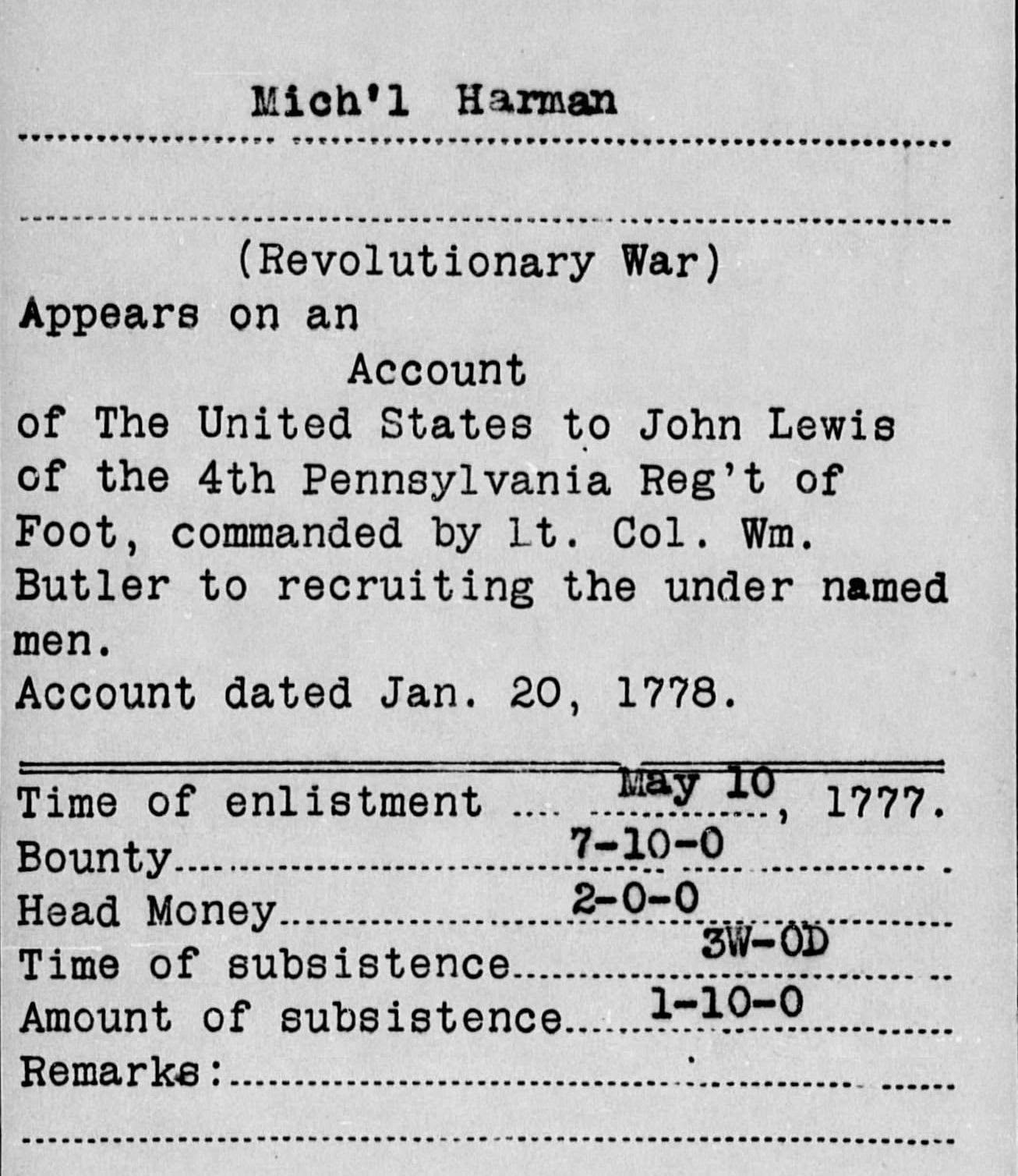
Going to Fold3.com, Horn explains that it is the online place for American military records (it's owned by Ancestry, of course, which he doesn't mention, but it is nice to see the show use a different Web site).  He has Harmon enter Michael's name as "Harman" and says she should do so because that's how the name appeared on the records they've looked at (conveniently sidestepping the fact that the search on Fold3 is not very flexible; I still wonder why Ancestry doesn't port its more robust search pages over).  Among the results is Michael's Revolutionary War service record.  He served under John Lewis in the 4th Pennsylvania Regiment of Foot, an infantry unit.  The account date on the card is January 20, 1778.  Harmon is very proud that he fought on the American side.  Michael enlisted on May 10, 1777 for three years, which was standard (plus he got a bounty!).  Harmon notes that he was only 23 years old.  Horn has to point out that 1877 was before the end of Michael's indenture period and says that Houts would have received compensation because of that.  This causes Harmon to wonder if there was a draft or if Michael volunteered.  Horn says it was the latter and that she should think about the risks Michael subjected himself to by being a soldier.

When Harmon asks what happened to Michael after that, Horn says that he sent the documents to his colleague Scott Stephenson, an expert on the Revolutionary War, and that Stephenson "might be able" to tell her more about her ancestor.  (Wow, that's pretty impressive!  Harmon hasn't even left yet, and Horn has already sent the documents on to someone else.  Oh, wait, you mean this was all found ahead of time?  Like it's scripted or something?)  Harmon effusively begins to thank Horn, then gives him a big hug.  She seems very genuine in her enthusiasm (unlike Kelly Clarkson).

In the outro to this segment, Harmon talks about how impressed she is with Michael and all the risks he took, beginning with coming here at only 18 years old.  She apparently has a soft spot for troops and really appreciates that Michael volunteered to serve his new country.  She also mentions that he went in wholeheartedly, but that's just her embroidering on the story, because we have no idea about that.  For all we know, he could have hated his work as a tanner and thought it would be an improvement to be a soldier.

Still in Philadelphia, Harmon now goes to the Free Library to speak with R. Scott Stephenson, Ph.D., director of collections and interpretation (I am so sorry they are using that word that way) at the Museum of the American Revolution.  (He helped Valerie Bertinelli with Quaker research.)  He says they can reconstruct a lot by using documents.  He hands Harmon a (copy of) a voucher dated May 7, 1778 that says "camp near Valley Forge."  Michael received $6; this was essentially a pay stub for his work in the army.  Stephenson explained that pay in the Continental Army was intermittent and that this was actually back pay.  Harmon looks on the voucher where it appears that Michael signed for his payment.  Stephenson points out that it actually shows an X and says "his mark", indicating Michael was illiterate.

George Washington and the
Continental Army, 1775
For all of Harmon's professed interest in history, hearing "Valley Forge" didn't make much of an impression on her, so Stephenson has to be very heavy-handed to get the next point across, asking her, "Does Valley Forge mean anything to you?"  She says she vaguely remembers studying it but could use a reminder.  Stephenson tells her that in September 1777 the British captured Philadelphia, which was the capital of the newly minted United States.  Congress fled Phillie entirely.  Michael and the 4th Pennsylvania, along with the rest of the Continental Army, had to find a place to hole up for the quickly approaching winter.  There was no city nearby, so on December 19, 1777, they created an encampment at Valley Forge, under the direct command of George Washington.  This finally gets Harmon's attention, as it slowly dawns on her that her ancestor was in the same place as the father of our country.  Suddenly she is excited, and she says her father will love to hear about it.  Stephenson says that Valley Forge is only about 30 miles away from Philadelphia and asks if she wants to visit.  Now that she understands its significance, she happily says yes.

Stephenson and Harmon drive to Valley Forge National Historical Park.  Stephenson explains that the cabins in the park are reconstructions of those that the soldiers, including Michael, used for shelter during their winter encampment.  Each "hut" would have housed twelve men.  Harmon says, "It's amazing," and I realized she had been saying that several times during the episode, to the point it had become meaningless (but I restrained myself from watching again to count the number of times).  When Stephenson and Harmon go into one of the cabins, Harmon discovers that it's pretty cold inside; Stephenson tells her that the buildings were not windtight or sealed from the rain because the men had to make do with minimal tools and no nails to put them together.  So while the British were in reasonably comfortable brick buildings in Philadelphia, 2,000 of these cabins housed the Continental Army at Valley Forge.  During the winter of 1777–1778, they suffered through shortages of food, clothing, and other supplies, because the Continental Congress was in chaos and couldn't help them.  Men caught pneumonia, typhoid, and other diseases, and about 2,500 men died there.  But Michael survived, and Harmon is elated to think that she could be walking on the same ground where he had stepped.

Stephenson talks about how these men were fighting for a country with power resting in the people, not a king, which was a radical idea at the time.  When Harmon asks whether Michael would have understood the historical significance of what he was taking part in, Stephenson tells her that Washington often told the men that "the fate of millions unborn" depended on what they were doing.  Unless Michael still hadn't learned any English, he probably had some idea.

And what happened to Michael after Valley Forge?  Stephenson says that most records are in the Pennsylvania State Archives in Harrisburg, and there should be more documents about Michael.

As she leaves Valley Forge, Harmon says how impressed she is with Michael and the strength he had in his heart (um, and where did she learn about that?).  He persevered through horrible conditions and was a remarkable man.  (Well, he did persevere, I'll give her that.)  Obviously, her resilience must have come from him (and now we're back to that theme).

Next up is a visit to Harrisburg and the Pennsylvania State Archives, of course.  As Harmon approaches the entrance, she is greeted by Major Sean Sculley, listed as an assistant professor of history at West Point (and boy, does he have a bunch of ribbons on his uniform!).  Information about Michael had been sent to Major Sculley, and as expected he had found more to share with Harmon.  First is a letter to George Washington from January 2, 1781, letting him know that the 4th Pennsylvania, the regiment Michael was in, had committed mutiny.  The unit's captain had been mortally wounded.  This sends Harmon into a tizzy — how could Michael do this?!

Major Sculley explains that the sergeants, corporals, and privates in the regiment had mutinied against General Anthony Wayne (apparently known by the nickname of "Mad Anthony").  The men then planned to march to Philadelphia to ask (ok, maybe demand) that Congress give them what they believed they were owed.  Michael and the other men had served for up to three years, or more, with hardly any food and little pay.  As far as they were concerned, Congress had committed a breach of contract.  Men whose enlistment periods had expired were not allowed to leave.

Harmon starts to get all worked up.  She goes on about how sad the situation was, that the men couldn't get food or clothes, and really gets a head of steam up.  Major Sculley interrupts her to point out that now she's beginning to understand how the men felt at the time.  Harmon responds that they had been honorable men (which she really doesn't know; I'm sure not all of them were), and the mutiny was going to be connected to all of their names.  Major Sculley points out that it was actually worse than that — mutiny was a capital offense, so they were risking hanging or a firing squad.

Major Sculley adds that Wayne was not really worried about the men going to Philadelphia, but rather that they would head to New York to join up with the British.  He shows her another letter, this one from the British to the Pennsylvania Line.  The British had offered to provide the men food, clothes, and the back pay that they were owed.  All the men had to do was turn their backs on the upstart rebels and return to the British side.  Under the circumstances at the time, this was a hard offer to pass up — but they did.  When two British spies arrived at the camp with the letter, sergeants involved with the mutiny arrested them and took them to General Wayne.  Hey, there's some hope after all!  Wayne was able to negotiate with the 76th and 77th (but where does the 4th fit into that?):  Men could be discharged and then re-enlist with a new bounty, or simply be discharged and head home.

So which did Michael choose?  Major Sculley has a book from the Pennsylvania archives.  I didn't see the title, but it has a list of NCO's.  Michael's period of service is given as May 5, 1777–1781, so he opted out.  Harmon figures out that when he was discharged, he was about 27 years old.  And where did he go after that?  Major Sculley says that Michael's son Peter was in Mercer County, Kentucky (though I didn't get how he determined that), so he had looked at tax lists for Mercer County.  Michael appears on the 1795 list with 130 acres of land, so he actually got land, nominally the reason that he might have left Germany.  Harmon comments that Michael was about 41 at the time of the tax list.

Harmon asks Major Sculley if he can tell her anything else.  He says they have reached the end of his expertise (Kentucky tax lists actually fall into his field of research?), so if she wants to learn more, she's going to have to go to Kentucky.  (Ok, that was expected.)

As Harmon leaves, she admits that her heart had sunk when she heard about the mutiny, but she understands why the men were driven to do it.  But Michael had a strong will and strong convictions (again, where did she learn that?  did I miss that scene?), and he had been denied what had been promised to him.  Then she brings it back to herself (really, is it always about her?):  Why does she have such a need for justice?  Where could it have come from?  Now she knows that she got it from Michael!  (Sure, uh-huh.)  She gets over herself for a moment and wonders what she will learn about Michael's life in Kentucky.  She asks whether he was married — probably, because we've already heard that he had a son — and how many children he might have had (still looking for that big family).

At the Harrodsburg Historical Society, in Harrodsburg, Kentucky (yes, in Mercer County), local historian Amalie Preston meets with Harmon in a curiously empty-looking room.  After some disingenuous introductory conversation, Harmon asks if Michael might have left a will.  (Of course he did.)  Preston has her look at an index, which indicates that a will for Michael Harmon is in Book 3, page 279.  After going to page 279 in that book (conveniently on the table), we see the will for M. Harmon, "signed" on July 21, 1807.  As with his pay voucher from 1778, there is an "X" and the notation of "his mark."  Forty years later, Michael is still illiterate, but he's managed to accomplish a lot.  We only get a couple of quick camera shots of the recorded copy of the will, but family members mentioned in bequests are Michael's wife, Peggy (£70), and his children Peter (we heard about him earlier; he's Angie Harmon's ancestor), Michael, Jacob, Peggy, Barbara, Kitty (also £70), and John.  Harmon is a little concerned at the bequest to Peter, which says "any of my plantations", and hopes that doesn't mean Michael owned slaves.  Preston explains that "plantation" can also be used to mean a big farm, and no, Michael did not own slaves.  And now Harmon finally has the big family she has been dreaming about, even if it's from two hundred years ago:  "This is where I get my need for a large family."  (Seriously?)

Preston tells Harmon she has one more treat coming:  She can go to the site where Michael lived.  Preston has contacted the present owner and asked for permission for Harmon to visit, and the owner said yes.  "Is that something you would like to do?"  Of course she would!  I actually did like what Harmon said next:  "I would love to take my daughters."  Now that's a way to try to get the younger generation interested in genealogy and history.

Leaving Harrodsburg, Harmon talks about Michael's bravery and courage (which she couldn't possibly know about, unless one of those researchers showed her some kind of commendation that we didn't get to see on air, but she's bound and determined to make Michael bigger than life) and what an exceptional man he was.  She is excited and nervous to see the land he had owned, and is happy that the girls are coming.

As Harmon drives toward the farm with her daughters in the car, she's enthusiastic, and she asks the girls if they're excited.  One of them pipes up, "Are we there yet?"  As they're pulling up in the car, Harmon admonishes, "Remember your manners, please."  (Some things never change, not even for celebrities.)

They are met by a pleasant-looking man, who introduces himself as Michael Harmon (the name was passed down!) and says they are fifth cousins once removed.  Harmon introduces her daughters, who have very modern names for girls:  Finley, Avery, and Emery (please forgive any misspellings on my part).  This Michael says that the land is still owned by Harmons 220 years later, which even I think is great.  He tells Harmon that they can see the whole farm from a higher spot and drives the car up there.  He points out that the distant treeline is the boundary to the property; all the land, cows, and everything else to that point is the family farm.  The girls start running around and playing, and Harmon gets philosophical.

All the fighting, suffering, and hardships Michael (the ancestor) went through were for this.  He had a beautiful life and was able to pass that down to herself and the generations to come after her.  Being here with her girls has made the journey complete, and now she feels whole.  This has given her a new light for the rest of her life and will affect everything she will do, and she is so thankful she was able to experience all of this.

I was kind of surprised at this emotional outpouring, but learning about her ancestor definitely seems to have affected her.  Personally, I think it's more than a bit of a stretch to think she "inherited" all the traits she went on about, but if it makes her happy to think Michael Harmon passed that down to her, who am I to burst her bubble?

Something I was struck by was how Harmon kept track throughout the episode of about how old Michael was at each event in his life she learned about.  I don't understand why it was so significant to her, but she was pretty consistent about it.  The only time I didn't hear her figure out his age was when she was looking at the will, which seemed counterintuitive.  After all, that was around the time he died, an age more people tend to be interested in.

Something else I noticed was that even though Harmon did find her big family, she didn't get the other tidbits we heard about in the beginning:  She didn't find any paintings or other pictures of her ancestors (no photos, as Michael died about 1807, before the age of photography), and even though she was "convinced" her father had Irish or Scottish ancestry, we didn't hear about that again.  Usually when the celeb talks about something like that, we see it later on.  Could the producers be deliberately giving us false leads so we don't automatically know what to expect in an episode?

I saw that same Ancestry.com advertisement where the actress says she found her grandfather's World War I draft card but what's shown is a card for World War II.  I'm beginning to consider the possibility that the reason it isn't being changed is the same as why we don't see quality control in the databases on the Web site:  It isn't costing them any business to air such an egregious mistake, so why spend money to fix it?

Now that we're in the third season of WDYTYA on TLC, I am beginning to see a little bit of a "formula" for the celebrities chosen.  First is the apparent marketing to a younger demographic, with actors generally more relevant to that group.  While on NBC each season had at least one black and one Jewish celebrity, on TLC each season has had at least one gay celebrity.  We still have somewhat of a nod to having a Jewish celebrity — Chelsea Handler (first season) is half Jewish; Josh Groban's father grew up Jewish but converted for marriage.  Previously we have had only white Western European celebrities, but this season has Julie Chen and America Ferrera.  It'll be interesting to see what happens going forward.

In a fun little coincidence, the night after this episode aired, Antiques Roadshow had an appraisal of a letter written by George Washington from Valley Forge in 1778.  (The link is currently having some problems, but I hope PBS fixes it soon.)

And I actually had finished writing this before tonight's episode with Sean Hayes, but I wasn't able to post it before the episode started!

Saturday, February 12, 2011

"Who Do You Think You Are?" - Tim McGraw

Tim McGraw's story tonight on Who Do You Think You Are? wasn't as compelling in some ways as that of Vanessa Williams -- free black versus slave family lines make for good drama -- but it was easier to find more direct parallels between McGraw's life and those of his ancestors.  Several of his ancestors pushed themselves and didn't play it safe, and he recognized some of that spirit in himself.  I admit I guessed the surveyor was George Washington as soon as McGraw asked about him, but that's because I remembered that Washington started out as a surveyor (a penchant for remembering weird little pieces of information comes in very handy when doing genealogical research).  The Elvis Presley connection was a surprise, though.  I would never have guessed the name started out as Presslauer.

The show overall followed formula.  It was nice to see McGraw start his search by talking to a relative.  It's possible his Uncle Hank might be the oldest family member still around (they didn't mention he played baseball also).  Then McGraw started gallivanting around the country -- Lee's Summit, Missouri; Rye Cove, Virginia; Richmond, Virginia; Shenandoah Valley, Virginia; Washington, D.C.; New York City.  He spoke with a genealogist, several professors, a curator.  Records were ready and waiting for him at each stop.  The leaps made based on what was presented on screen were astounding, though I'm sure that the background research we didn't get to see backs it all up.  But it presents an unrealistic picture to viewers who don't understand how many hours that research took, and that most people don't go in person to every repository when doing research.

And of course, the ubiquitous Ancestry.com references.  The genealogist who did not say, "Let's look for your ancestor in records," or "Let's look for your ancestor in the census," but who said, "Let's look on Ancestry.com."  One of those particularly annoying commercials -- "You don't have to know what you're looking for, you just need to start looking."  If you don't know what you're looking for, how in the world will you know what it is when you find it?  It reminds me of a current Jack in the Box commercial, where Jack is explaining product placement to his wife.

I think my favorite parts of the episode were when McGraw was reading out loud, trying to puzzle out the centuries-old handwriting.  It certainly looked and sounded real as he stumbled over some of the words.  If it wasn't, please don't burst my bubble.

I'm going to go out on a limb here.  I predict that not one celebrity on this season of WDYTYA is going to do any real research of his own beyond talking to relatives, but that each one will simply visit repositories around the country and the world and find researchers who have everything prepared for him, ready to be handed to him on a figurative silver platter.

Of course, now that I've said that, it'll come back to bite me.  But you know what?  That's okay.  I would rather be proven wrong and have *someone* do some research of his own.