I'm still trying to catch up on commentary for this season of
Who Do You Think You Are? The third episode this season (the second new one) was the first one TLC has aired with a celebrity with non-European ancestry (about time!).
The teaser for this episode told us that Alfre Woodard would trace the lost path of her father's family and discover an ancestor born in chains. She would follow his courageous footsteps to freedom and beyond.
Alfre Woodard is an accomplished actress with a 35-year career. She has won four Emmys and one Golden Globe and has been nominated once for an Oscar. Some of her best known work is HBO's
Mandela, Spike Lee's film
Crooklyn, and the recent movie
12 Years a Slave. She is a philanthropist and an activist, working for positive social change through the arts in the United States and globally. Woodard lives in Santa Monica with her two children, Mavis and Duncan, and her husband, writer/producer
Roderick Spencer.
Woodard starts out very existential. To her, family is life and the way we learn to be in the world, and we are the manifestations of our fathers' and mothers' dreams. Her mother was Constance Elizabeth Roberson. Constance's mother was Big Momma Ada, who had seventeen siblings, and her mother's father had twenty siblings. When they held family reunions they couldn't invite everyone, because there wasn't enough room.
Woodard's father was Marion Hugh Woodard, who was born in Lincoln County, Oklahoma. His parents were Minnie Minerva, from Tennessee, and Alexander Woodard, from Texas. Her grandfather died when her father was only 3, so she doesn't know about anything earlier than that. She's taking this genealogical journey for her father, a self-made entrepreneur and a family man. She believes she got her daring from her father. She has no expectations of what she is going to learn and says, "Surprise me!"
Woodard begins her journey in her own home. She says she has asked genealogist
Joseph Shumway (AG; we've seen him on five episodes previously) to help her. She tells him that her roots are wide but not deep and that she wants to learn about her father's family history. She knows that her grandfather was Alex and that her father was born June 3, 1920 in Lincoln County, Oklahoma.
Shumway tells her they should start with the U.S. census so they can identify her father's parents. Her has her go to Ancestry.com (of course) and click on the U.S. census collection link, then look for Alexander Woodard (with exact spelling) from the main census search page. The top two hits, for 1920 and 1930, seem to be for the right family. Shumway directs her to look at the 1920 census. When she brings up the image, she finds the head of household was her grandfather, Alex A. Woodard, and his wife was Minnie H. (Alexander was one of the children). She recognizes the names of an aunts and an uncle, but her father isn't there. The official enumeration date for the 1920 census was January 1, and her father wasn't born until June, so he missed being counted (which is why I would have started with the 1930 census, to try to find the family with her father there, and that way I would know it was the right family). Shumway states that January 1 tells us the date the family was visited, which is incorrect; per the information on the census page, they were actually visited on January 16.

Alex Woodard was listed as 40 years old and born in Louisiana, Woodard's first surprise, as she thought he was born in Texas. Now Shumway tells Woodard to do something no one should ever do: go straight from 1920 to the 1880 census to find Alex with his parents. Under normal circumstances, jumping 40 years at once is a great way to make a mistake and follow the wrong person, who superficially seems to be the relative you're looking for. By going from one census to the next chronologically, you minimize the chances of picking up the trail of the wrong guy. So they should have looked at 1910 and 1900 before 1880. But, of course, they've done all the research ahead of time, so Shumway already knows what they're going to find.
This time Shumway has Woodard search for Alex Woodard born in 1880, and what do you know, there he is. Woodard's grandfather Alex was 5 months old, born in December 1879, and living with his parents, Alex and Lizzie Woodard, in Jackson Parish, Louisiana. Alex the father was 39 years old, a farmer, and born in Georgia. After a few seconds, the meaning of this registers with Woodard, and she looks shocked. If Alex Sr. was born about 1841 in Georgia, "Mother of God, he was enslaved!" So when she said, "Surprise me!", she wasn't kidding, even though it shouldn't have come as a surprise that her family had roots in slavery if they were from the South.
The program cuts to a commercial break here, and when it returns, the narrator tells us that Woodard is at her home in Los Angeles. In the introduction, however, we were told that Woodard lives in Santa Monica. Sorry,
Mr. Narrator, Santa Monica is NOT Los Angeles.
Returning to the revelation that her great-grandfather was born in Georgia, Woodard asks if it's possible to find out where in Georgia he was from. Shumway says he can do some "extra digging" to "try to narrow down" a more specific place (I despise this pretense that the information hasn't already been found) and that he will get back to her.
In an interlude apparently meant to suggest that Woodard is waiting to learn what Shumway might find out with his "extra digging", she talks about how her people, and all enslaved people, came out of slavery with nothing. She wants to trace how her family got out, if the footprints are still there.
Shumway reappears with his "new" additional information about where Alex was likely from. He suggests that Woodard meet with a historian in Houston County, Georgia.
And off to Houston County she goes, to Perry specifically, which is the county seat. At the courthouse she finds Dr.
Daina Ramey Berry, a historian of American slavery. Berry starts off by telling Woodard, "You know that he would be listed under a white Woodard family," and "Enslaved people often kept the surnames of their owners." I'm getting really tired of this trope. Modern scholarship has shown that the majority of former slaves did
not take the names of their former owners. The two most common surnames after Emancipation were Washington (for George Washington) and Freeman (which should be self-explanatory).
Tony Burroughs, probably the preeminent black researcher in this country,
has stated that in his many, many years of research, he has found only about 15% of former slaves that took prior owners' names. It's convenient for
WDYTYA to trot it out because it's a lot easier to explain, and it's nice that it's worked for them in the limited amount of research on black celebrities they've done, but from everything I have learned, it
just isn't accurate.
Ok, off the soapbox. After saying this, Berry says they should be able to find some information in white slaveholder records, particularly the annual returns. Those are for the taxes that were collected on property, including slaves. As slaves were not taxed by name until they turned about 5, and Alex was born about 1841, Berry suggests Woodard look for a book in the late 1840's. She chooses 1849, which seems to be the only book in that section that has a big white label on the spine (coincidence?). (Why not 1846 or 1847, which would have been right about the time Alex would have been listed by name? Or did they look at those years, and they didn't make it to the final program because there was nothing exciting?)
Woodard searches the index of W names and finds John Woodard, who "could be" Alex's owner. She goes to page 42, which isn't an annual return after all, but an estate appraisal taken after John Woodard died. It is titled "Appraisement of the Estate of John Woodward Deceased", which throws Woodard off because of the different spelling of the name. Berry explains that spelling could change depending on who was writing (which is at least accurate, if not a complete explanation). Woodard reads the beginning of the inventory, which starts with the names of slaves and their values. She soon comes to Alec, valued at $400, which Berry tells her is her great-grandfather. And starting at this point, she calls him Alec instead of Alex.
Woodard asks, "Who is his mom?", to which Berry replies, "We don't know." The reason she gives for this is that slaves didn't have birth certificates. Well, that isn't a complete answer either, because in Georgia in the 1840's, I don't think anyone had birth certificates. And many slave owners actually did keep track of when their slaves were born (such as with
Lionel Richie's ancestor), but that information was in their personal papers, which aren't always available. Again,
WDYTYA goes for the quick, oversimplified answer, rather than accuracy and educating viewers. Yes, I know the program is entertainment, not educational, but it's still annoying.
Ok, back off the soapbox. Berry explains that the mother role in Alex's life would have been filled by "fictive kin", the family that slaves created for themselves.
We hear from the narrator at this point, who explains that beginning in the early 1600's, 10 million Africans were forced into slavery in North and South America and in the Caribbean. About 400,000 of them were brought to North America. As property, they had no legal rights and were often separated from their actual famly members. To preserve their humanity, they created their own families and kinship networks, which provided support.
Woodard goes back to reading from the estate appraisal and finds that after the slaves the livestock were listed, which justifiably offends her. She comments that Mr. Woodard didn't seem to own many slaves, and Berry classifies him as a typical small slaveholder. But now that their owner had died, the slaves would have been waiting to find out what would happen to them and where they would go. Berry says that they lived in fear of separation. To learn what did happen, Woodard next goes to page 426 (even though pages 341, 342, and 397 appeared in the index also). There she finds "Distributing of the Estate of John Woodard Decd" and says, "This shit [which was bleeped out] is making me anxious!"

The narrator tells us, "Alec faced being separated from the other slaves he had grown up with when his owner, John Woodard, died." We don't actually know that Alex grew up with any of the other slaves listed in the inventory, at least not from what was shown on the program. We know only that they were all owned by John Woodard when he died, and we don't even know when that was, although
this page says it was 1846. We are given no information about how long any of them have been there or been together. Now, if John Woodward did die in 1846, it is possible that the slaves listed in the inventory had stayed together in the five years between his death and the appraisal.
Returning to Woodard, she reads that Martha Blount, formerly Woodard, was to receive the Negro Milly, valued at $1,000, and that Laura Woodard was to receive Harriett, valued at $500. Then she reads that
William Woodard would receive one Negro boy, Elic, valued at $700. This, we are told, is Alec/Alex. Woodard suddenly remembers that some of her older aunts and uncles referred to their father as Elic; the younger ones had called him Alec. (This was actually a great example of how hearing something can trigger a memory.)
The distribution of the estate was signed off on September 14, 1856, at which time Alec would have been about 15 years old. Woodard comments that he would have been entering the period of his prime value as a slave, and Berry says the $700 is comparable to the cost of a car today. They also talk about how Alec would most likely have been separated from his fictive kin at this point. (But the
complete distribution shows that, in addition to Alec, five more of John Woodard's slaves went to William, who inherited more than half of his father's slaves. So most of these fictive kin actually seem to have stayed together, at least for a time.)
Woodard asks whether Alec stayed in Georgia. Berry says, "I'm going to do some digging" (just like Shumway, right?) to try to find more information. She'll look for records closer to the Civil War. Before she leaves, Woodard gives Berry a big hug and tells her they're kin now.
Woodard feels she is on the cusp of something, like waiting for the arrival of a child. She's chasing a spirit and wants to learn who Alec is, and she hopes Alec will speak to them.
We next see Woodard driving along a country road in Houston County. She tells us that "last night" Berry looked at records for John Woodard (sure she did!) and found a deed for his land when he owned Alec. Berry told her she should go look, and now she's following that lead to track Alec. The GPS in the car (which I noticed had the brand name and license plate blurred out; I don't know if they've done this on previous episodes) says, "Turn right onto Woodard Road," which brings a happy little scream from Woodard. At the intersection of Moody and Woodard roads she turns left and finds a big stand of trees. She gets out of the car, takes off her shoes, and pours a
libation of water to her ancestors, saying that it is a way of connecting with Alec on the ground he worked and sweated into. The ceremony is an acknowledgment that you didn't invent yourself and a way of humbling yourself to your ancestors. Before she leaves, she picks up several pine cones and takes them with her.
 |
William Woodard's slaves listed in
the 1860 census slave schedule |
Woodard returns to see Berry and proudly shows her some of the pine cones from Woodard Road, then asks what happened to Alec after he went to William Woodard. Berry looked for William in censuses and found him in Jackson Parish, Louisiana. He had migrated west, probably because of the availability of land. Berry does not show him and his family, however, but has the 1860 census slave schedule, dated December 13. The slave schedules listed slave owners by name but enumerated slaves only by age, sex, and color. William had three slaves, a 32-year-old female, a 16-year-old male, and an 8-year-old male. Berry talks only about the 16-year-old, whom she says was likely Woodard's great-grandfather. He should be about 19, but Berry says that any time a slave was listed with an age it could vary, because they didn't have birth certificates. (What she doesn't say is that was also the case with people who were not enslaved. Very few people in the 19th century in the U.S. had birth certificates, and most had no need to know how old they were, so many people's ages varied from census to census.) They talk about how Alec has been separated from his family (but the woman and the boy are likely two of the slaves from John Woodard's estate, so they would have been part of that family). Often one can turn to annual tax lists to learn the names of slaves in a household, but perhaps they were not available for this time and location, or the producers wanted to emphasize Alec's isolation rather than the complete story.
Berry now says that Woodard should go to Louisiana to continue her research, at the Louisiana State Archives. It is difficult to trace blacks due to fires and burnt records (which affect
everyone's research, not just that of blacks; just ask anyone researching ancestors from the South), but maybe she will be able to pick up Alec's trail after the Civil War. (Translation: We
will be picking up Alec's trail after the Civil War.)
Woodard adapts a quote from one of Maya Angelou's poems, "
Still I Rise":
I come, bringing the gifts that my ancestors gave,
I am the dream and the hope of the slave.
She then says that Alec has gone from being an ancestor to a relative, which is a wonderful way of personalizing the research process. And off she heads to Louisiana.
In Baton Rouge Woodard goes to the
Louisiana State Archives. As she walks in the building, she talks about how it is June 19, or
Juneteenth (did the producers actually plan that?), the day that slaves "in the Southwest" learned that they had been freed by the Emancipation Proclamation. (Well, close: It's the day that slaves in Texas learned they were free. It is celebrated in many Southern states, however.) Inside she meets Dr.
Mark Schultz and promptly points out to him that it's Juneteenth. The two of them seem to have a natural chemistry as they work together, which was really fun to watch.
They begin by talking about Alec's move from Georgia to Louisiana, and Schultz says that probably the "most horrific experience" a slave could have was to have your family torn apart (though I tend to believe that being a slave in and of itself would be the most horrific experience). That said, he tells Woodard that for research during
Reconstruction the best source for information is the
Freedmen's Bureau records (I'm so glad they discussed these extremely important records!). He says that they are held at the National Archives in Washington, D.C. (but doesn't mention that they are also available at all regional branches of the National Archives, and online on several sites, including Ancestry). Woodard knows that the bureau was when the federal government assisted former slaves, and Schultz points out that it also settled issues between former slaves and their former owners. (It did a lot more than that, but that's apparently what's going to be relevant here.)
Schultz says that he did a "digital search" (but doesn't say where, which suggests it was not on Ancestry) and found a record relating to Alec. The record is from Verna(?), Louisiana and is dated January 18, 1868. B. D. Blount, who we are given to assume was Martha (Woodard) Blount's husband, said he was willing to give up the three children claimed by "Elic" if they were willing to leave. Woodard immediately asks if the children were Alec's, but the record doesn't state whose children they were. Then she wants to know why Alec even had to ask, because B. D. shouldn't have had any claim on the children, and Schultz says that the children might not have been "free" yet, which leads to a discussion of how people might not be free if they hadn't heard the news yet. (They did not bring up the fact that the children might have been legally bound to Blount by a contract, a matter that the Freedmen's Bureau also supervised, which would have given him a claim.) Unfortunately, the children's names were not mentioned, and they don't know if Alec got the children (
i.e., they couldn't find any further records). Not all records of the Freedmen's Bureau have survived.
Next Schultz says they should look at tax rolls, and they move to a microfilm reader. They start off in 1867 in Jackson Parish. Alec (this time as Allen, but we have to hope they know it's the right person) paid $1.00 as a
poll tax, which was to register to vote. Schultz explains that this is the period of the largest wave of black voters in American history. The narrator steps in say that after the Civil War and the abolishment of slavery, resistance to emancipation continued in the South. Laws were created that blocked blacks from being elected to office, owning land, and working in certain jobs. Poll taxes were deliberately expensive to try to prevent the impoverished former slaves from being able to pay. Even when they did pay, they faced intimidation and violence if they tried to exercise their right to vote.
Schultz says that Alec would have given up a day's wages to pay that poll tax. The expense notwithstanding, 90% of black men registered to vote in Louisiana. Beyond the problem of paying the money, it was dangerous to do so, because this was when the
KKK was first organized, and they practiced political terrorism. Families who challenged white supremacy were prepared to die when they did so. Woodard is inspired to sing part of "
Lift Every Voice and Sing" (lucky Dr. Schultz!):
Facing the rising sun of our new day begun,
Let us march on till victory is won.
Schultz asks whether Alec had a family. Woodard remembers the 1880 census she looked at with Shumway and tells Schultz about Alec's wife, Lizzie, and the nine children, including that the youngest was her own grandfather. Schultz suggests they skip to the year after the census to search for Alec again. This is again bad practice, skipping years, so the only logical reason is because they already know something "interesting" shows up that year, and indeed, in 1881 the tax list shows that "Alex" is taxed on 80 acres of land. He owns land! He is a farmer, which we saw in the 1880 census, but now we know it's his own property. (In theory, he could have owned land earlier than this, but since they didn't show us those tax lists, my guess is probably not.) Woodard comments that he had plenty of kids to help him, and Schultz points out that a single man couldn't afford to be a landowner on his own at this time; it took a family effort.
As a landowner, Alex has moved up to a higher class. At Schultz's suggestion, they now jump a decade ahead to 1891, and we discover that Alex "Woodward" has 240 acres. Woodard is very excited and says that her grandfather would have been 9 years old, the "same age where we met Elic!" (Except that we know from the 1880 census that her grandfather was born about December 1879, which means in 1891 he would have been 11. I know, I am such a party pooper.)
Moving ahead one more year, in 1892 Alex is back down to 80 acres, valued at $106. Unfortunately for Alex, he bought additional land right before the
agricultural depression of the 1890's (hindsight is great, isn't it?). This depression hit the entire country and affected many other people. Woodard wants to find out where the land went; Schultz tells her they don't have any records of Alex after 1892 but doesn't say why (possibilities: he didn't pay the property taxes after 1892; he wasn't in Jackson Parish anymore; he left the state; the records no longer exist). He says, "Fortunately, this isn't the last hole to dig in" (what a great expression!) and that Woodard should go to Jackson Parish, where deed records might have more information for her. Before Woodard leaves, she tells Schultz that he is now officially her "brother from another mother" and gives him a sincere hug.
Outside, Woodard talks about her great-grandfather's ingenuity (huh?), persistence, and work ethic, and how freedom is the ability to go as far as you can go. After the Emancipation Proclamation, Alex made a substantial life for himself. He passed on the knowledge of how to build a life as a gift to his descendants.
In Jackson Parish, Woodard goes to the courthouse in Jonesboro, the parish seat. Historian Dr.
Beverly Bond is there to greet her. She has found a record from 1896 pertaining to Alex. J. G. Barbee and J. C. Gifford of
Wharton County, Texas made a loan to Alex, $1,375 to be repaid in one to five years at 10% interest. Woodard comments that it was a "big deal to be able to get a loan, even now." Alex was buying 95 acres in Wharton County. Woodard is happy he finally made it to Texas (though we don't actually know that he was in Texas, only that he bought land in Texas). Bond tells Woodard that Wharton County is in southeast Texas, an area of good farmland. She adds that after the Civil War many former slaves established Wharton (which is inaccurate, because the county existed in the United States at least as early as 1850, as it was enumerated in the census that year).
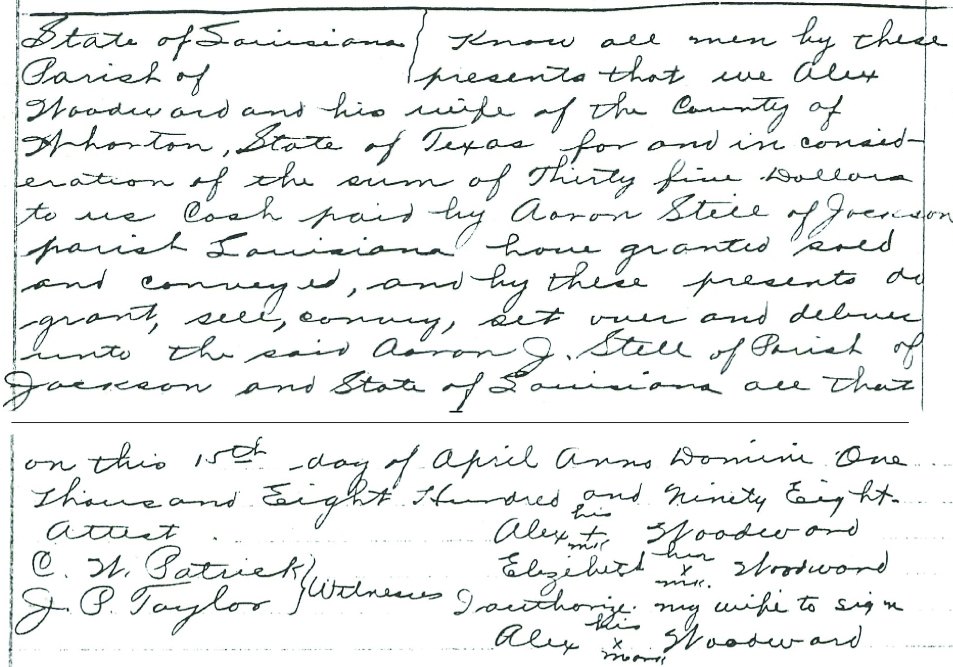
Bond asks Woodard, "Can I show you another record?" (I keep waiting for someone to say no) and pulls out a conveyance record (deed) from 1898. At this point Alex was about 57 years old and had been in Texas for (presumably) two years. The deed shows that Alex and his wife sold 80 acres in Jackson Parish for $35 to Aaron J. Stell, also of Jackson Parish. It takes a few seconds, but then Woodard realizes how little Alex was selling the land for, and she gets very indignant. She apologizes to Bond but admits she's outraged at the small amount. Bond explains that land was going up and down in value and then adds that Aaron Stell was Lizzie's brother. Though Bond seems to be emphasizing the relationship more than the name, Woodard latches onto the name, because now she has a last name for Lizzie (which would seem to be a big deal, considering that the floating family tree shown at the beginning of the episode did not show last names for either her mother or her grandmother). Alex might have been able to get more money, but this way he kept the land in the family.

Alex and Lizzie both "made their marks" (they were illiterate) at the bottom of the deed. Woodard is struck at how Lizzie has now become a full human being to her, because she was legally recognized in the document as Alex's partner. (I'm sorry that her appearance in the census wasn't sufficient.)
Bond has one more item for Woodard: a map showing the 240 acres that Alex had owned. It lies off of R. F. Stell Road (but no comment is made about that also being the last name of Aaron and Lizzie). I wanted to know which were the 80 acres he originally had and then sold to Aaron Stell.
As she drives to Alex's former property, Woodard says she is happy that he kept the land in the family. Alex had the wherewithal and wits to be a businessman in a system where he was on the buttom rung. Woodard considers Lizzie to have been his equal.
As Woodard turns onto the property, a clearly visible sign says "Posted No Trespassing Keep Out", but she figures that technically she isn't trespassing because she is the great-great-granddaughter of Elizabeth Stell. (Besides, the camera crew is with her, so I figure they must have gotten permission from
someone to be there.) This land is grown over, and it's obvious that no one has farmed it in a long time. She pours a libation here also but does not remove her shoes, which kind of surprised me.
Woodard closes by talking about how her roots are still wide but they've taken hold. Alex and Lizzie kept on living, doing, and working, with an eye on the horizon and thinking ahead to the next step. Alex is now a fleshed-out character, and she's proud of his business dealings. She plans to tell her family the story and to keep on telling it, to make sure it isn't forgotten (hooray!).