

Genealogy is like a jigsaw puzzle, but you don't have the box top, so you don't know what the picture is supposed to look like. As you start putting the puzzle together, you realize some pieces are missing, and eventually you figure out that some of the pieces you started with don't actually belong to this puzzle. I'll help you discover the right pieces for your puzzle and assemble them into a picture of your family.
Sunday, June 12, 2016
Loving Day 2016
It is Loving Day, and therefore time to celebrate the U.S. Supreme Court decision in 1967 that struck down antimiscegeneation laws in those states that still stood firmly by them. Those sixteen states, all in the South, did not permit someone classified as "black" (the "one-drop rule" prevailing) and someone classified as "white" to be married, some of the states even disallowing marriages performed in states that permitted the unions. If not for the Loving v. Virginia decision, my brother might not have been able to marry Sandra, and my family would not have had the pleasure of welcoming her and her family into our lives. This year will be their 5th anniversary.


Saturday Night Genealogy Fun: My Genealogy Database Statistics

1) If you have your family tree research in a genealogy management program (GMP), whether a computer software program or an online family tree, figure out how to find how many persons, places, sources, etc. are in your database. (Hint: The Help button is your friend!)
2) Tell us which GMP you use and how many persons, places, sources, etc. are in your database(s) today in a blog post of your own, in a comment to this blog post, or in a Facebook status or Google+ stream comment.
Randy uses Roots Magic 7 but generously gave instructions on how to find the statistics in several programs, including Family Tree Maker 16, which is what I use. I didn't take a screen capture of the results from my inquiry, but the statistics from the default settings are:
• Size: 6,835 kb
• Total number of individuals: 7,884
• Total number of marriages: 2,622
• Average lifespan: 57 years 4 months
• Earliest birth: 1540, Ebert Mack (from my adoptive Sellers line)
• Text record: 71,765 (I have no idea what this means)
• Total number of generations: 18
• Total number of different surnames: 1,970
I don't know if I can adjust the inquiry to add more statistics, but the default shows that Family Tree Maker gives substantially different information than Roots Magic. But now I know how many people I have in my database (which is not totally up-to-date, unfortunately, or it would show a birth in 1508, along with several hundred more individuals)!
Thursday, June 9, 2016
Treasure Chest Thursday: Jean La Forêt's Diary, la troisième partie

It's Thursday, so it must be time to learn more about Jean La Forêt's experiences in the U.S. Army! I hope this week's segment lives up to the excitement of last week's bounty on Jean's head. Because the last entry on the fourth page rolled over to the next page, I've included that piece this week.


-- >< -- >< -- >< -- >< --
1889
Juillet – 2 Arrive à San Francisco
" – 4 – Grande parade à S.F. Saluons le "Duquesne" bâtiment de guerre français, Amiral Lefèvre. Marseillaise par la musique du Regiment.
Juillet. 8. Quittons San Francisco pour Monterey, passant par Boots Parc, San Matéo, Menlo Park, Mountain View, Saratoga, Alma, Soquel, Watsonville, Castroville.
Juillet – 18 – Arrivons à Monterey
Août – 11 – Quitte l'armée.
Août – 16 – Quitte Monterey pour San Francisco.
Août 19 – Quitte San Francisco pour Hoopa Valley.
Août 24 – Quitte Hoopa Valley pour Requa où j'arrive le 28 avec Rust, agent général (H. N. Rust)
1889
Sept. 18 Je prends charge de la cannery et du store de Bourkoff(?) et Co. comme surintendant et comptable
Oct. 19 Un parti de six assassins essayent de m'assassiner. Je dois la vie à mon revolver et à mon sang froid, mais aussi un peu à Hattie.
Dec. 24 Mes ennemis essayent d'acheter un indien pour me tuer d'embuscade. L'indien a peur et me prévient.
1890 – Fevrier 19 – La compagnie s'écroule ruinée par mauvaise saison et la malhonnetété du principal. Je quitte Requa pour
1890
Crescent City où j'arrive le 22 –
Mars – 1 – Quitte Crescent City pour San Francisco où j'arrive le 2(?) Mars.
Mais – 14 – Vais à Athlone avec Mr. Wilson B. Morse je reste sur sa proprieté jusqu'en Juin 14.
Juin – 15 – A San Francisco
Juin 20 – A San José retourne S.F. le 22.
Juillet 28 à San José retourne à S.F. le 31
Août – 26 – Entre le Corp de la Marine à Mare Island et j'y reste jusqu'au 1er Novembre.
1890
Nov. 1 Pars de Mare Island pour San Francisco pour l'Alaska. Embarque à San Francisco le 1er 10h. du matin sur l'"Umatilla" avec détachement de cinq marines et six marins.
Nov. 4 Arrivons à Port Townsend, Washington d'où nous repartons le 7 Nov. avec steamer "City of Topeka".
Nov. 14 – Arrivons à Sitka, Alaska où nous restons jusqu'à nouvel ordre, sous les ordres de Capt. Fahrenholt, du navire de guerre "Pinta". Les marines vont à bord et nous restons à terre, cantonnés dans un vieux bâtiment appartenant autrefois au gouvernement Russe.
-- >< -- >< -- >< -- >< --
1889
July 2 Arrive at San Francisco
" 4 – Big parade in San Francisco. We welcome the Duquesne, a French warship, Admiral Lefèvre. "Marseillaise" with music from the regiment.
July 8. We leave San Francisco for Monterey, passing through Boots Parc, San Mateo, Menlo Park, Mountain View, Saratoga, Alma, Soquel, Watsonville, Castroville.
July 18 – We arrive in Monterey
August 11 – Quit the Army.
August 16 – Leave Monterey for San Francisco.
August 19 – Leave San Francisco for Hoopa Valley.
August 24 – Leave Hoopa Valley for Requa, where I arrive on the 28th with Rust, general agent (H. N. Rust)
1889
September 18 I take charge of the cannery and the Bourkoff store and company as manager and accountant
October 19 A party of six assassins tries to kill me. I owe my life to my revolver and my composure, but also a little to Hattie.
December 24 My enemies try to pay an Indian to kill me in an ambush. The Indian is afraid and warns me.
1890 – February 19 – The company collapses, ruined by a bad season and the dishonesty of the owner. I leave Requa for Crescent City, where I arrive on the 22nd –
March 1 – Leave Crescent City for San Francisco, where I arrive March 2(?).
May 14 – Go to Athlone with Mr. Wilson B. Morse I stay on his property until June 14.
June 15 – To San Francisco
June 20 – To San Jose return S.F. the 22nd.
July 28 – To San Jose return San Francisco the 31st
August 26 – Enlist in the Marine Corps at Mare Island and stay there until November 1.
1890
November 1 Leave Mare Island for San Francisco and then Alaska. Embark in San Francisco on the 1st at 10:00 a.m. on the Umatilla with a detachment of five marines and six sailors.
November 4 Arrive at Port Townsend, Washington from which we leave on November 7 with the steamer City of Topeka.
November 14 – Arrive at Sitka, Alaska where we stay until new orders, under the command of Capt. Fahrenholt, of the warship Pinta. The marines go on board and then stay ashore, billeted in an old building that formerly belonged to the Russian government.
-- >< -- >< -- >< -- >< --
I promise I had not read these journal entries before I wrote the intro paragraph to this post, where I said that I hoped this week would live up to last week's excitement. But it sure did! Six assassins tried to kill Jean? And then an Indian is hired to kill him, but is afraid and tells him about it? How in the world did this man survive to marry Emma?
Moving past that, Jean left the Army on August 11, 1889 and went right back to Requa, which he had left on June 22, not even two months earlier, apparently after a court case that didn't go his way. And then he took a job running a company there. This sounds kind of squirrelly to me, but it might have all been aboveboard. Maybe it wasn't, and that has something to do with the assassination attempt. But his separation date from the Army was exactly five years after his enlistment, so that may have been the term he signed up for. When Emma applied for a pension, she said he was discharged on August 10, a minor discrepancy.
Five months later the company fell apart. Jean bounced around for a while, staying for a month in Athlone before returning to the San Francisco area. And then what did he do? He joined the Marines on August 26, 1890. Maybe he missed military discipline (and a regular paycheck and meals).
Something intereresting to note is what Jean did not write in his diary. According to Emma's 1917 emergency passport application, Jean was naturalized as a U.S. citizen in San Francisco on March 22, 1890. Yet Jean doesn't mention that at all.
At the time I described that passport application, I questioned Emma's statement that Jean had lived uninterruptedly in San Francisco from 1884 to 1909. I'm only up to the end of 1890 in Jean's diary, and so far he lived in New York (where he enlisted in the Army), San Francisco, Requa, and Athlone. The first time he was even in San Francisco was July 10, 1886, and he left after four days. So yeah, Emma pretty much blew that one. Maybe that's what Jean told her?
Captain Fahrenholt, under whose command Jean came in November 1890, was Oscar Walter Fahrenholt, who later became a rear admiral in the Navy. I'm still working on just who H. N. Rust was.
Wednesday, June 8, 2016
Ancestry.com Visits the San Francisco Bay Area

Space is still available for the 2016 Ancestry Day by the Bay, taking place on Saturday, June 18, from 8:00 a.m. to 4:00 p.m. at the South San Francisco Conference Center. Come for a fun, information-packed day to learn how to research your family. Ancestry will bring some of its top researchers, who will show how to locate your ancestors and trace your family history using their voluminous resources. Sign up and learn more today.
This year Ancestry's conference partner is the Angel Island Immigration Station Foundation (AIISF). All proceeds from this event go to AIISF's Immigrant Voices Initiative, which tells the stories of immigrants to the Pacific Coast.
There will be a full day of presentations from Ancestry staff. In addition, representatives from the San Francisco Bay Area Jewish Genealogical Society, African American Genealogical Society of San Francisco, California Genealogical Society, San Francisco Public Library, San Mateo County Genealogical Society, U.S. Citizenship and Immigration Services, and Daughters of the American Revolution will be on hand to tell you how their groups can help you continue your research beyond the basics.
The day's classes will include:
Beginner's basics session
How to get the most out of Ancestry.com's Web site
Using AncestryDNA to further your family research
Sharing your family story
Door prizes, including a gift certificate for genealogy research assistance (donated by me!), will be awarded throughout the day.
The optional luncheon includes a presentation by speaker Paula Williams Madison, former NBC Universal executive and author/producer of the book and film Finding Samuel Lowe, about the search for her Hakka Chinese grandfather's story. Paula Williams Madison has African, Chinese, and Jamaican ancestry.
Angel Island Day
There is also an Angel Island Day on the island on Friday, June 16, featuring speakers Zack Wilske, from U.S. Citizenship and Immigration Services, and former National Archives staff member Marisa Louie, talking about the resources these organizations offer. A few tickets are left for the whole package (ferry, shuttle, lunch, Immigration Station admission). If sold out, you can make your own transportation arrangements and still enjoy the program.
Find out more about both of these exciting days here.

My Extended Jamboree Weekend

The highlight for me on Friday (my first day at the conference, because I didn't go to the DNA Thursday events) was the "Manumissions and Motivations: Uncovering Possible Family Connections" session by Michael Nolden Henderson. He discussed a case study from his own family research, where reading between the lines in a manumission and extrapolating the information pointed to the probable family connection it concealed. He has done some impressive research on his family, going back several generations. I also heard Gena Philibert-Ortega talk about "Women's Work: Tracing Your Ancestor's Ouccupations and Volunteer Work", which surprisingly had only about 20 people in attendance in a room capable of holding more than 100. The day's (and the weekend's) "lowlight" was the Librarian's Boot Camp, which ran from 8:30 a.m. to 12:00 noon; I wish I had slept in.
Although I didn't attend the Friday banquet, I heard the next day that the speaker, David Rencher, gave my blog a callout. Linda Okazaki, the California Genealogical Society president, told me that he showed an image of my post about the situation with the Solano County Archives in conjunction with his discussion about records preservation and the roles that genealogists can play in publicizing that type of information and bringing it to the attention of others. That's pretty cool!
Saturday was full of great sessions. Unfortunately, several of them were scheduled at the same time as mine, so I couldn't go to them in person! But I was able to hear Michael Strauss talk about "Secret Societies: Finding Your Ancestors in Fraternal Organizations", which was educational and fun. He has found information about some truly "interesting" organizations, and he's a very enthusiastic speaker. Karen Mauer Jones' presentation, "Low Bridge, Ev'rybody Down: Navitaging the Erie Canal Records", and Connie Lenzen's on "Strategies for Adoption Research and Finding Other Missing Persons" were also full of useful content and methods.
Sunday was a shorter day, but many sessions still sounded really good. The best was Pam Vestal's talk on "Voting Records: Genealogy's Best Kept Secret." While I don't think of voting records as that big of a secret, she has found some unusual items, including the fact that Multnomah County, Oregon voter cards asked for full names of the parents of the person registering, making them another place one can look for maiden names. I also enjoyed the Rev. David McDonald's session, "An Illegitimacy: A Mid-19th Century German Immigrant to the U.S.", and I have finally heard a presentation by JewishGen's Warren Blatt, who spoke on "Polish-Jewish Genealogical Research."
Part of what kept me so busy was the extra volunteering I was doing. I was a room monitor for four speaker sessions and a research assistant for three time slots. I also spent about an hour and a half at the California State Genealogical Alliance information table on Friday afternoon and spoke to a few people about the organization. And CSGA helds its board meeting on Saturday, which I attended, because I am a board member.
I was able to do some socializing, though. I went to lunch with seventeen other genealogists who have gone (or are going) through the ProGen Study Group, and now I have faces I can put to several names. I also was part of the California Genealogical Society group photo, where I learned a fantastic way of organizing people for group photos. I hope I remember it the next time the occasion arises. And I ran into several friends just walking around.
I have to say I had a successful conference. I learned a lot, saw old genealogy friends and made new ones, and had a great time! About the only thing that could have made it better would be if I had won one of the door prizes, but I guess you can't have everything.
As if all that hadn't been enough, the day after the conference, I wrapped up my long weekend by speaking at the Jewish Genealogical Society of Los Angeles on Monday evening. My presentation on finding women's maiden names went well, and a lot of people had great questions. I left immediately afterward and made it back to Oakland at 3:00 a.m. Tuesday. My car then proceeded to die on me later on Tuesday morning, but it managed to last long enough for me to pick my birds up from boarding and get them home.
I haven't driven to Los Angeles in a few years, and I have to admit I was surprised by the changes in what I saw on the way south. There used to be several citrus groves along I-5, but now most of them appear to have been pushed aside in favor of stand after stand of almond trees. Until I got close to the Grapevine, I had seen only one citrus stand. Even down south I saw (yet more) almond trees. There used to be many plantings of grapes, but this time I saw only a few. Apparently almonds really do rule. Also missing up north were the fun rhyming highway signs from Shane P. Donlon, who probably had been inspired by Burma Shave. Now that I think about it, a lot of those signs were in the now-missing citrus groves.
One thing that hadn't changed was how many rivers, creeks, and other water courses were bone dry: Ortigalita Creek, Salado Creek, Kern River, Arroyo Pasajero, and far too many more. Of course, the Kern River flood canal ("flood" being a euphemism for agricultural run-off) wasn't wanting for water. And somehow, Orestimba Creek managed to have a reasonable amount of water. But it sure was a dry-looking drive down.
Sunday, June 5, 2016
Saturday (Sunday!) Night Genealogy Fun: My Best Genealogy Research Find in May 2016

For this week's mission (should you decide to accept it), I challenge you to:
1) I am away at the SCGS Genealogy Jamboree this weekend, having too much fun (I hope!).
2) What was your best genealogy "research find" in May 2016? It could be a record, it could be a photograph, etc. Whatever you judge to be your "best."
3) Tell us about it in a blog post of your own, in a comment to this blog post, or in a Facebook or Google+ post.
I think by far my best "genealogy" find this past May was when I was watching Antiques Roadshow on PBS and saw the segment with drawings of twelve young black students from 1864 Baton Rouge, Louisiana. On May 25 I posted about the drawings and on June 1 about the teacher's narrative describing events in the area. It doesn't matter that the information has nothing to do with my family. I am happy I was able to capture good images of all but one of the children, and Schalene Dagutis has added the post to the Slave Name Roll Project. I hope publicizing the information helps some researchers connect to images of their relatives.
 |
| Mary Lawrence, aged 12 years Baton Rouge Aug. 30 1864 A good scholar, pleasant girl |
Thursday, June 2, 2016
Treasure Chest Thursday: Jean La Forêt's Diary, part deux

Last week I began the transcription and translation of Jean La Forêt's diary with the first four pages. It's a new week and time for another four pages.


-- >< -- >< -- >< -- >< --
1887 – Jan. 1 – Deuxième warrant.
" Mai 1 – Retourne à Hoopa Valley où je reste jusqu'au 10 Octobre.
" 10 Octobre – Retourne à Requa avec six hommes et un sous-officier pour arrêter troubles. Capitain Dougherty avec nous.
" Oct. 12 – Arrivons à Requa embouchure du fleuve Klamath où je reste en charge de la Reserve Indienne du Bas Klamath et commandant du Poste militaire.
" Decembre 12–14 – Premier conflit avec les authorités civiles de Del Norte Co. Mandats d'arrêts lancés contre moi – Affaires McKenzie et Hume. Un Detachment militaire est envoyé à mon secours et nous tenons tête. Authorités civiles recrutent une petite Compagnie pour forcer mon arrêt. Grand revue-ménage à Crescent City, Capitale de Del Norte.
1887 – Decembre 22–23 – Le sheriff arrive et entre en pourparlers. Pas de resultat, mes ordres étants de tenir tête jùsqu'au dernier homme et j'ai des gaillards décidés avec moi.
1888 – Janvier 2–3 - Chassés de nos quartiers par l'innondation, Le Klamath detruit maisons et proprietés le long de ses rives. Embouchure fermée et s'ouvre dans le coin nord.
" Janv. 3 – Je quitte Requa avec six hommes d'escorte pour Fort Gaston où je reste jùsqu'au 27 février.
1888 – Février 27 – Retourne à Requa pour reprendre mon Commandement. Des mandats d'arrêt son de nouveau lancés contre moi et un recompense de $250 ou douze cent cinquante fres est offerte à quiconque me livrerait, viviant ou mort. Soldats et indiens me sont dénoncés et je puis rire au nez des imbéciles.
Les journaux me déchirent, surtout ceux de la côte du Pacifique; ceux de l'Est me défendent légèrement. Honnêts gens et Armée de mon côte.
1889. Juin. 1 – Envoyé de plus en plus par authorités de Del Norte. Pars de Requa par Hoopa pour conférer avec Capt. Dougherty; il me donne le conseil de voyager pour quelques temps jùsqua'à ce que la Cour a décidé.
" Juin 4 – Je pars pour Eureka de là à Arcata et Trinidad où je reste jùsqu'au 20 Juin.
Juin 20 – Reçois l'ordre d'abondonner la Reserve et de ramener Detachment et propriété du gouvernement à Hoopa Valley.
Juin 22 Quitte Requa avec Detachment et arrive à Fort Gaston le 27 Juin.
Juin 28 Pars pour San Francisco avec Co. à l'encampement d'été.
-- >< -- >< -- >< -- >< --
1887 January 1 – Second warrant.
" May 1 – Return to Hoopa Valley where I stay until October 10.
" 10 October – Return to Requa with six men and a noncommissioned officer to stop unrest.
" October 12 – We arrive at Requa at the mouth of the Klamath River where I am in charge of the Indian Reservation of the Lower Klamath and commanding officer of the military post.
" December 12–14 – First conflict with the civil authorities of Del Norte County. Arrest warrants issued for me – McKenzie and Hume business. A military detachment is sent to save me and we hold position. Civil authorities recruit a small company to force my arrest. Grand jury inquiry in Crescent City, capital [county seat] of Del Norte.
1887 December 22–23 – The sheriff arrives and begins negotiations. No change, my orders being to hold position to the last man, and I have determined men with me.
1888 January 2–3 – Chased from our quarters by the flood, the Klamath destroys houses and property along the length of its banks. The river mouth is blocked and opens to the north.
" January 3 – I leave Requa with a six-man escort for Fort Gaston, where I stay until February 27.
1888 February 27 – Return to Requa to resume my command. Arrest warrants are again issued for me and a reward of $250 or 1,250 "fres" to whomever delivers me, alive or dead. Soldiers and Indians inform me, and I laugh in the face of the fools.
Newspapers rip me up, especially those from the Pacific coast; those from back east slightly defend me. I have honest men and the Army at my side.
1889 June 1 – Sent away increasingly by Del Norte authorities. Leave Requa for Hoopa to discuss with Capt. Dougherty; he recommends I travel for a while until the court makes a decision.
" June 4 – I leave for Eureka and from there to Arcata and Trinidad, where I stay until 20 June.
June 20 – Receive orders to abandon the reservation and to take the detachment and government property back to Hoopa Valley.
June 22 Leave Requa with detachment and arrive at Fort Gaston 27 June.
June 28 Leave for San Francisco with company for the summer encampment.
-- >< -- >< -- >< -- >< --
I believe what Jean means by "second warrant" is that he was promoted on January 1, 1887. He seems to have been doing well in the U.S. Army.
On the other hand, he definitely ran into problems in Del Norte County. He doesn't explain the back story of the unrest, but these pages say that Dougherty (or perhaps Jean, as his agent) expelled John McKenzie and R. D. Hume from the Klamath Indian Reservation, and that Hume sued Dougherty and Jean. And he had a bounty on his head! This is going to be a fascinating story to research! I wonder if I'll be able to find some documentation of the bounty offer (or what 1,250 "fres" was) . . . .
As if that weren't enough to deal with, in the middle of the court problems, the Klamath River flooded the post! The 1888 flood is mentioned in this report (look at the bottom of the link page, 3-10) on the Klamath Hydroelectric Project.
Jean didn't record in his journal the court's decision, but since he abandoned the post and brought everything back, I'm guessing it went against him and Dougherty. I'll just have to wait until I'm finished going through my entire "treasure chest" to find out.
This man had an interesting life well before he met Emma!
Wednesday, June 1, 2016
Susan Carhart Tallman's Narrative from 1864
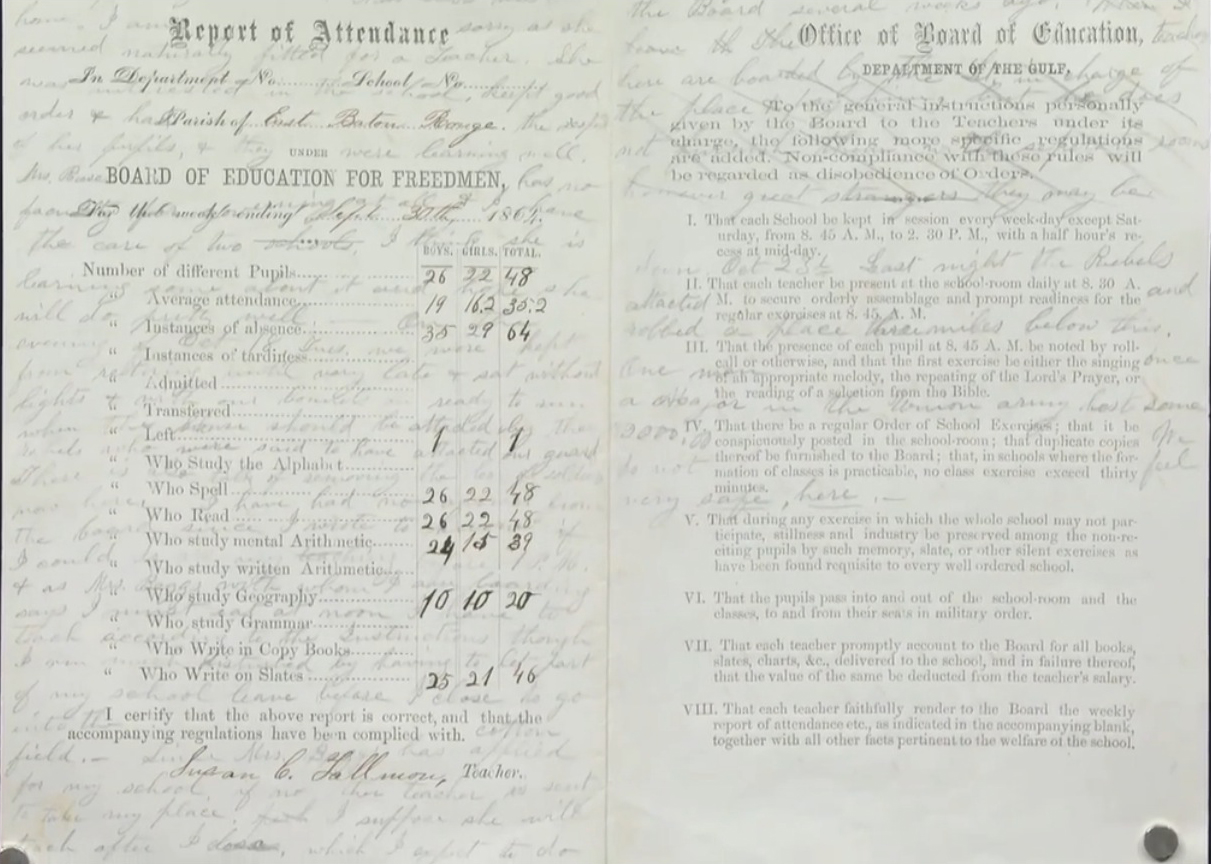
When I posted the drawings of the twelve students from the 1864 school for freedmen in Baton Rouge , I said I was working on transcribing the narrative that the teacher, Susan Carhart Tallman, wrote over a school form. I had several deadlines pop up over the weekend, but I made time to finish the transcription tonight. I was able to read most of the handwriting, but four words have continued to elude me, and I'm unsure of a few others. If anyone can figure out what the missing words are, or if you think I've made a mistake somewhere, please post and let me know. I will be happy to update the transcription as necessary.
I think I captured all the close-ups shown in the segment. Normally I make graphics smaller for my blog, so posts will load more quickly, but I've left these images as large as possible, to help facilitate legibility.


Here's my transcription. I did both Tallman's narrative and the form itself. I figured I might as well do it all while I was working on it.
-- >< -- >< -- >< -- >< --
Susan (Carhart) Tallman’s handwritten note over the school form:
Left page:
[At?] my place
Oct 21, during this week Miss(?) Davis(?) was called home. I was sorry as she seemed naturally fitted for a teacher. She was interested in the school, kept good order + had the respect of her pupils, + they were learning well. Mrs. Reese(?) has no faculty for [illegible] at all + I have the care of two schools. I think she is learning some about it and hope she will do pretty well. —— On the evening of Oct 18, Tues. we were kept from returning until very late + sat without lights + with our bonnets on ready to run when the school should be attacted [sic] by the rebels who were said to have attacted [sic] our guard There is also talk of removing the last(?) of soldiers now here. I have had no answer from the board since I wrote to [illegible] if I could do any teaching before 1 P.M. + as Mrs. Boggs with whom I am boarding says I must eat at noon I have to teach according to the instructions though I am much disturbed by having to let part of my school leave before I close to go into the cotton field. —— Since Mrs. Boggs has applied for my school, if no other(?) teacher is sent, [illegible] I suffer she will teach after I close(?), which I expect to do
Right page:
on the first of November, as I wrote to the Board several weeks ago. When I leave, the teachers here are boarded(?) by the Lt. in charge of the place + [illegible] him, but he does not furnish them with separate room however great strangers they may be. [In the narrative, Tallman had crossed out with Xes this section I have marked with strikethrough.]
Sun. Oct 23d Last night the Rebels attacted [sic] and robbed a place three miles below this. One man once a Major in the Union army lost some 2000.00 We do not feel very safe, here. —
===
School attendance form:
Report of Attendance
In Department No ……..… School No …………
Parish of East Baton Rouge.
UNDER
BOARD OF EDUCATION FOR FREEDMEN,
For the week ending Sept. 30th, 1864.
BOYS. GIRLS. TOTAL.
Number of different
Pupils 26 22 48
“ Average attendance 19 16.2 35.2
“ Instances of absence 35 29 64
“ Instances of tardiness
“ Admitted
“ Transferred
“ Left 1 1
“ Who Study the Alphabet
“ Who Spell 26 22 48
“ Who Read 26 22 48
“ Who study mental Arithmetic 24 15 39
“ Who study written Arithmetic
“ Who study Geography 10 10 20
“ Who study Grammar
“ Who Write in Copy Books
“ Who Write on Slats 25 21 46
I certify that the above report is correct, and that the accompanying regulations have been complied with.
Susan G. Tallman, Teacher
===
Board of Education rules:
Office of Board of Education
DEPARTMENT OF THE GULF.
To the general instructions personally given by the Board to the Teachers under its charge, the following more specific regulations are added. Non-compliance with these rules will be regarded as disobedience of Orders.
I. That each School be kept in session every week-day except Saturday and Sunday, from 8. 45 A. M., to 2. 30 P. M., with a half hour’s recess at mid-day.
II. That each teacher be present at the school-room daily at 8. 30 A. M. to secure orderly assemblage and prompt readiness for the regular exercises at 8. 45 A.M.
III. That the presence of each pupil at 8. 45 A.M. be noted by roll-call or otherwise, and that the first exercise be either the singing of an appropriate melody, the repeating of the Lord’s Prayer, or the reading of a selection from the Bible.
IV. That there be a regular Order of School Exercises; that it be conspicuously posted in the school-room; that duplicate copies thereof be furnished to the Board; that, in schools where the formation of classes is practicable, no class exercise exceed thirty minutes.
V. That during any exercise in which the whole school may not participate, stillness and industry be preserved among the non-reciting pupils by such memory, slate, or other silent exercises as have been found requisite to every well ordered school.
VI. That the pupils pass into and out of the school-room and the classes, to and from their seats in military order.
VII. That each teacher promptly account to the Board for all books, slates, charts, &c., delivered to the school, and in failure thereof, that the value of the same be deducted from the teacher’s salary.
-- >< -- >< -- >< -- >< --
Something I hadn't picked up on while watching this, but that became clear to me while transcribing the document, was that even this early the school was under the auspices of the military. The Board of Education was part of the Department of the Gulf, the students were to go everywhere in military order, and the person in charge of "the place" (the school, I believe) was a lieutenant.
One thing I'm wondering about is how Mrs. Tallman could have a partial student. The average attendance for girls was 16.2. I suppose it would make more sense if I knew what the average was computed from — daily attendance over the week, perhaps?
Subscribe to:
Posts (Atom)