Showing posts with label Antiques Roadshow. Show all posts

Friday, December 30, 2016

Top 10 Posts of 2016

It is very close to the end of the year, and it's natural to look back at one's work over that time.  This year's most viewed posts fall somewhat between the results from last year and those of the year before.  In 2014 the top posts covered a wide range of topics, while in 2015 the list was solidly populated by Who Do You Think You Are?  This year half the list is WDYTYA, and the other half is all over the place.  So it appears I still have my mandate, but people are reading other topics also.

Tied at #10 are an episode of Who Do You Think You Are? (no surprise), the one about Scott Foley, and a post about one of my family mysteries, the question of whether the biological father of my grandfather Bertram might also have been the father of Bertolet, the daughter my great-grandmother had three years after her husband had died.  It's nice to see that a story about my family can compete with WDYTYA.

The next two are more episodes of Who Do You Think You Are?Katey Sagal at #9 and Chris Noth at #8.  They were were within just a few views of each other.

Coming in at #7 is when I worked out several generations of my female ancestors' ages at death, one of my posts for Randy Seaver's Saturday Night Genealogy Fun meme.  (The corresponding post about my male ancestors' ages at death had a 10% lower viewing count, possibly because it was published a week off schedule.)

I am very happy to see that the post about photos of "contraband" scholars that were appraised on an episode of Antiques Roadshow placed high, at #6.  I keep hoping that someone will find a photograph of an ancestor in that collection.

Returning to Who Do You Think You Are?, the episode with Aisha Tyler placed #5 on the list of most-viewed posts.  She was the opening episode for this year's season and generated a lot of interest.

A big surprise was that how many place names appear in my Family Tree Maker family database came in at #4.  This was another Saturday Night Genealogy Fun post, which certainly helps garner more viewers, but that's a pretty narrow topic.

Neoklis Girihidis
Another surprise, but a good one, was that one of my posts about opportunities to volunteer or share information placed #3 on the year's list.  The number of views was significantly higher than any other volunteer post.  I suspect one of the projects particularly caught people's attention, but I have no idea which one.  I hope it was the one about the Greek man looking to contact the Jewish boys he helped escape during World War II.

This year the highest an episode of Who Do You Think You Are? placed was again #2.  My review of the Lea Michele episode was extremely popular, even though I wasn't able to post it until more than a month after the program aired.  I transcribed all the documents that were shown, however, and I'm sure that helped bring in readers.

Warming my little editor's heart, the #1 post on my blog this year was about copyright.  Yes, the post wherein I chastised two genealogical societies (not by name, of course) for abusing others' copyrights was well ahead of #2, by a good 10% more views.  I hope the post helps people think more carefully before they just copy things from the Internet and put them into their society newsletters.  No, just because it's on the Internet does not mean it's free, and the author didn't put it there so you could copy it.

Now that I've gone through the list, the final surprise is that not a single post about newspapers made it into the top 10.  Considering that two did last year (and three were in the top 12), I wonder what happened.

I checked to see how many episodes of Who Do You Think You Are? were aired this year:  a grand total of six.  And five of those made it into my top 10.  For some reason, Molly Ringwald didn't interest people anywhere near as much as the other celebrities.  But now I know why other topics were able to do as well.

I wasn't able to compare the number of shares this year, because Blogger/Google no longer seems to provide that statistic.  The most commented-on post was another Saturday Night Genealogy Fun one, where Randy asked everyone to write about their most recent unknown ancestor.  That generated almost 40 comments, most from a very generous woman who looked for newspaper articles to help me in my search.  It worked — I think I've identified my grandfather's father.  I'm now searching for a likely Y-DNA candidate for testing.

Something that has not changed since last year is my overall most-viewed post.  That, now with about 67% more views than the runner-up (Lionel Ritchie on Who Do You Think You Are?, the same as last year), is the discussion of the potential of gaining citizenship through descent for people wishing to reclaim ancestral connections.  That post about citizenship is also far in the lead in the number of comments, with more than 150.

Sunday, June 5, 2016

Saturday (Sunday!) Night Genealogy Fun: My Best Genealogy Research Find in May 2016

I was at Jamboree this weekend, and it's amazing how much time it took, not only in being at the conference during the day, but recovering from all the fun every evening when I went home.  I didn't even see Randy Seaver all weekend!  And I was just too pooped last night to take him up on this week's challenge for Saturday Night Genealogy Fun:

For this week's mission (should you decide to accept it), I challenge you to:

1)  I am away at the SCGS Genealogy Jamboree this weekend, having too much fun (I hope!).

2)  What was your best genealogy "research find" in May 2016?  It could be a record, it could be a photograph, etc.  Whatever you judge to be your "best."

3)  Tell us about it in a blog post of your own, in a comment to this blog post, or in a Facebook or Google+ post.


I think by far my best "genealogy" find this past May was when I was watching Antiques Roadshow on PBS and saw the segment with drawings of twelve young black students from 1864 Baton Rouge, Louisiana.  On May 25 I posted about the drawings and on June 1 about the teacher's narrative describing events in the area.  It doesn't matter that the information has nothing to do with my family.  I am happy I was able to capture good images of all but one of the children, and Schalene Dagutis has added the post to the Slave Name Roll Project.  I hope publicizing the information helps some researchers connect to images of their relatives.

Mary Lawrence, aged 12 years Baton Rouge Aug. 30 1864 A good scholar, pleasant girl

Wednesday, June 1, 2016

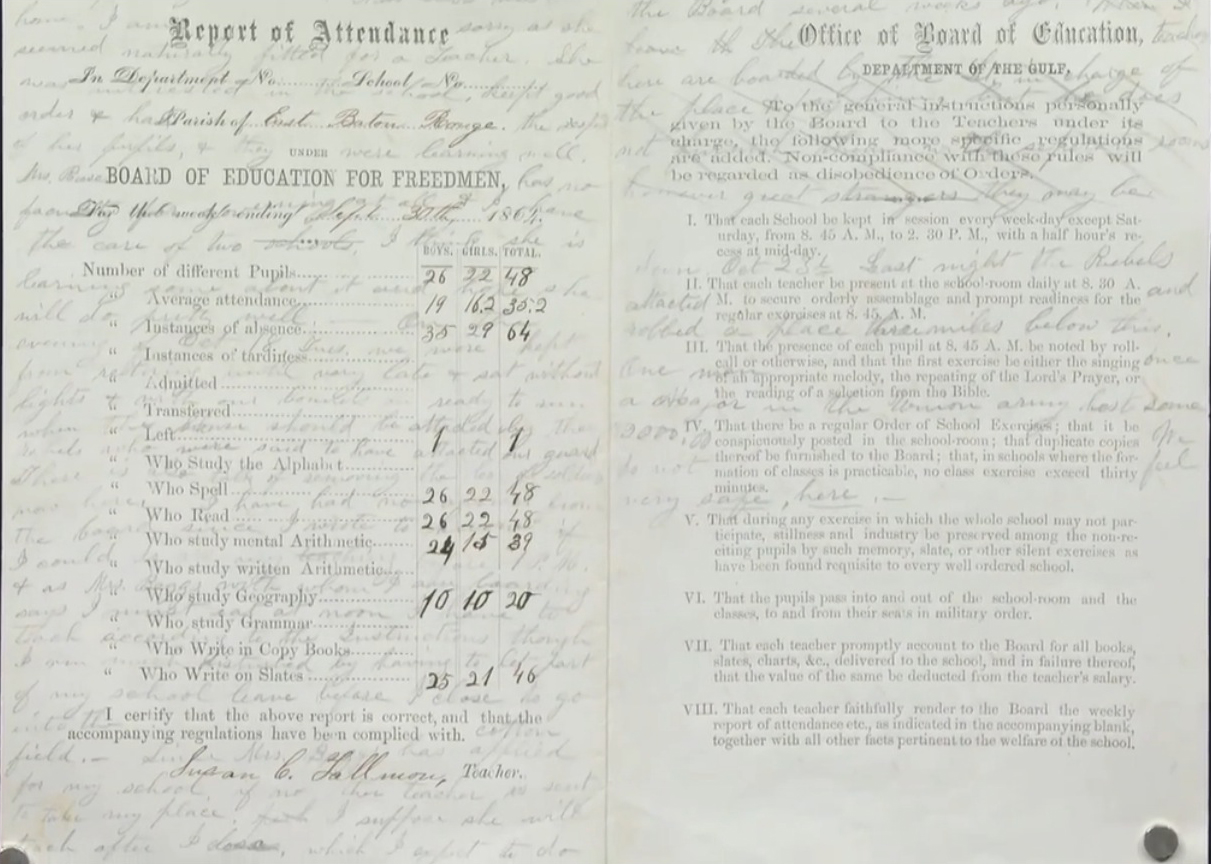
Susan Carhart Tallman's Narrative from 1864


When I posted the drawings of the twelve students from the 1864 school for freedmen in Baton Rouge , I said I was working on transcribing the narrative that the teacher, Susan Carhart Tallman, wrote over a school form.  I had several deadlines pop up over the weekend, but I made time to finish the transcription tonight.  I was able to read most of the handwriting, but four words have continued to elude me, and I'm unsure of a few others.  If anyone can figure out what the missing words are, or if you think I've made a mistake somewhere, please post and let me know.  I will be happy to update the transcription as necessary.

I think I captured all the close-ups shown in the segment.  Normally I make graphics smaller for my blog, so posts will load more quickly, but I've left these images as large as possible, to help facilitate legibility.


Here's my transcription.  I did both Tallman's narrative and the form itself.  I figured I might as well do it all while I was working on it.

-- >< -- >< -- >< -- >< --


Susan (Carhart) Tallman’s handwritten note over the school form:

Left page:

[At?] my place

Oct 21, during this week Miss(?) Davis(?) was called home.  I was sorry as she seemed naturally fitted for a teacher.  She was interested in the school, kept good order + had the respect of her pupils, + they were learning well.  Mrs. Reese(?) has no faculty for [illegible] at all + I have the care of two schools.  I think she is learning some about it and hope she will do pretty well.  ——  On the evening of Oct 18, Tues. we were kept from returning until very late + sat without lights + with our bonnets on ready to run when the school should be attacted [sic] by the rebels who were said to have attacted [sic] our guard   There is also talk of removing the last(?) of soldiers now here.  I have had no answer from the board since I wrote to [illegible] if I could do any teaching before 1 P.M. + as Mrs. Boggs with whom I am boarding says I must eat at noon I have to teach according to the instructions though I am much disturbed by having to let part of my school leave before I close to go into the cotton field.  ——  Since Mrs. Boggs has applied for my school, if no other(?) teacher is sent, [illegible] I suffer she will teach after I close(?), which I expect to do


Right page:

on the first of November, as I wrote to the Board several weeks ago.  When I leave, the teachers here are boarded(?) by the Lt. in charge of the place + [illegible] him, but he does not furnish them with separate room however great strangers they may be.  [In the narrative, Tallman had crossed out with Xes this section I have marked with strikethrough.]

Sun. Oct 23d Last night the Rebels attacted [sic] and robbed a place three miles below this.  One man once a Major in the Union army lost some 2000.00  We do not feel very safe, here. —

===


School attendance form:

Report of Attendance
In Department No ……..… School No …………
Parish of East Baton Rouge.

UNDER
BOARD OF EDUCATION FOR FREEDMEN,
For the week ending Sept. 30th, 1864.

                                                     BOYS.            GIRLS.            TOTAL.
Number of different Pupils                26                22                    48
“ Average attendance                        19                16.2                  35.2
“ Instances of absence                       35                29                     64
“ Instances of tardiness
“ Admitted
“ Transferred
“ Left                                                   1                  1
“ Who Study the Alphabet
“ Who Spell                                       26               22                    48
“ Who Read                                       26               22                    48
“ Who study mental Arithmetic        24                15                   39
“ Who study written Arithmetic
“ Who study Geography                   10                 10                   20
“ Who study Grammar
“ Who Write in Copy Books
“ Who Write on Slats                        25                21                    46

I certify that the above report is correct, and that the accompanying regulations have been complied with.
Susan G. Tallman, Teacher

===


Board of Education rules:

Office of Board of Education
DEPARTMENT OF THE GULF.

To the general instructions personally given by the Board to the Teachers under its charge, the following more specific regulations are added.  Non-compliance with these rules will be regarded as disobedience of Orders.

I.  That each School be kept in session every week-day except Saturday and Sunday, from 8. 45 A. M., to 2. 30 P. M., with a half hour’s recess at mid-day.

II.  That each teacher be present at the school-room daily at 8. 30 A. M. to secure orderly assemblage and prompt readiness for the regular exercises at 8. 45 A.M.

III.  That the presence of each pupil at 8. 45 A.M. be noted by roll-call or otherwise, and that the first exercise be either the singing of an appropriate melody, the repeating of the Lord’s Prayer, or the reading of a selection from the Bible.

IV.  That there be a regular Order of School Exercises; that it be conspicuously posted in the school-room; that duplicate copies thereof be furnished to the Board; that, in schools where the formation of classes is practicable, no class exercise exceed thirty minutes.

V.  That during any exercise in which the whole school may not participate, stillness and industry be preserved among the non-reciting pupils by such memory, slate, or other silent exercises as have been found requisite to every well ordered school.

VI.  That the pupils pass into and out of the school-room and the classes, to and from their seats in military order.

VII.  That each teacher promptly account to the Board for all books, slates, charts, &c., delivered to the school, and in failure thereof, that the value of the same be deducted from the teacher’s salary.

VIII.  That each teacher faithfully render to the Board the weekly report of attendance etc., as indicated in the accompanying blank, together with all other facts pertinent to the welfare of the school.
 
-- >< -- >< -- >< -- >< --

Something I hadn't picked up on while watching this, but that became clear to me while transcribing the document, was that even this early the school was under the auspices of the military.  The Board of Education was part of the Department of the Gulf, the students were to go everywhere in military order, and the person in charge of "the place" (the school, I believe) was a lieutenant.

One thing I'm wondering about is how Mrs. Tallman could have a partial student.  The average attendance for girls was 16.2.  I suppose it would make more sense if I knew what the average was computed from — daily attendance over the week, perhaps?

Thursday, May 26, 2016

"Contraband" Scholars in 1864 Baton Rouge

The new episode of Antiques Roadshow that aired on Monday, May 23, 2016 — the third hour from the visit to Cleveland that was filmed on July 11, 2015 — had an incredible item.  A man brought in some papers that came from a box of stuff that he bought for $2 at a rummage sale about 15 years ago.  The items are an amazing piece of black history from Louisiana during the Civil War.

A man named George Tallman, possibly a colonel in the Union army (according to the guest), was in Baton Rouge after the Union forces had taken it over.  He sent for his wife, Susan Carhart Tallman, who was a teacher, so she could set up a school to teach some of the children of the slaves who had been freed in the area.  Somehow, some of her papers ended up in the box from the rummage sale.  The man brought in a photo of George and Susan Tallman, a school attendance sheet with a narrative written over it, and Susan Tallman's drawings of twelve of her students.  She called them her "contraband scholars."

The students' names are Henry and Horace, Ellen's sons; Melvina Blufus; Comfort Holmes; Frederick Johnson; Mary Lawrence; Tilda Ann Mingo; Julia Morris; Alice Parkins; Earnest Scott; and Susanna Thomas.  Of the twelve drawings, only one, that of Comfort Holmes, was not shown clearly enough for me to capture the image.  One drawing, of a 7-year-old boy, did not have a name on it.

Oct. 1864 Baton Rouge La Henry, Ellen's three year old boy. Sweet, forward
Horace, Ellen's son aged 5 Oct 3d 1864 Baton Rouge La
Frederick Johnson
Alice Parkins aged 11 A tenderhearted, affectionate neat girl,
good to work & studious, but slow about learning Baton Rouge La
Aged about 7 A handsome pleasant little boy Intelligent, but not too forward Oct 24 1864 Baton Rouge La
Earnest Scott, aged 10 Baton Rouge, La. Aug 1864 A left-handed little artist
Tilda Ann Mingo aged 9 Sept 30th, 1864, Baton Rouge La
Julia Morris aged 10 Baton Rouge Aug. 1864 Sings like a mockingbird. black. A real Gipsy. deceiftul quick
Mary Lawrence, aged 12 years Baton Rouge Aug. 30 1864 A good scholar, pleasant girl
Susanna Thomas aged 13 Baton Rouge Aug 30, 1864
Melvina Blufus aged 15 Baton Rouge, La Aug 1864
Comfort Holmes Sept 1864 Age 14 Baton Rouge La

I hope that someone finds a family member in these drawings.

There might have originally been more than these twelve drawings.  Several of the drawings have numbers in the upper-left corners; that of Frederick Johnson has a 16.

I'm working on transcribing the letter and hope to post it soon.

If you visit the link to this appraisal on the Antiques Roadshow site, you can watch the video and read the transcript.

Update:  The transcription of Susan Carhart Tallman's narrative has been posted!

Monday, February 2, 2015

Family Discoveries: Franklin P. Sellers

The Jeffersonian
(Stroudsburg, Pennsylvania),
December 19, 1850, page 2
When I posted recently about my second-great-grandfather Cornelius Godshalk Sellers, I mentioned that I had found his father's name, Franklin Sellers, several times on a blog about Warren County, New Jersey, in the Civil War.  Most of the posts about Franklin were related to the newspaper he published, the Belvidere Intelligencer.  He was very pro-Union and invited Belvidere soldiers to write to him at about their experiences, and he would publish their letters in the newspaper.  He seems to have held true to his word, because I found several examples on the site.  He apparently was having a feud with John Simerson, the publisher of the Warren Journal, so his solicitation of letters from soldiers may not have been entirely patriotic, as publishing the letters was sure to help circulation.

Also mentioned in three of the transcribed newspaper articles was Franklin's stepson, William (or maybe John) Mathews.  I already was pretty sure my third-great-grandmother had been married previously, because the record of her marriage to Franklin Sellers called her "Mrs. Rachel Mathews", but this was the first time I had found information that she had children from the earlier marriage.  I'm currently on the hunt for documents about William, but in a timely coincidence, soon after I read that he was present when Colonel Elmer Ellsworth was shot and killed while taking down a Confederate flag in Washington, D.C., Antiques Roadshow aired a segment in the first episode of the new season with someone who brought in a piece of that very flag.  I got goosebumps watching it!

Through the Chronicling America newspaper directory, I have found the names of more newspapers for which Franklin was the publisher.  The Public's Advocate and Literary & Humorous Journal (now how's that for a name?) was published in Doylestown, Pennsylvania, beginning in 1838.  Olive Branch, under several name variations, was also published in Doylestown, from 1842 to about 1853; Franklin was the editor in 1851.  From sometime between 1850–1853 to 1857, Olive Branch came from Norristown, Pennsylvania.  Concurrent with that, The People's Beacon and Independent Weekly Record appeared in Lambertville, New Jersey, from 1853–1858.  And then there was the Belvidere Intelligencer, which Franklin ran from 1861 until his death in 1863.  (What was he doing between 1858 and 1861?)  I know newspapers from that period are hard to come by, but boy I would love to have a copy of at least one newspaper which he published.

Franklin's name shows up a few times in histories of Doylestown and Bucks County.  The stories say that he started Olive Branch, which was a temperance newspaper, because he himself had previously had troubles with alcohol.  (I'm sure many people will find it amusing that I have an ancestor who was involved in the temperance movement.)  But one history of Doylestown said it was a "very spicy paper", so I guess he wasn't stodgy!

If all of that weren't enough to demonstrate that Franklin was a newspaperman through and through, every document I received from the New Jersey State Archives relating to him was a receipt for payment for publishing advertising, announcements, and more for the Union cause.  Maybe I can claim I got part of my interest in editing and publishing from him?

I now have a mystery about Franklin, though.  My previous research had indicated his middle name was Peter.  According to the transcribed articles on the Warren County Civil War blog, however, he called himself Franklin Pierce Sellers in his newspaper.  Jay Richards, the author of the blog, suggested that Franklin might have renamed himself to sound more "presidential."  I will, of course, be adding the middle name question to my (long) list of research items . . . .

Monday, October 13, 2014

Digitize and Share Those Newspapers!

Tonight on Antiques Roadshow I watched the first of three episodes from Jacksonville, Florida.  One of the items appraised was a bound collection of original copies of a newspaper running from 1861–1865.  The Family Friend was published in Monticello, Florida.  The appraiser, Ken Gloss, explained that this is a particularly rare find because it was a Confederate newspaper.  As the war went on the Confederacy ran out of supplies for everything and publishing a newspaper probably was not a high priority, so it's pretty impressive that this one had issues in 1865.  There were even two copies of the issue reporting on Abraham Lincoln's assassination, though it appeared almost two weeks after the fact, because news traveled slowly in those days.

The Family Friend appears in the newspaper directory that is part of the Library of Congress Chronicling America Web site.  While the site is known primarily for its collection of online digitized newspapers, it also includes the directory, a listing of newspapers that were published in the United States, not only those that have been digitized.  The only known issues listed in the directory are from February 22, 1859 to December 24, 1861 at the University of Florida in Gainesville and one issue, January 16, 1864, at the American Antiquarian Society in Worcester, Massachusetts.  The Florida Digital Newspaper Library at the University of Florida has 140 issues of The Family Friend digitized, apparently the issues listed in the Chronicling America directory.  The copies the guest on Antiques Roadshow owns may be the only ones still in existence for the later dates.  I checked the lists of newspapers on NewspaperArchive.com, GenealogyBank.com, and Newspapers.com, and it does not appear on any of them.


So my question is, who knows this man, and how do we convince him that the newspapers need to go somewhere where everyone can read them — such as being digitized and placed online?  Assuming that he still has the book, of course.  I hope he didn't simply place them in an auction to be sold to the highest bidder, then to be hidden away in someone's personal library.  I know the filming was done during the summer of 2013, so he's had a year — what has happened with those newspapers?

Saturday, June 7, 2014

Genealogy at "Antiques Roadshow"

I played hooky today.  I volunteered at the taping of Antiques Roadshow that took place at the Santa Clara County Convention Center in Santa Clara, California.  Instead of working on genealogy, I helped with production on the set, mostly by corraling lines of guests waiting for their appraisals.  I figured it was going to be a genealogy-free day.

But then I saw Ron and Pam Filion of SFGenealogy in the jewelry line and went over to say hello.  And a friend who used to be staff at the Oakland FamilySearch Library showed up in the collectibles line with her stepmother.  Then another woman in the collectibles line recognized me from a newspaper presentation I gave to the Santa Clara County Historical and Genealogical Society.  And a very sweet 91-year-old told me about her daughter, who used to be the director of the Santa Cruz FamilySearch Center.

On top of all that, David Gallagher of the Western Neighborhoods Project, with whom I worked on the committee that organized this year's San Francisco History Expo, was in the books and manuscripts line with a 1935 testimonial of some sort to "Uncle" Joe McLaren of the San Francisco Bohemian Club.  The oversize sheet was filled with signatures of people who wanted to say what a great guy Uncle Joe was.  The page had probably about 100 signatures.  What a fascinating resource to place those men in San Francisco in 1935!

Well, so much for my genealogy-free day!

I am a major Roadshow geek.  When I had time during my breaks I ran around and got autographs from almost all the appraisers.  I was sad that I wasn't able to get Kerry Shrives, because every time I went by she was busy doing appraisals.  And I didn't get Kevin Zavian, who kind of seemed to be in a grumpy mood anyway.  But I found out that Ted Trotta's mother's name is also Janice!

Volunteering to help at the Roadshow allows you to have two items appraised, the same as people who win tickets to attend.  I didn't do well with my jewelry items.  A brooch that my former boss sold me as early Victorian was appraised by Rhinestone Rosie as late Victorian and worth about only $50 (unfortunately, less than I paid for it).  A string of pearls the same boss had told me were cultured pearls from the 1920's Rosie and a second appraiser determined to be well made glass pearls with ground fish scales coating the outside to give a somewhat gritty texture, reminiscent of the texture of natural pearls.  She told me the sterling silver clasp was worth more than the pearls.  And this is the second time Rosie has told me my jewelry item was actually glass.  (I'm glad the pearls didn't cost me anything!)

I did much better with a gorgeous green silk cloak that was sold to me as having been worn by Maureen O'Hara in the movie Ten Gentlemen from West Point.  Two appraisers at the textiles table agreed that even without authentication of the provenance from the movie the cloak is worth what I paid for it (hooray!).  If I can find a still from the movie showing O'Hara in the cloak and get a certificate of authentication that the cloak was worn in the movie, however, the value goes to several thousand dollars.  I guess I gotta watch that movie sometime soon.  And O'Hara is still alive!  Maybe she remembers the cloak ....

Sunday, April 6, 2014

Transcription Mentioned on Television!

from Antiques Roadshow
I have written before about the importance of transcribing records so that they can be shared with more people.  Of course, one of the largest ongoing transcription projects in genealogy is FamilySearch's "indexing" work, with thousands and thousands of people around the world helping to create the searchable databases available on FamilySearch.org.  Genealogists are fortunate to have this incredible free resource.  Commercial sites such as Ancestry.com use paid transcribers to create their indices.

Families often have handwritten items that would benefit from being transcribed.  If you have your great-grandmother's diary, you're the only one who can read it.  If you transcribe her entries and put them in a word processor document, you can share the information with other family members.  The same goes for letters, bible entries, and other family items.

I've mentioned that I have written to Antiques Roadshow and suggested that their appraisers should bring up transcription to guests who bring items in.  Some of the letters and diaries that I have seen on the program have fantastic first-hand historical information, and I just know that almost all those people go home and lock up their heirlooms — and the information in them.  The items are preserved but no one can learn from them.  I received a response from AR saying my transcription suggestion was a good idea, but I hadn't seen anything come of it.

But on a recent episode of Antiques Roadshow, for the first time, I heard an appraiser tell a guest he should transcribe the letters he had!  Ken Gloss, of Brattle Book Shop in Boston, appraised a collection of Confederate Civil War letters that were found in an old house.  He asked the guest if he had ever considered transcribing the letters so he would know all the details in them.  Unfortunately, the guest's response was less than enthusiastic.  But I can hope that maybe after the episode aired and his lack of enthusiasm was broadcast nationwide he has had second thoughts.

Look at that sample up there at the top of this post.  That isn't hard to read.  I'll even start it for him:

Grenada Miss [probably Mississippi] June 14th 1862
... F. J. Sayle
Dear Sister
Yours of a late d [date, from complete image]
... to hand — While conveying the said
... –ie's critical situation, it gave grea [great, from complete image]

What family items have you transcribed and shared?

Tuesday, December 18, 2012

Genetic Voiceprints?

BBC has posted an audio file of a discussion on forensic phonetics, the science of studying voices in relation to legal proceedings.  While voiceprints are not unique in the way that fingerprints are, phonetics scientists work on identifying distinctive characteristics in speech so as to identify specific speakers.

So this made me wonder how much of a genetic component there is to what our voices sound like and what can be passed down in a family.  I know that I have always sounded like my mother (which definitely caused some problems after she passed away).  People often got us confused on the phone.

Twins often sound very much alike.  For example, if you've ever watched Antiques Roadshow and seen Leigh and Leslie Keno, they sound almost exactly like each other.  I used to practice listening to them without looking at the screen to see if I could figure out which brother was which.  But then one day I heard someone who sounded a lot like them, but not quite the same.  It took a while for the camera to show the appraiser, and it wasn't either one of them!  When they finally showed the person's name, it was Mitchell Keno, their older brother.  So there's something in their family that's come down through all three men's voices.

Wouldn't it be cool to find out that you sounded like your great-great-grandmother (or -grandfather)?  Unfortunately, I suspect very, very few of us have recordings of our ancestors beyond (maybe) our parents and grandparents.  But making digital recordings is so easy now, you can record your own voice so your descendants can hear you.  Or make a video!  Then maybe your great-great-granddaughter (or -grandson) will find out that she sounds just like you.

If you had an ancestor who was a performer of some sort, you might be able to find movies, albums, or some other sort of recordings of the person's voice.  I've even heard of people tracking down old radio recordings.  Hunt around and see what you can come up with.

Tuesday, February 15, 2011

FamilySearch.org and the Importance of Transcription

At the Sunday, February 13, meeting of the SFBAJGS, Margery Bell of the Oakland Regional Family History Center talked about FamilySearch.org in the past, present, and future.  She gave an overview of some of the site's history, demonstrated tools that are currently available, and talked a little about what is anticipated for the future.

FamilySearch.org is in a state of transition.  Several different sites, including the old site and some beta sites, are being combined into one super-site.  The site has free educational resources, historical records, and family trees.  There is already a wealth of information available, and more is being added daily.  Some of the ideas for the future are linking documentation to individuals in order to substantiate facts, and the capability of uploading scans of personal documents and photos of family artifacts to share them with other researchers.  It is exciting to have so much available, and for free!  You should check back on a regular basis to see what has been added and what changes have been implemented.

Most genealogists are probably familiar with FamilySearch.org's massive ongoing project to transcribe and put online the LDS church's vast collection of microfilmed records.  (Personal rant:  The church calls this indexing, but the volunteers aren't actually creating indices.  They are *transcribing* information from records, and those transcriptions are compiled by programmers into searchable databases, which are the indices.)  Thinking about the church's transcription project reminded me of other items that should be transcribed.

The importance of transcription goes beyond public records of the types that have been microfilmed by the church.  Families often have historical items -- diaries, letters, family bibles.  Those items should be transcribed also, and the transcriptions shared with family members, at least.  Having only one copy of something increases the risk of losing the information.  Old paper is suspectible to ink bleeding, ink fading, and paper dissolution.  Items can be lost or stolen.  Fire and water can damage precious items.  Even if you still have the item, the paper in a diary can become so fragile that you can no longer turn the pages, or the ink can fade so that you cannot read it.

Monday night I was watching Antiques Roadshow.  One of the items appraised was a signal book used by the guest's great-great-grandfather during the U.S. Civil War.  This was the signal man's handwritten notes of the orders he was given and to whom he sent the information.  Pages were dated 1863; there were orders that had come from General U.S. Grant.  The appraiser, Rafael Eledge, said he had never actually seen a signal book in the 20 years he has been working with Civil War artifacts.  But that book is probably just sitting in a drawer in its owner's home again, the information locked inside it.

I wrote to Antiques Roadshow once through their Web form after a similar appraisal of paper items.  I asked why they didn't encourage the appraisers to suggest to guests that they transcribe the written information so that it can be shared, not only by family members but by scholars and researchers.  Not surprisingly, I received an autosponder e-mail:  "Thank you for your inquiry.  Many questions can be answered by visiting our FAQ page.  Blah blah blah."  So much for that idea, I thought.  But then a day or two later, an actual person from AR sent a message telling me what a great idea it was and that he was going to pass it on to a producer.  Unfortunately, nothing seems to have come of it, because I have not once seen an appraiser say anything about transcribing.

What family artifacts do you have that you haven't transcribed?