Showing posts with label Georgia. Show all posts

Saturday, May 18, 2024

Saturday Night Genealogy Fun: Use FamilySearch Full-text Search

The challenge today from Randy Seaver for Saturday Night Genealogy Fun is valid for varying definitions of the word "fun."

Come on, everybody, join in and accept the mission and execute it with precision.

1.  Use the FREE FamilySearch Full-Text Search (https://www.familysearch.org/search/full-text) to find a record for one of your ancestors that is new to you.

2.  Share your results on your own blog or in a Facebook post.  Please share a link in Comments on this post if you write your own post.

I'm going to be a party pooper again, sorry.

Non sequitur:  Have you ever heard the party pooper song?
"Every party needs a pooper, that's why we invited you.
"Party pooper!  Party pooper!"

Okay, back on track.

First, I admit I had not tried to use the full-text search yet.  I hate blindly fishing around in records and much prefer to have an actual research plan.

That said, I did as Randy suggested and tried to find a new record for one of my ancestors.  I would have been happy to find a record for a relative on a collateral line.

No such luck.

I went to the link that Randy provided.  I noted that it said I would be browsing "US Land and Probate Records, Mexico Notary Records, Australia Land and Probate Records, New Zealand Land and Probate Records and US Plantation Records."  (I also noted that to the left it said, "Only two collections are currently available to browse . . . .", so something is out of date.)

I decided I would try to find something in the plantation records by using as a keyword one of the locations I am researching in the part of my family that was enslaved.  So I typed in "upatoi" (a location in Georgia) and let 'er rip.

I got a total of 24 results.  Okay, that's pretty manageable.

Then I looked at the filters.

I had options of Collection, Year, Place, and Record Type.

The first one I tried to use to narrow down my hits was Place.  The only option was United States of America, which applied to all 24 hits.  Okay, that's useless.

I looked at Collection.  That gave me choices of "Alabama, Wills and Deeds, ca. 1700s-2017 (1)", "Georgia, Wills and Deeds, ca. 1700s-2017 (4)", "Pennsylvania, Wills and Deeds, ca. 1700s-2017 (1)", and "United States, Indenture Records, 1600-2001 (18)."

As I was hoping to find information about plantation records, I chose the Georgia wills and deeds.

Boy, was I disappointed.

Nothing about plantation records.  Nothing even in the 19th century.  "Muscogee, Georgia, United States Will 1949", "Muscogee, Georgia, United States Will 1955", "Marion, Georgia, United States Deed, Mortgage 1965", and "Marion, Georgia, United States Deed, Mortgage 1960."

Okay, let's look at the indenture records.

Of the 18 records, 16 are titled "Riverdale Cemetery, Columbus, Muscogee, Georgia, United States Enslavement, Cemetery" followed by a year ranging from 1881 to 1952.  Two are "Georgia, United States Enslavement, Cemetery 1921", and you can see from the teaser text that they're the same item.  So none of these years is during the period of chattel slavery in this country, which officially ended in 1865.  And I don't understand why cemetery records are listed under indenture records.  But I gamely clicked on the first result to see what it would show me.

The first link said it was for 1881.  The page told me it was a full transcript from "Riverdale Cemetery.  Cemetery Records 1866–2000, Enslavement Records 1866–2000."  Um, say what?  What enslavement records begin in 1866, the year *after* slavery officially ended?  And the record itself was an obituary for a man born in 1881 in Alabama.  The obit mentioned he had celebrated his 50th anniversary, so figure he was at least 70 years old; that means that he died about 1951.  Sure, it's a record having to do with Riverdale Cemetery, but saying it's for 1881 is misleading at best and a train wreck at worst.  How is this supposed to be helpful to me?

I clicked on the first link for "Georgia, United States Enslavement, Cemetery 1921" to see if it was any better.  It was listed as a full transcript from "Georgia.  Cemetery Records 1866–2000, Enslavement Records 1866–2000."  Okay, same logic problem as the previous one.  This was also an obit.  This man was born in 1877 in Upatoi and died at 82, so it's from about 1959.  The 1921 that shows up in the link name?  "The aldermanic form was government was abandoned in Columbus in 1921."  Even less relevant than the first link I tried!

I then tried to cut down on the number of hits.  I had "upatoi" as my keyword, so I added "crawford" (one of my family names).  Silly me, I thought the search engine would search for records where both words appeared and cut down the number of hits, maybe even to zero.

I was wrong.

Instead of 18 results, I now had 6,760.  It would appear that adding a term causes the search engine to return results with either of the search terms, not both of them.  I did note that if you add a plus sign in front of a term, it will include that term.  When I searched for +upatoi and +crawford, I had no results.  Well, I did cut it down to zero!

I tried one last search.  I used "slaves" as my keyword.  I had 446,052 results.  I restricted the place to Marion County, Georgia, and the number of results dropped to 41.  The links were to wills and deeds ranging from 1846 to 1862 as far as the period of slavery was concerned, but several titles listed years after 1865 and even into the 20th century.  I clicked a link to one that was titled "Marion, Georgia, United States Deed, Mortgage 1936."  The image was said to be from "Marion.  Deeds 1845–1965, Mortgages 1845–1965."  It was actually from 1858–1859.  I did not find "1936" anywhere in it; the closest was "one hundred thirty six."

I went back to the search results page and added "kinchafoonee" (another location associated with the family), and the results stayed at 41.  Since my previous attempt at adding a name appeared to indicate that the search engine was returning results with either search term, I interpreted this to mean that none of the records for Marion County include Kinchafoonee in the text, or at least not with that spelling.  When I added a plus sign in front of each term, I had no results, so my interpretation appeared to be correct.

I never even saw anything with results that said they were from plantation records.  I suspect that the only way to get those is with the plantation owner's name.  Since I still have not found the name of a single slaveholder in my family, I guess I won't be getting far with those.  I did not see a way to focus my browsing on just one set of records included in the full-text search.

Obviously, the advantage of the full-text search is that it's creating a searchable database of words from handwriting, which is very cool, and that you don't have to wait for a real index.  On the other hand, it's like putting a search term into Google, which used to be great but has been getting worse for quite some time.  You get results with your search term (well, if you're lucky; nowadays Google routinely returns results with no appearance of your search term anywhere on the page), but the context could be anything.  An index gives you context.  And yes, I admit I am very biased, because I'm an indexer.

After this dismal experience, I am reminded of a study I read about many years ago.  Researchers observed people searching for information.  The people searching used an index or did a general text search, such as by using Google.

Even though search results were consistently better and desired information was found more quickly when using the index, the majority of searchers, when allowed to choose the search method, defaulted to doing a general text search the majority of the time.  When it was pointed out to them that the results were better with the index, the response was that it was simply easier to do the general search, and they didn't care that the results were not as good.  Me, I care.  My time is valuable.

I am very happy for Randy that he found five new records for his ancestor.  After seeing my search results, I think I'm going to wait for actual searchable indices for these record collections.  I get tired of beating my head against the wall after a while.

Addendum:  I decided to try one last time, with one of the unique surnames I am researching.  My aunt's paternal grandfather changed his name when he became a U.S. citizen.  He made up a name, which is unique to that family.  If I find that name, it's my aunt's family.  I searched for that name in the database and got a grand total of two hits:  my aunt's great-grandmother's will and her probate.  The reason the name showed up is because my aunt's mother (the granddaughter of the deceased) was named in the will under her married name.  Because it's a unique name, it allowed me to find the will, so that's a new record!  Yay, I found one, even if for my aunt's ancestor and not mine!  And now I know when her great-grandmother died, which is new information.

Friday, August 20, 2021

FInding My Aunt Carol

I had known about my Aunt Carol for years.  My mother, who cared so much about knowing and staying in touch with family members, made sure of that, even if Carol was my father's sister, not hers.

But the problem my father had was that she wasn't his sister — she was his half-sister.  She was born from the relationship my grandfather had after he left my grandmother, and my father resented that for decades, as I eventually learned.

When my mother compiled a list of all known relatives out to stepgrandparents (yes, really!) for my brother, who was applying for a job with a security clearance, Carol was included.  I knew her full name — Carol Beth Sellers — and her birthday — August 20, 1954.  Mommy thought she was born in Niceville, Florida.  We knew her mother's name was Anita.  And that was about it.

My grandfather died in 1995, as did my mother.  Adelle, my grandfather's widow when he died, went to live with her nephew; she had no children of her own to take her in.  She herself died in 2000.

I still don't know how much of my grandfather's "stuff" Adelle kept with her when she moved to her nephew's home.  (For instance, the whereabouts of Grandpa's Shriner's fez are still unknown.)  Apparently, however, some of what Adelle did take with her were a lot of Grandpa's papers from when he worked in the Civil Service with the U.S. Air Force and several photos from his marriage to Anita.

The reason the papers and photos became known is that some years after Adelle had died, the nephew contacted my aunt Dottie — my father's oldest sister from Grandpa's side of the family — and asked if anyone in the family was interested in those items.  I am so happy Dottie said yes.

Dottie got everything from Adelle's nephew and then sat on the papers and photos for a couple of years before asking my father if he wanted them.  And thus they were passed on to a new caretaker for a while.

My father had them for some time.  He had made plans — he wanted to scan all the Civil Service documents and then share them with other family members, particularly me, the primary one interested in our family history.  He even told me that he had them and was going to share the scans after he had made them.

The problem was, however, that there were a LOT of papers.  Grandpa was known for being a little obsessive about keeping things, and his work documents were no exception.

After a while Daddy decided he wasn't going to get around to doing all that scanning and asked if I just wanted the documents, and I could be the one stuck scanning them and sharing with family members.  And of course I said yes.

When he sent everything to me, the first thing I did was separate the work documents from the several photos that were included.  When I looked through the photos, I recognized my father in a couple and my grandfather in several, but I didn't know who the woman and young girl were who appeared many times.  After asking my father and aunt, I learned they were Anita, my grandfather's wife after his relationship with my grandmother, and my aunt Carol, Anita's daughter and Daddy's youngest sister.

My father made it clear he was not interested in the photos in any way — "That is not my sister.  I've never had anything to do with her."  Of course, using his logic, his sisters Dottie and Mildred shouldn't have wanted anything to do with him, as Grandpa had left their mother to live with my grandmother (not divorcing their mother until Anita insisted on being able to marry, as I'll explain in a little while), and my older half-sister Laurie shouldn't have wanted to keep in touch with my siblings and me.  And I eventually determined that he was in photos with Carol, debunking what he said.  But that's okay, life has a way of working out sometimes.

There were so many photos, I couldn't let them just be.  I decided I had to find Anita and/or Carol and reunite them with the photos.

I asked my aunt Dottie if she was in touch with Anita or Carol.  She said no.  My only clue starting out was my grandfather's obituary, which included Carol as a surviving family member and had her last name as Ebanks.

This was the early days of genealogy information being available online.  I didn't find anything relevant with searches.  I wasn't finding much of anything with the name Ebanks at all.  I started to think that it might be Eubanks, just misspelled, so searched for that also.  I found more results, just not for the person I was looking for.

I was making a lot of phone calls by searching phone directories for Ebanks and Eubanks.  I don't remember now how I made the connection (this was several years ago), but in calling someone else named Ebanks, she told me she knew about Anita and that she used to work for this one company; maybe they could help me get in touch with her.

I was certainly grasping at straws by that point, so I said, sure, it couldn't hurt to try.  And I called the company.  I'm certain it was against policy, but the woman I spoke to said that not only did she know Anita, who had retired by that time, but she could give me a phone number for her!  I did the genealogy happy dance around the living room.

When I called Anita, she confirmed that she was indeed the ex-wife of my grandfather and the mother of my aunt Carol.  I told her how happy I was to find her and that I had been searching for her so that I could return the photos.  She appreciated the effort I had gone to and was looking forward to seeing them again after all those decades.

She also got chatty and told me a little about herself and her relationship with Grandpa.  They met each other working at Fort Dix in New Jersey.  He apparently had been chasing after her for a while.  At some point she told him he would have to prove to her that he was divorced because she was a good Christian girl and wouldn't take up with any married man.  And he did it!  He divorced his wife!  She even went looking in her house for the divorce paperwork, which she had a copy of, so she could tell me what it said.  She found it and read some from it but neglected to tell me the name of the wife!  (I didn't find out until some years later that the divorce was from his first wife, Elizabeth, and not my grandmother, Anna, who had apparently "lived in sin" with Grandpa for all the years they were together.  When I did discover that, I immediately called my father to tell him that he was officially a bastard because his parents had never been married.  He thought that was hilarious and broke out laughing.)

I don't remember now if I sent the photos to Anita or to Carol.  I think I sent them to Anita.  I'm sure that I got Carol's address from Anita at that time, and I wrote to her.

A year or so after that, I had plans to be in Atlanta for a convention.  I realized how close that was to where Carol lived and decided I finally had to meet my aunt.  At the end of the convention, the friend who was there in Atlanta with me (coincidentally also named Carol) and I drove to lovely Toccoa (birthplace of DeForest Kelley!) to meet her.  We had a wonderful time, and I am still so happy I made the effort to do that.

When my father was turning 70, I tried to arrange for all four of his children to come to Florida to celebrate.  (Well, three of us made it.)  I also invited Carol, who wasn't able to come, but she asked for Daddy's mailing address so she could send a card.  When I arrived in Florida, the first thing my father did was show me the card that Carol had sent for his birthday, telling him how much she cared about him even though they hadn't spent that much time together during their lives.  He cried when he told me how happy he was that I had helped put him in touch with his sister.

Carol wasn't able to travel much around that time, but at some point she made it down to Florida, and the four siblings were together for one of my most treasured photographs.

Saturday, August 17, 2019

Saturday Night Genealogy Fun: Were You in a Youth Organization?

Randy Seaver has taken an idea from someone else for this week's Saturday Night Genealogy Fun posting challenge.

Here is your assignment, if you choose to play along (cue the Mission:  Impossible! music, please!):

(1)
Did you join a youth organization such as Boy Scouts, Girl Scouts, Camp Fire, Job's Daughters, for example?

(2) Tell us about it in a blog post of your own, in a comment on this blog, or in a Facebook post.

Thank you to Lisa Gorrell for suggesting this several months ago.


I was in a few youth organizations at different times.  When my family lived in California, I was in Camp Fire Girls (today, apparently, simply Camp Fire), as was my younger sister.  My mother was our group leader (whatever the group was called).  That would have left my brother alone, so he was our (unofficial) group mascot and participated in activities with us.  We were in the youngest age group, which at that time was called Bluebirds.  I think somewhere I still have my Bluebird uniform.  The Wikipedia Camp Fire page says that kids can earn beads; I have no recollection if we earned anything or just did social activities.

The next group I was in was Girl Scouts, which was after my family returned to the States from Australia.  I must have been a Junior Girl Scout, I think for all three years of junior high school.  I remember earning badges, particularly my cooking badge, for which I learned how to make authentic Italian food from the chef at a local restaurant.  I think my mother was their bookkeeper, so I had an in.  I still make my pasta sauces the old-fashioned way I was taught then.  I earned a sewing badge, too.  I also still have that uniform and my badges.

After the third year of Junior Girl Scouts, we went on a big trip to Atlanta, which is about 325 miles from the tiny little settlement of Villa Tasso, Florida, where my family lived.  We visited Stone Mountain and Underground Atlanta, and probably a few other sites.  The main thing I recall from that trip, however, was how the driver of the car I was in got lost in the "wrong part" of Atlanta on our way to where we were staying. (Translation:  She was a "traditional" white Southerner, and we somehow ended up in the black part of town.)  She was freaking out and panicking, totally afraid of the people around her, even though they weren't doing anything.  This was well before the days of ubiquitous mobile phones, so no Google Maps or even being able to call one of the other driver/chaperones.  We were able to get to where we were supposed to be because I knew how to read a map.  I talked her through Atlanta streets block by block until we arrived.  I think I'm happy I don't remember her name.  And somehow I just never got excited enough to be a Senior Girl Scout.

The third group I participated in was 4-H.  I think that was only for one summer while we lived in Villa Tasso.  I have no memories of what we did, simply that I did it as a summer activity.

In college, my best friend was involved with the Future Farmers of America chapter in Santa Maria, California.  One weekend we went up to help out at an event.  I ended up in a hog pen, trying to convince a hog which direction it wanted to go.  As I recall, I was not particularly successful, and one of the kids had to help me out.  But the hog eventually ended up where it was supposed to be.

Sunday, January 10, 2016

Online Newspaper Archive Round-up

It's been a couple of months, so it's time to post about the latest links to be added to the Wikipedia newspaper archive page.  Most of the new links are free, which is always appreciated.  One new country has been added, though I don't know how many people are researching Sierra Leone in the late 1800's.  Some of the new links are actually magazine archives, but they still seem to fit under the newspaper/periodical category.

I've been seeing many posts lately about college yearbooks being digitized, but that really is a different kind of publication.  What do you think, should there be a Wikipedia page collecting listings of online archives of college yearbooks?

• Saskatchewan, Canada:  The Saskatchewan Historic Newspapers Online collection has newspapers from many cities and towns, but I can't find a list of titles or dates that are covered.

• Canada (multiprovince):   The Drouin Institute has links to an English-language page with transcribed obituaries, which is free.  The Institute also has a paid subscription site which has newspaper images and many more records.

• England:  The Middle East magazine, a well regarded journal about the Middle East, has an online archive covering 1974–2014, available only as an institutional subscription.

• Sierra Leone:  The Earley Dawn, published in Bonthe from 1885–1892, has been digitized and is available on the FultonHistory.com site.  Heaven knows where Tom Tryniski found this microfilm!

• United Kingdom:  The Journal of the Royal Army Medical Corps for 1903–present, plus index volumes for 1903–1965, is online.  It seems to be free, but I'm not completely sure.

• California:  The Hemet–San Jacinto Genealogical Society has an obituary index for the Hemet News, Press Enterprise, and Valley Chronicle, but no indication of the years covered.

• California:  The J, the weekly Jewish newspaper for the San Francisco Bay Area, has an archive going back to 1995.  The paper includes many wedding announcements, obituaries, and other life events.

• Georgia:  The Callaway Beacon was a weekly magazine published for the employees and families of the Callaway Mills Company in LaGrange, Georgia.  Issues from 1955 and 1957 are now online.

• Illinois:  The Polish Genealogical Society of America has posted indices of death notices appearing in the Chicago Polish-language newspaper Dziennik Chicagoski, for 1890–1971.  If you find an obituary you want, you can order a copy from the society,

• Indiana:  The Hamilton East Public Library has a newspaper index for Hamilton County, with no list of years or titles covered.  On the other hand, if you find a relevant article, they will send you a scan by e-mail for no charge.

• Michigan:  The Michigan Digital Newspaper Portal has links to individual newspaper sites and also allows you to search the entire collection in one place.

• New York:  The famous Yiddish newspaper The Forward/Forverts and two more Jewish newspapers published in New York have been added to the growing collection of Jewish newspapers on the National Library of Israel site.  I do not read Yiddish, so I am not sure, but I think the paper is searchable in Yiddish.

• New York:  A database of New York Evening Post death notices from 1801–1890 is in the collections at NEHGS.

• New York:  The Ram, the Fordham University student paper, is online from about 1914–2008.  It's hard to tell exactly what years are covered, as the dates are not displayed in order, even when I request the database to do so.  I have found articles about one of my cousins who attended the dental school at Fordham in the paper.

• New York:  The Troy Genealogical Society has added several more indices from newspapers:  a marriage index from the Burden Iron Company, and death notices from Troy newspapers for 1797–1860.  From the latter, notices for Revolutionary War soldiers and soldiers from other wars have separate lists online.

• Ohio:  The Toledo–Lucas County Public Library has posted an obituary index for the Toledo Blade for 1837–present.

• Pennsylvania:  Someone at the Adams Memorial Library has a sense of humor.  The Latrobe Bulletin obituary index for 1902–present has been dubbed the "dead-a-base."

• South Dakota:  South Dakota only recently was added to the Chronicling America collection, with five newspapers.  Now 13 newspapers covering 1875–1919 are online.

• Multistate:  Aviation Week & Space Technology has published an online archive of all of its issues, dating back to 1916.

• Multistate:  The Garon family newspaper articles is a collection relating to that particular family and its related lines.  The articles cover 1855–2013 and are mostly from Michigan, Minnesota, and Wisconsin, but there are a lot of them with a wide range of subjects.

• Multistate:  The Media History Digital Library is a growing collection of periodicals relating to the histories of the movie, broadcasting, and sound industries.  One of the subcategories is even "Government and Law."

• Multistate and World:  Newspapers in Microform is a Library of Congress catalog of newspapers published in the U.S. and around the world from 1948–1983, downloadable as three PDF files.

Other Newspaper News

The Chicago Tribune has a beta site for its new archive search engine, which is currently free to use.  After the beta has finished, the site will  become a paid subscription one.  Coverage appears to be complete from 1857–1991, with some issues going back to 1849.  There is also a FAQ page.

The National Endowment for the Humanities (NEH) has created a contest for people to use the Chronicling America database.  It wants people to create Web-based projects based on information from the newspapers in the database.  Prizes are $5,000 for first, $3,00 for second, and $2,000 for third place, with separate prizes possible for K–12 contestants.  The contest closes June 15, 2016.

NEH is also currently accepting proposals from institutions that would like to apply for grants to have their newspapers digitized and become part of the National Digital Newspaper Program.  The deadline for receipt of proposals is January 14, 2016.

Monday, November 30, 2015

Interesting 1917 Adoption Story in Newspaper

I kind of have adoption on the brain at the moment, because I'm still working to help my aunt try to find the son she gave up for adoption 70 years ago.  (Progress has been made!  Cumberland County has said that there is a record!)  So this story about a woman who seems to have adopted a baby boy in 1917 caught my eye when I was reading this newspaper for another article.  I wonder if this child's adoption file is traceable based on the small amount of information in the article.  I wonder if the boy was ever told this story.

I also found it surprising that someone would call the police department to inquire about where to get a baby.  I somehow don't think that was the standard procedure for adoption, even in 1917.

-- >< -- >< -- >< -- >< --

Atlanta Constitution, March 22, 1917, page 13

Recalls Promise and Now Baby Boy Has a Fine Home

When Woman Brings Homeless Child to Police Station Secretary Morris Remembers Telephone Request of Months Ago.

If it had not been for the fact that William T. Morris, secretary to the chief of police, made a rash promise some four months ago, and for the further fact that a good-hearted woman of Atlanta is anxious for a baby in her home, one 18-month-old boy would still be homeless.

At the time above mentioned, the telephone on Morris’ desk rang.

“Hello,” he answered.  “Chief’s office; secretary talking; something I can do for you?”

The voice was a timid feminine one.

“Yes,” it said.  “I want to know if you can tell me where I can get a baby?”

Morris took the lady’s telephone number and promised to help her if he could.

Wednesday afternoon a woman carrying a pretty child of 18 months came to the station.  She told the chief that the child had been left with her by its mother and that she was to receive $5 per week for caring for it, but that the mother had left the city, also leaving about five weeks’ wages due.

“I can’t afford to care for the boy,” she cried.  “But he’s such a fine little fellow that I hate to give him up.  If only I could get some good home for him—”

She was telling her story to other officials, but Morris had heard enough to recall the telephone conversation with a certain pretty little woman of Atlanta.

He fumbled in his desk through many memoranda and finally dug up a telephone number.

“Is this Mrs. ——?” he asked.

“Yes,” came the answer.

“Have you found that baby yet?”

“No, I haven’t; but I’m still looking.”

“Well,” said Morris, clearing his throat in his most impressive manner, “if you want a boy, now is your chance.”  Then directions were given and the lady in question called at the place where the baby is now staying Wednesday afternoon, and then she decided that Thursday she would take what steps were necessary to legally adopt it.

Her name?

She requested that it be withheld until the papers were properly executed.

“You see,” she said, “I want the child; but I’m afraid that if anything is published now some one else will get him.”

Wednesday, October 21, 2015

Black and White and Read All Over . . . .

Several new links have been added to the Wikipedia online newspaper archives page, so I thought I should let everyone know about them.  All but two are free, which is always nice to hear.  Many more college student publications have appeared online; this seems to be an ongoing trend.  And there's one new country, Japan, which is one of the fee-based archives.

Australia:  The Ryerson Index contains publication information about more than 5 million death notices from 281 Australian newspapers, ranging from 1803 to the present.  The majority of the entries are from New South Wales, but other parts of the country do have coverage.

Brazil:  An older archive of Diario de Pernambuco, covering 1825–1924, is now available to go with the modern archive.  Maybe at some point the mid-20th century will be added?

Brazil:  The Diarios Oficiais ("Official Gazettes") of several cities and states are online.

British Columbia, Canada:  There are three new links for British Columbia, one index and two sets of transcriptions.  The index is for Victoria newspapers from 1858–1936 and includes BMD announcements, general news articles, and more.  The Qualicum Beach Family History Society has transcribed obituaries from many newspapers in the Parkville and Qualicum area from 1948–1994.  The second set of transcriptions is mostly BMD notices from British Columbia newspapers from 1861–1875.

Manitoba, Canada:  The Manitoban, the student publication for the University of Manitoba, is available for 1914–2012.  The Winnipeg Tribune archive currently covers 1890–1950, 1957–1960, and 1969, but there are plans to digitize and upload the missing years.

Québec, Canada:  McGill University student publications from 1875–2001 are on Internet Archive.  They include the McGill Gazette, McGill Fortnightly, McGill Outlook, Martlet, and McGill Daily.

Saskatchewan, Canada:  The Saskatchewan Obituaries Project is digitized scrapbooks of obituary clippings.

Canada (national):  The Drouin Institute has an online collection of transcribed obituaries from throughout Canada.  The site and the obituaries are all in French.

China:  Four more Shanghai papers published by the Jewish refugee community, three in German and one in English, have been added to Internet Archive.

Ireland:  PDF's of bound volumes of the Dublin Gazette from the 1750's to around 1800 can be downloaded from the Oireachtas Library Web site.  The Connolly Association has made available The Irish Democrat and its predecessor, Irish Freedom.

Japan:  The entire run (1897–2014) of the Japan Times, an English-language newspaper, has been digitzed and is available as a paid subscription through an outside agency.  This is probably designed as an institutional subscription only, but I can't find the site, only the marketing materials.

United Kingdom:  A generous person has created two Google Custom Searches:  one for all the national British newspapers, and a second that includes 384 local, city, and regional papers.

Arkansas:  The Ashley County Ledger has an obituary index and transcriptions for 1965 to the present.  The Pine Bluff/Jefferson County Library has an obituary index for local newspapers from the 1820's to the present.

Connecticut:  The Ferguson Library has provided an index to obituaries appearing in seven Stamford newspapers from 1830 to the present.

Georgia:  The Digital Library of Georgia has added two new collections:  Southern Voice, an LGBT publication, for 1988–1995; and six West Georgia historic newspapers covering 1843–1942.

Hawaii:  Two student publications from the University of Hawaiʻi at Mānoa are now online:  Ka Leo o Hawaiʻi, a newspaper, for 1922–1949 and 2002–2010; and Ka Palapala, kind of a student annual, for the 1920's to the 1960's.

Idaho:  The Gooding County Historical Society has a page with downloadable Excel files with obituary indices for Gooding County from 1946–1947 and 1980–2011.

Illinois:  Illinois Wesleyan University has digitized student publications ranging from 1870 to the present.  The Illinois Digital Archives has added the Huntley Farmside for 1960–2000 and two collections relating to World War II:  The Herald (for Melrose Park and area) for 1941–1945, and clippings and index cards relating to servicemen from Park Ridge.

Indiana:  The Tell City–Perry County Public Library has an obituary index for 2010–2014.  The Torch, the Valparaiso University student newspaper, has been digitized for 1914–1992.

Iowa:  Granville and Newspaper Archive have worked together to place four Granville newspapers and a scrapbook collection online.

Louisiana:  Centenary College of Louisiana, in Shreveport, has four student publications online covering 1899 to the present, including one published in French.

Massachusetts:  If you had whalers in your family, you'll want to look at this.  The Whalemen's Shipping List and Merchants' Transcript for 1843–1914, published in New Bedford, is online courtesy of the National Maritime Digital Library.

Montana:  The Columbia Falls Columbian for 1891–1925 (I believe it is the complete run) has been digitized by Veridian.

New Jersey:  A scattering of issues of the Newark Sunday Call from 1871–1881 and 1881–1946 are available in two separate collections from Google News Archive.

Ohio:  The Cleveland Jewish News Digital Archive has added a few more historical Cleveland Jewish newspapers to its database.  The Cleveland Public Library has two indices on its site for several Cleveland newspapers, one for death notices and one for general news items.  Ohio Memory, the state digitization project, has added several newspapers to its collection.

Tennessee:  This one's a little different.  The Knox County Public Library has digitized and posted two years of the Knoxville News-Sentinel as a sample to motivate people to donate to a fundraiser to raise enough money for NewsBank to digitize the newspaper for the years 1922–1990.  The two years available are 1940 and 1982 (no idea how those years were chosen).  What I'm particularly curious about is whether the newspaper is planned to be available as a NewsBank subscription, since the library is raising the funds.

Texas:  Some death notices and news items were transcribed from two Arlington newspapers and put together as books, which have now been scanned and can be downloaded from the Arlington Public Library Web site.  The Dallas Voice, an LGBT newspaper, has been scanned for 1964 to the present and is available through the Portal to Texas History.  And Lamar University student publications from 1933 to the present have been digitized and are on the university library site.

United States (national):  Obituary Central is an index to obituaries from throughout the country.  Warning:  When you first go to the page you get an annoying pop-up ad.

It's interesting how digital partnerships work (or don't).  The Poughkeepsie Journal is online again, on its third host site.  I first found the historical Journal on Ancestry.com.  Then the license apparently expired, and it was not available for a couple of years.  Next it appeared on Footnote.com.  When Ancestry bought Footnote's parent company, it was unable to work out a license with ProQuest, which had created the digital archive of the newspaper.  The digital Journal has been offline for several years, collecting virtual dust on a virtual back shelf somewhere at ProQuest, and even the Journal didn't have access to it.  But now Ancestry.com and Gannett, the Journal's owner, have redigitized the newspaper, through to the present, and it's on Newspapers.com.  You can read a little more about the current situation at Dick Eastman's blog.

Sunday, September 6, 2015

"Who Do You Think You Are?" - Alfre Woodard

I'm still trying to catch up on commentary for this season of Who Do You Think You Are?  The third episode this season (the second new one) was the first one TLC has aired with a celebrity with non-European ancestry (about time!).

The teaser for this episode told us that Alfre Woodard would trace the lost path of her father's family and discover an ancestor born in chains.  She would follow his courageous footsteps to freedom and beyond.

Alfre Woodard is an accomplished actress with a 35-year career.  She has won four Emmys and one Golden Globe and has been nominated once for an Oscar.  Some of her best known work is HBO's Mandela, Spike Lee's film Crooklyn, and the recent movie 12 Years a Slave.  She is a philanthropist and an activist, working for positive social change through the arts in the United States and globally. Woodard lives in Santa Monica with her two children, Mavis and Duncan, and her husband, writer/producer Roderick Spencer.

Woodard starts out very existential.  To her, family is life and the way we learn to be in the world, and we are the manifestations of our fathers' and mothers' dreams.  Her mother was Constance Elizabeth Roberson.  Constance's mother was Big Momma Ada, who had seventeen siblings, and her mother's father had twenty siblings.  When they held family reunions they couldn't invite everyone, because there wasn't enough room.

Woodard's father was Marion Hugh Woodard, who was born in Lincoln County, Oklahoma.  His parents were Minnie Minerva, from Tennessee, and Alexander Woodard, from Texas.  Her grandfather died when her father was only 3, so she doesn't know about anything earlier than that.  She's taking this genealogical journey for her father, a self-made entrepreneur and a family man.  She believes she got her daring from her father.  She has no expectations of what she is going to learn and says, "Surprise me!"

Woodard begins her journey in her own home.  She says she has asked genealogist Joseph Shumway (AG; we've seen him on five episodes previously) to help her.  She tells him that her roots are wide but not deep and that she wants to learn about her father's family history.  She knows that her grandfather was Alex and that her father was born June 3, 1920 in Lincoln County, Oklahoma.

Shumway tells her they should start with the U.S. census so they can identify her father's parents.  Her has her go to Ancestry.com (of course) and click on the U.S. census collection link, then look for Alexander Woodard (with exact spelling) from the main census search page.  The top two hits, for 1920 and 1930, seem to be for the right family.  Shumway directs her to look at the 1920 census.  When she brings up the image, she finds the head of household was her grandfather, Alex A. Woodard, and his wife was Minnie H.  (Alexander was one of the children).  She recognizes the names of an aunts and an uncle, but her father isn't there.  The official enumeration date for the 1920 census was January 1, and her father wasn't born until June, so he missed being counted (which is why I would have started with the 1930 census, to try to find the family with her father there, and that way I would know it was the right family).  Shumway states that January 1 tells us the date the family was visited, which is incorrect; per the information on the census page, they were actually visited on January 16.


Alex Woodard was listed as 40 years old and born in Louisiana, Woodard's first surprise, as she thought he was born in Texas. Now Shumway tells Woodard to do something no one should ever do:  go straight from 1920 to the 1880 census to find Alex with his parents.  Under normal circumstances, jumping 40 years at once is a great way to make a mistake and follow the wrong person, who superficially seems to be the relative you're looking for.  By going from one census to the next chronologically, you minimize the chances of picking up the trail of the wrong guy.  So they should have looked at 1910 and 1900 before 1880.  But, of course, they've done all the research ahead of time, so Shumway already knows what they're going to find.

This time Shumway has Woodard search for Alex Woodard born in 1880, and what do you know, there he is.  Woodard's grandfather Alex was 5 months old, born in December 1879, and living with his parents, Alex and Lizzie Woodard, in Jackson Parish, Louisiana.  Alex the father was 39 years old, a farmer, and born in Georgia.  After a few seconds, the meaning of this registers with Woodard, and she looks shocked.  If Alex Sr. was born about 1841 in Georgia, "Mother of God, he was enslaved!"  So when she said, "Surprise me!", she wasn't kidding, even though it shouldn't have come as a surprise that her family had roots in slavery if they were from the South.


The program cuts to a commercial break here, and when it returns, the narrator tells us that Woodard is at her home in Los Angeles.  In the introduction, however, we were told that Woodard lives in Santa Monica.  Sorry, Mr. Narrator, Santa Monica is NOT Los Angeles.

Returning to the revelation that her great-grandfather was born in Georgia, Woodard asks if it's possible to find out where in Georgia he was from.  Shumway says he can do some "extra digging" to "try to narrow down" a more specific place (I despise this pretense that the information hasn't already been found) and that he will get back to her.

In an interlude apparently meant to suggest that Woodard is waiting to learn what Shumway might find out with his "extra digging", she talks about how her people, and all enslaved people, came out of slavery with nothing.  She wants to trace how her family got out, if the footprints are still there.

Shumway reappears with his "new" additional information about where Alex was likely from.  He suggests that Woodard meet with a historian in Houston County, Georgia.

And off to Houston County she goes, to Perry specifically, which is the county seat.  At the courthouse she finds Dr. Daina Ramey Berry, a historian of American slavery.  Berry starts off by telling Woodard, "You know that he would be listed under a white Woodard family," and "Enslaved people often kept the surnames of their owners."  I'm getting really tired of this trope.  Modern scholarship has shown that the majority of former slaves did not take the names of their former owners.  The two most common surnames after Emancipation were Washington (for George Washington) and Freeman (which should be self-explanatory).  Tony Burroughs, probably the preeminent black researcher in this country, has stated that in his many, many years of research, he has found only about 15% of former slaves that took prior owners' names.  It's convenient for WDYTYA to trot it out because it's a lot easier to explain, and it's nice that it's worked for them in the limited amount of research on black celebrities they've done, but from everything I have learned, it just isn't accurate.

Ok, off the soapbox.  After saying this, Berry says they should be able to find some information in white slaveholder records, particularly the annual returns.  Those are for the taxes that were collected on property, including slaves.  As slaves were not taxed by name until they turned about 5, and Alex was born about 1841, Berry suggests Woodard look for a book in the late 1840's.  She chooses 1849, which seems to be the only book in that section that has a big white label on the spine (coincidence?).  (Why not 1846 or 1847, which would have been right about the time Alex would have been listed by name?  Or did they look at those years, and they didn't make it to the final program because there was nothing exciting?)

Woodard searches the index of W names and finds John Woodard, who "could be" Alex's owner.  She goes to page 42, which isn't an annual return after all, but an estate appraisal taken after John Woodard died.  It is titled "Appraisement of the Estate of John Woodward Deceased", which throws Woodard off because of the different spelling of the name.  Berry explains that spelling could change depending on who was writing (which is at least accurate, if not a complete explanation).  Woodard reads the beginning of the inventory, which starts with the names of slaves and their values.  She soon comes to Alec, valued at $400, which Berry tells her is her great-grandfather.  And starting at this point, she calls him Alec instead of Alex.

Woodard asks, "Who is his mom?", to which Berry replies, "We don't know."  The reason she gives for this is that slaves didn't have birth certificates.  Well, that isn't a complete answer either, because in Georgia in the 1840's, I don't think anyone had birth certificates.  And many slave owners actually did keep track of when their slaves were born (such as with Lionel Richie's ancestor), but that information was in their personal papers, which aren't always available.  Again, WDYTYA goes for the quick, oversimplified answer, rather than accuracy and educating viewers.  Yes, I know the program is entertainment, not educational, but it's still annoying.

Ok, back off the soapbox.  Berry explains that the mother role in Alex's life would have been filled by "fictive kin", the family that slaves created for themselves.

We hear from the narrator at this point, who explains that beginning in the early 1600's, 10 million Africans were forced into slavery in North and South America and in the Caribbean.  About 400,000 of them were brought to North America.  As property, they had no legal rights and were often separated from their actual famly members.  To preserve their humanity, they created their own families and kinship networks, which provided support.

Woodard goes back to reading from the estate appraisal and finds that after the slaves the livestock were listed, which justifiably offends her.  She comments that Mr. Woodard didn't seem to own many slaves, and Berry classifies him as a typical small slaveholder.  But now that their owner had died, the slaves would have been waiting to find out what would happen to them and where they would go.  Berry says that they lived in fear of separation.  To learn what did happen, Woodard next goes to page 426 (even though pages 341, 342, and 397 appeared in the index also).  There she finds "Distributing of the Estate of John Woodard Decd" and says, "This shit [which was bleeped out] is making me anxious!"


The narrator tells us, "Alec faced being separated from the other slaves he had grown up with when his owner, John Woodard, died."  We don't actually know that Alex grew up with any of the other slaves listed in the inventory, at least not from what was shown on the program.  We know only that they were all owned by John Woodard when he died, and we don't even know when that was, although this page says it was 1846.  We are given no information about how long any of them have been there or been together.  Now, if John Woodward did die in 1846, it is possible that the slaves listed in the inventory had stayed together in the five years between his death and the appraisal.

Returning to Woodard, she reads that Martha Blount, formerly Woodard, was to receive the Negro Milly, valued at $1,000, and that Laura Woodard was to receive Harriett, valued at $500.  Then she reads that William Woodard would receive one Negro boy, Elic, valued at $700.  This, we are told, is Alec/Alex.  Woodard suddenly remembers that some of her older aunts and uncles referred to their father as Elic; the younger ones had called him Alec.  (This was actually a great example of how hearing something can trigger a memory.)

The distribution of the estate was signed off on September 14, 1856, at which time Alec would have been about 15 years old.  Woodard comments that he would have been entering the period of his prime value as a slave, and Berry says the $700 is comparable to the cost of a car today.  They also talk about how Alec would most likely have been separated from his fictive kin at this point.  (But the complete distribution shows that, in addition to Alec, five more of John Woodard's slaves went to William, who inherited more than half of his father's slaves.  So most of these fictive kin actually seem to have stayed together, at least for a time.)

Woodard asks whether Alec stayed in Georgia.  Berry says, "I'm going to do some digging" (just like Shumway, right?) to try to find more information.  She'll look for records closer to the Civil War.  Before she leaves, Woodard gives Berry a big hug and tells her they're kin now.

Woodard feels she is on the cusp of something, like waiting for the arrival of a child.  She's chasing a spirit and wants to learn who Alec is, and she hopes Alec will speak to them.

We next see Woodard driving along a country road in Houston County.  She tells us that "last night" Berry looked at records for John Woodard (sure she did!) and found a deed for his land when he owned Alec.  Berry told her she should go look, and now she's following that lead to track Alec.  The GPS in the car (which I noticed had the brand name and license plate blurred out; I don't know if they've done this on previous episodes) says, "Turn right onto Woodard Road," which brings a happy little scream from Woodard.  At the intersection of Moody and Woodard roads she turns left and finds a big stand of trees.  She gets out of the car, takes off her shoes, and pours a libation of water to her ancestors, saying that it is a way of connecting with Alec on the ground he worked and sweated into.  The ceremony is an acknowledgment that you didn't invent yourself and a way of humbling yourself to your ancestors.  Before she leaves, she picks up several pine cones and takes them with her.

William Woodard's slaves listed in
the 1860 census slave schedule
Woodard returns to see Berry and proudly shows her some of the pine cones from Woodard Road, then asks what happened to Alec after he went to William Woodard.  Berry looked for William in censuses and found him in Jackson Parish, Louisiana.  He had migrated west, probably because of the availability of land.  Berry does not show him and his family, however, but has the 1860 census slave schedule, dated December 13.  The slave schedules listed slave owners by name but enumerated slaves only by age, sex, and color.  William had three slaves, a 32-year-old female, a 16-year-old male, and an 8-year-old male.  Berry talks only about the 16-year-old, whom she says was likely Woodard's great-grandfather.  He should be about 19, but Berry says that any time a slave was listed with an age it could vary, because they didn't have birth certificates.  (What she doesn't say is that was also the case with people who were not enslaved.  Very few people in the 19th century in the U.S. had birth certificates, and most had no need to know how old they were, so many people's ages varied from census to census.)  They talk about how Alec has been separated from his family (but the woman and the boy are likely two of the slaves from John Woodard's estate, so they would have been part of that family).  Often one can turn to annual tax lists to learn the names of slaves in a household, but perhaps they were not available for this time and location, or the producers wanted to emphasize Alec's isolation rather than the complete story.

Berry now says that Woodard should go to Louisiana to continue her research, at the Louisiana State Archives.  It is difficult to trace blacks due to fires and burnt records (which affect everyone's research, not just that of blacks; just ask anyone researching ancestors from the South), but maybe she will be able to pick up Alec's trail after the Civil War.  (Translation:  We will be picking up Alec's trail after the Civil War.)

Woodard adapts a quote from one of Maya Angelou's poems, "Still I Rise":
     I come, bringing the gifts that my ancestors gave,
     I am the dream and the hope of the slave.

She then says that Alec has gone from being an ancestor to a relative, which is a wonderful way of personalizing the research process.  And off she heads to Louisiana.

In Baton Rouge Woodard goes to the Louisiana State Archives.  As she walks in the building, she talks about how it is June 19, or Juneteenth (did the producers actually plan that?), the day that slaves "in the Southwest" learned that they had been freed by the Emancipation Proclamation.  (Well, close:  It's the day that slaves in Texas learned they were free.  It is celebrated in many Southern states, however.)  Inside she meets Dr. Mark Schultz and promptly points out to him that it's Juneteenth.  The two of them seem to have a natural chemistry as they work together, which was really fun to watch.

They begin by talking about Alec's move from Georgia to Louisiana, and Schultz says that probably the "most horrific experience" a slave could have was to have your family torn apart (though I tend to believe that being a slave in and of itself would be the most horrific experience).  That said, he tells Woodard that for research during Reconstruction the best source for information is the Freedmen's Bureau records (I'm so glad they discussed these extremely important records!).  He says that they are held at the National Archives in Washington, D.C. (but doesn't mention that they are also available at all regional branches of the National Archives, and online on several sites, including Ancestry).  Woodard knows that the bureau was when the federal government assisted former slaves, and Schultz points out that it also settled issues between former slaves and their former owners.  (It did a lot more than that, but that's apparently what's going to be relevant here.)

Schultz says that he did a "digital search" (but doesn't say where, which suggests it was not on Ancestry) and found a record relating to Alec.  The record is from Verna(?), Louisiana and is dated January 18, 1868.  B. D. Blount, who we are given to assume was Martha (Woodard) Blount's husband, said he was willing to give up the three children claimed by "Elic" if they were willing to leave.  Woodard immediately asks if the children were Alec's, but the record doesn't state whose children they were.  Then she wants to know why Alec even had to ask, because B. D. shouldn't have had any claim on the children, and Schultz says that the children might not have been "free" yet, which leads to a discussion of how people might not be free if they hadn't heard the news yet.  (They did not bring up the fact that the children might have been legally bound to Blount by a contract, a matter that the Freedmen's Bureau also supervised, which would have given him a claim.)  Unfortunately, the children's names were not mentioned, and they don't know if Alec got the children (i.e., they couldn't find any further records).  Not all records of the Freedmen's Bureau have survived.

Next Schultz says they should look at tax rolls, and they move to a microfilm reader.  They start off in 1867 in Jackson Parish.  Alec (this time as Allen, but we have to hope they know it's the right person) paid $1.00 as a poll tax, which was to register to vote.  Schultz explains that this is the period of the largest wave of black voters in American history.  The narrator steps in say that after the Civil War and the abolishment of slavery, resistance to emancipation continued in the South.  Laws were created that blocked blacks from being elected to office, owning land, and working in certain jobs.  Poll taxes were deliberately expensive to try to prevent the impoverished former slaves from being able to pay.  Even when they did pay, they faced intimidation and violence if they tried to exercise their right to vote.

Schultz says that Alec would have given up a day's wages to pay that poll tax.  The expense notwithstanding, 90% of black men registered to vote in Louisiana.  Beyond the problem of paying the money, it was dangerous to do so, because this was when the KKK was first organized, and they practiced political terrorism.  Families who challenged white supremacy were prepared to die when they did so.  Woodard is inspired to sing part of "Lift Every Voice and Sing" (lucky Dr. Schultz!):
     Facing the rising sun of our new day begun,
     Let us march on till victory is won.

Schultz asks whether Alec had a family.  Woodard remembers the 1880 census she looked at with Shumway and tells Schultz about Alec's wife, Lizzie, and the nine children, including that the youngest was her own grandfather.  Schultz suggests they skip to the year after the census to search for Alec again.  This is again bad practice, skipping years, so the only logical reason is because they already know something "interesting" shows up that year, and indeed, in 1881 the tax list shows that "Alex" is taxed on 80 acres of land.  He owns land!  He is a farmer, which we saw in the 1880 census, but now we know it's his own property.  (In theory, he could have owned land earlier than this, but since they didn't show us those tax lists, my guess is probably not.)  Woodard comments that he had plenty of kids to help him, and Schultz points out that a single man couldn't afford to be a landowner on his own at this time; it took a family effort.

As a landowner, Alex has moved up to a higher class.  At Schultz's suggestion, they now jump a decade ahead to 1891, and we discover that Alex "Woodward" has 240 acres.  Woodard is very excited and says that her grandfather would have been 9 years old, the "same age where we met Elic!"  (Except that we know from the 1880 census that her grandfather was born about December 1879, which means in 1891 he would have been 11.  I know, I am such a party pooper.)

Moving ahead one more year, in 1892 Alex is back down to 80 acres, valued at $106.  Unfortunately for Alex, he bought additional land right before the agricultural depression of the 1890's (hindsight is great, isn't it?).  This depression hit the entire country and affected many other people.  Woodard wants to find out where the land went; Schultz tells her they don't have any records of Alex after 1892 but doesn't say why (possibilities:  he didn't pay the property taxes after 1892; he wasn't in Jackson Parish anymore; he left the state; the records no longer exist).  He says, "Fortunately, this isn't the last hole to dig in" (what a great expression!) and that Woodard should go to Jackson Parish, where deed records might have more information for her.  Before Woodard leaves, she tells Schultz that he is now officially her "brother from another mother" and gives him a sincere hug.

Outside, Woodard talks about her great-grandfather's ingenuity (huh?), persistence, and work ethic, and how freedom is the ability to go as far as you can go.  After the Emancipation Proclamation, Alex made a substantial life for himself.  He passed on the knowledge of how to build a life as a gift to his descendants.

In Jackson Parish, Woodard goes to the courthouse in Jonesboro, the parish seat.  Historian Dr. Beverly Bond is there to greet her.  She has found a record from 1896 pertaining to Alex.  J. G. Barbee and J. C. Gifford of Wharton County, Texas made a loan to Alex, $1,375 to be repaid in one to five years at 10% interest.  Woodard comments that it was a "big deal to be able to get a loan, even now."  Alex was buying 95 acres in Wharton County.  Woodard is happy he finally made it to Texas (though we don't actually know that he was in Texas, only that he bought land in Texas).  Bond tells Woodard that Wharton County is in southeast Texas, an area of good farmland.  She adds that after the Civil War many former slaves established Wharton (which is inaccurate, because the county existed in the United States at least as early as 1850, as it was enumerated in the census that year).

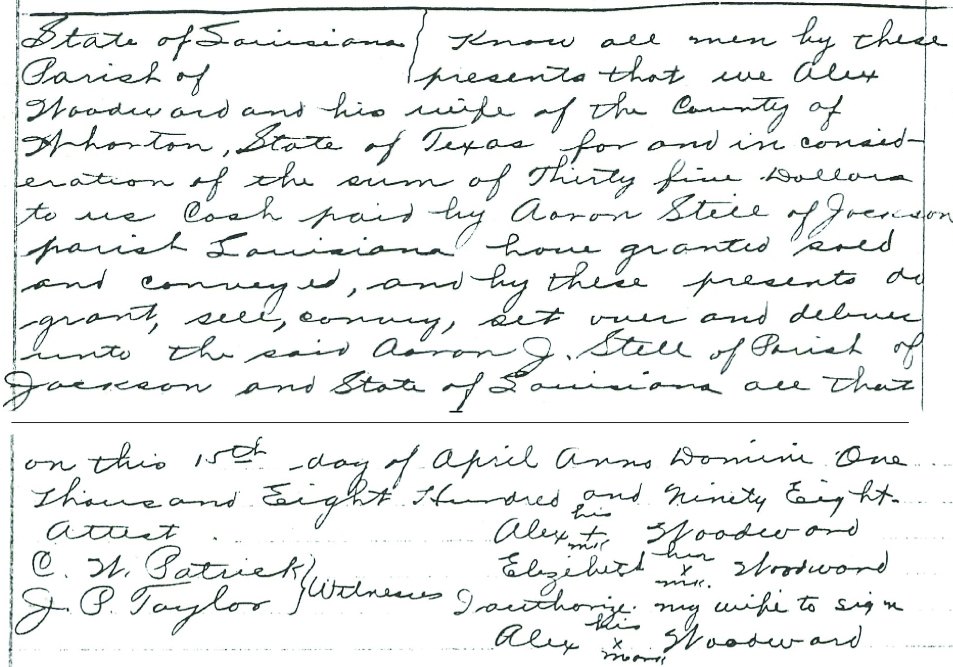
Bond asks Woodard, "Can I show you another record?" (I keep waiting for someone to say no) and pulls out a conveyance record (deed) from 1898.  At this point Alex was about 57 years old and had been in Texas for (presumably) two years.  The deed shows that Alex and his wife sold 80 acres in Jackson Parish for $35 to Aaron J. Stell, also of Jackson Parish.  It takes a few seconds, but then Woodard realizes how little Alex was selling the land for, and she gets very indignant.  She apologizes to Bond but admits she's outraged at the small amount.  Bond explains that land was going up and down in value and then adds that Aaron Stell was Lizzie's brother.  Though Bond seems to be emphasizing the relationship more than the name, Woodard latches onto the name, because now she has a last name for Lizzie (which would seem to be a big deal, considering that the floating family tree shown at the beginning of the episode did not show last names for either her mother or her grandmother).  Alex might have been able to get more money, but this way he kept the land in the family.


Alex and Lizzie both "made their marks" (they were illiterate) at the bottom of the deed.  Woodard is struck at how Lizzie has now become a full human being to her, because she was legally recognized in the document as Alex's partner.  (I'm sorry that her appearance in the census wasn't sufficient.)

Bond has one more item for Woodard:  a map showing the 240 acres that Alex had owned.  It lies off of R. F. Stell Road (but no comment is made about that also being the last name of Aaron and Lizzie).  I wanted to know which were the 80 acres he originally had and then sold to Aaron Stell.

As she drives to Alex's former property, Woodard says she is happy that he kept the land in the family.  Alex had the wherewithal and wits to be a businessman in a system where he was on the buttom rung.  Woodard considers Lizzie to have been his equal.

As Woodard turns onto the property, a clearly visible sign says "Posted No Trespassing Keep Out", but she figures that technically she isn't trespassing because she is the great-great-granddaughter of Elizabeth Stell.  (Besides, the camera crew is with her, so I figure they must have gotten permission from someone to be there.)  This land is grown over, and it's obvious that no one has farmed it in a long time.  She pours a libation here also but does not remove her shoes, which kind of surprised me.

Woodard closes by talking about how her roots are still wide but they've taken hold.  Alex and Lizzie kept on living, doing, and working, with an eye on the horizon and thinking ahead to the next step.  Alex is now a fleshed-out character, and she's proud of his business dealings.  She plans to tell her family the story and to keep on telling it, to make sure it isn't forgotten (hooray!).
Thursday, September 3, 2015

Slaves Listed in the Estate of John Woodard

I know many people watched the episode of Who Do You Think You Are? that followed Alfre Woodard's quest to learn more about her ancestors.  During that program, one of the resources used was documents relating to the estate of John Woodard, said to be one of the owners of Woodard's great-grandfather Alex Woodard.  While the focus of the program was on Woodard's ancestor, additional slaves were named in those documents, and their names deserve to be recovered also.

The scene took place in Perry, Houston County, Georgia at the courthouse.  The first page Woodard looked at was "The Appraisement of the Estate of John Woodward, Deceased", dated April 2, 1851, which listed the following people at the top of the inventory:

Peggy and child, $900
Amanda, $300
Epsey, $200
Milly, $600
Alec, $200
Easter, $500
Benjamin, $400
Luvenia, $800
Polly, $500
Harriett, $200

These individuals appeared to be the only slaves owned by John Woodard.  Alfre Woodard commented on the small number, and the researcher helping her, Dr. Daina Ramey Berry, replied that Mr. Woodard was a typical small slave holder.

From the inventory appraisal Woodard turned to the "Distributing of the Estate of John Woodard, Decd", dated September 1, 1856, of which we saw only small parts on screen.  I was able to piece together the following:

Martha Blount, formerly Woodard, who was hypothesized as John Woodard's daughter, received Milly, then valued at $1,000.

Laura Woodard (probably another daughter of John Woodard) received Harriet, valued at $500 (discussed on screen), and Mandy (in all likelihood Amanda), valued at $500 (not discussed but visible in shots of the distribution papers).

William Woodard (probably John Woodard's son) received not only "Elic", who should be Alec/Alex, valued at $700, but also the following (who were not discussed but who could be seen in shots of the papers):
Peggy and child Laura
Epsey
unseen name
unseen name
unseen name "and child"

This section followed the listing of Elic and read "and the following Negroes appraised as follows (Viz)."  These seven individuals were in a column on the left, and then a column to the right said "Value", but I did not see values listed, only ditto marks.  I was able to extrapolate that three names came after Epsey because of the ditto marks and the fact that I could read "and child" in the last row.

So from the original list of slaves from the 1851 appraisal, Peggy and child (now named as Laura), Epsey, Amanda, Milly, Alec, and Harriet are accounted for in the distribution.  Because the rest of the names were not shown, we do not know which of Easter, Benjamin, Luvenia, and Polly were among the three additional slaves inherited by William Woodard, or which of the three women had a child between 1851 and 1856.  We also do not know what happened to the fourth person.

Later in the program we saw William Woodard in the 1860 slave census, which showed he had a 32-year-old female and an 8-year-old male in addition to Elic/Alec/Alex, so we can hypothesize that the last name from the above list and her unnamed child might be the woman and child on that census listing, but only additional research, such as in tax lists, can determine if that is correct.

Tuesday, July 14, 2015

Newspapers, Newspapers, Newspapers . . . .

It's time for another round-up of the latest additions to the Wikipedia online newspaper archive pageAdvantage Preservation has been on a binge of digitization lately, so more newspapers seem to be coming online every day, which is great for us researchers.  And almost all the new links are free, which is even better.

Belgium:  The Bibliothèque Royale de Belgique (Royal Library of Belgium) has uploaded free digital images of newspapers dating from 1831–1918.  The site is in French, Dutch, and English, and some of the newspapers are in German.  Newspapers from 1919–1950 are indexed and appear in search results, but due to copyright issues, those images are not free.

Canada:  I found a trove of Mennonite links.  There are links to indices for death notices and obituaries in five Mennonite newspapers, and an author/subject index for one of the newspapers (which was published in in the United States for a time and so also shows up in the Multistate list).

China:  The Shanghai Echo, a periodical for Jewish refugees who had fled Europe, is online for 1946 to 1948.

England:  The Foxearth and District Local History Society has posted transcribed selections from newspapers in the East Anglia area.

England:  Spare Rib, a feminist publication, has been digitized and uploaded in its entirety.

England:  A book was published with a detailed index of The (London) Times of 1863, and that book is available online as a downloadable PDF.

Ireland:  Ancestry.com has created a new newspaper site, IrishNewspapers.com.  I wonder if this means it's trying to go back to the pricing model it used to have, where you could pay for different databases separately.

Poland:  There is an index to death notices published in Nasz Przegląd ("Our Review"), a Polish-language Zionist newspaper that was published daily in Warszawa from March 1923 until August 1939.

Russia:  This is another Mennonite resource.  Someone created an index of Mennonite-relevant stories in the German-language Odessaer Zeitung ("Odessa Newspaper").

California:  The Genealogical Society of Santa Cruz County has an index to early local newspapers, available as PDF files.  I don't see that the index tells you which paper an entry is from, but maybe I'm just overlooking it.

Georgia:  The Uncle Remus Regional Library System, which covers six counties (but not the ones I'm researching, of course), has several newspapers available online, courtesy of Advantage Preservation.

Indiana:  The New Albany–Floyd County Public Library has an index to local newspapers for 1847 to the present.

Indiana:  The obituary index for the Plymouth Pilot Daily is downloadable as several PDF files.

Iowa:  Ten newspapers from Dickinson County have been digitized by Advantage Preservation.

Massachusetts:  The first 30 years of the Boston Jewish Times are available courtesy of the American Jewish Historical Society.

Michigan:  More than one million subject index cards from the Detroit News are available on the Seeking Michigan site.

Michigan:  The Milford Public Library not only hosts an obituary index for the Milford Times for 1929–1949, but they will provide you a free copy of the obituary when you find one you want.

Michigan:  This one's a little unusual.  A cemetery has the local newspaper, the Petoskey News Review for 1874–2001, on its site.

Montana:  The student newspaper for Bozeman High School for 1939–2015 is available online, courtesy of Advantage Preservation.

Montana:  Montana State University is in the process of placing digital copies of its student newspaper, the Exponent, online.  Not everything is there yet.

Nebraska:  Advantage Preservation worked with the North Bend Public Library to digitize three local newspapers there.

New Jersey:  Ten early Plainfield newspapers running from 1837–1918 are on the Plainfield Library's Web site.

New Jersey:  The Rockaway Township Free Public Library has the Iron Era and Rockaway Record available online.

New York:  Allegany Public Library and Advantage Preservation teamed up to put four Allegany newspapers online.

New York:  The Troy Irish Genealogy Society has added a marriage notices index to complement its Lansingburgh newspapers death notices index.

North Carolina:  The Duke Chronicle, the student newspaper for Duke University, is online but only for the 1960's and 1980's.

Ohio:  A collection of newspapers printed by the Wright Brothers has been digitized and is available on two sites, Dayton Metro Library and Wright State University.

Tennessee:  An obituary index for the Nashville Tennessean for 1964 to the present is on the Nashville Public Library's site.

Multistate:  The American Historical Society of Germans from Russia hosts an index for about 200,000 obituaries.  There is no indication on the site what years this covers.

Multistate:  MennObits has transcribed obituaries from Mennonite newspapers from 1864 to the present.

I hope you find some great information in at least one of these newspapers!

Tuesday, March 3, 2015

Slave Names Found in My Research

Slave cabins, Bass Place,
Columbus, Muscogee County, Georgia
Last month, for Black History Month, Schalene Dagutis started the Slave Name Roll Project.  She began to go through will and property records she has obtained in her research and posted the names of any slaves listed in the documents.  She also has invited other researchers to send her links to their lists, to bring the information together in a central location.  I just finished transcribing two wills and an inventory from Elbert County, Georgia, and these are the names I recovered.


Will of Christopher Clark, 1803
"I Lend to my Beloved Wife During her Natural Life, . . . Seventeen Negroes with there [sic] future Increase, to Witt"
Jack
Sam
Frank
Bob
Lucy
Sall
Betty
Patty
Caster
Peaphence
Amy
Polly
Edmond
Jack
Rachel
Easter

"I Give and Bequeath unto my Son Micajah Clark his heirs and assigns for Ever one Negro Boy Named Manger"

"I Give and Bequeath unto my Daughter Molly Oliver her heirs and assigns forever one Negro Girl, Named Mary, with her future Increase"

Inventory of estate of Christopher Clark (son of the above Christopher Clark), taken November 12, 1819
Kend
John
African Jack
Peter
Tom
Nelly & Rulin her child
Rody/Rhoda
Philadelphia & Nancy
Malia
Caroline
Fanny Carolines Child
Sellen
Rachel
Lewis
Robert
Hannah
Asbury
Lewis
Midliton/Middleton
Harry
Sukky
Peggy
Young Fanny
Sopa
Polly
Charlotte
Martha
Mary
Luke
Jake
Sally
Phoebe
Matilda

Saturday, August 16, 2014

Another Round of Newspaper Links

I have the 1976 disco song "More, More, More" going through my head, because that's what is happening with newspaper archives:  More and more of them are being posted online, which is a great thing for genealogy researchers.  And we still always want more!  While I haven't been able to catch up to adding all of the links to the Wikipedia newspaper archive page, this is a list of the current additions, several of which are university student newspapers.  There is one new country represented:  Vietnam.  Oh, and all of the new links are free!

• Hungary:  An archive of newspapers from South Hungary covering 1910–1945 is now available.
• California:  The Contra Costa County Historical Society has an online index of obituaries from about 1855–1920, mostly from the Contra Costa Gazette.  The society also offers to mail you a copy of an obituary you find in the index.
• California:  Stanford University's Stanford Daily is available from 1892–2009.
• California:  The University of California at San Francisco's student newspaper, Synapse, is online from 1957–2013.
• Georgia:  Three historic Savannah newspapers — Savannah Georgian (1819–1856), Savannah Morning News (1868–1880), and Savannah Republican (1809–1868) — have been added to the Digital Library of Georgia database.
• Georgia:  The Southern School News (1954–1965), which reported on desegregation issues across the South, has also been added to the Digital Library of Georgia.
• Hawaii:  Another extensive collection of Hawaiian-language newspapers is online.
• Illinois:  The Bloomington (DuPage County) Public Library has an online obituary index that includes downloadable PDF's of many of the obituaries.
• Illinois:  The North Suburban Library, near Chicago, also has an online obituary index (index only, though) that covers roughly 1880's–1980's.
• Iowa:  The Iowa Old Press site, part of Iowa GenWeb, has transcribed articles from 19th- and 20th-century newspapers throughout the state.
• Iowa:  The cities of Mount Vernon and Lisbon (Linn County) have a searchable and browsable historical newspaper archive on the Cole Library Web site.
• Massachusetts:  The Boston College newspaper collection includes the BC student newspaper; the student newspaper published by Newton College of the Sacred Heart, a women's college; a Boston-area Catholic newspaper; and two additional Catholic-church-related publications.
• Missouri:  The St. Louis Globe-Democrat has an online name (for A–R) and subject index to their morgue of clippings.  The page lists the years covered as about 1930–1986, but a search for "smith" gave results from at least 1920–1998.  This is an ongoing project, with more entries being added to the database.
• New Jersey:  The New Brunswick Free Public Library has two newspapers available free, New Brunswick Daily Times and Daily Home News, that are also available on a paid site.
• New Jersey:  The Papers of Princeton collection includes the Daily Princetonian, Local Express, Princeton University Weekly Bulletin, and Town Topics, covering 1876–2013.
• New York:  The Columbia Spectator student newspaper from Columbia University is online from 1877–2012.
• New York:  Cornell University's student newspaper, The Cornell Daily Sun, can be read from 1880–1981.
• New York:  The Vassar College student newspaper collection includes seven publications and covers 1872–2013.
• Ohio:  Kent State University's student newspapers from 1939–1969 can be read online.
• Ohio:  Wright State University's student newspaper, The Guardian, is available online for the years 1965–1982 and 2012–2013, with more to come.
• Virginia:  The Library of Virginia has an extensive collection of newspapers, ranging from 1809–1999 and including more than 65 titles.
• Virginia:  The Collegian, the student newspaper of the University of Richmond, is online from 1914–2013.
• Multistate:  Japanese internment camp newspapers from World War II are available on Densho.
• United States:  The American Legion has an online archive of several of its publications, including American Legion Weekly, American Legion Monthly, American Legion Magazine, and The American Legion.  The latter is available for 2003–2011, while the first three are said to cover 1919–1949.
• Vietnam:  The National Library of Vietnam has a collection of digitized newspapers covering 1890–1955.  The site is in Vietnamese.

Some big news:  Two new states, Nevada and South Dakota, have been awarded federal grants to digitize their historic newspapers, which will then be added to the Library of Congress Chronicling America newspaper database.  Some South Dakota newspapers are already available on Chronicling America, and I look forward to seeing Nevada newspapers in the future.  Only thirteen states are not yet partners in the program.

Don't forget, if you find an online newspaper collection that isn't on the Wikipedia page, please add it, so it's easy for everyone to find!