Showing posts with label transcription. Show all posts

Wednesday, April 18, 2018

National Volunteer Week: What Can You Do?

I often post about opportunities to volunteer and help with various genealogical and historical projects.  It's a way of giving back, plus it makes more information available to everyone.  I haven't run across that many projects since my most recent post, but seeing that it's National Volunteer Week right now (running April 15-21 this year), it seemed like a good time to publicize what I have.

In the late 1930's, Kitchener Camp, near Sandwich, Kent, England, was used to house male Jewish refugees from Nazi Germany.  A Web site has been created to collect documents, letters, photographs, and histories of the camp and share them in an online exhibition.  Materials from November 1938 through 1942 are being sought.  The creators of the site plan to donate the collected materials in 2019, the 80th anniversary of the camp's establishment, to an appropriate institution for permanent preservation.  A form is available if you have anything you can contribute to this memorial.  If you can identify anyone in the photos that are already posted on the site, that information is also welcome.

-- >< -- >< -- >< -- >< --

Elizabeth
Bryant
This one will be relevant primarily for people in Australia.  The Australian National Film and Sound Archive (NFSA) has asked for help in identifying hundreds of photographs of acting hopefuls who were looking for a break in the 1930's.  Most of the photos, which were submitted to a casting call, are of young women.  The photos themselves all appear to be online on this site, which is arranged as an exhibition, and images of some of the original casting books can be found here.  Contact information for NFSA is on this page.

-- >< -- >< -- >< -- >< --

The Boston Public Library has a project to transcribe its significant Anti-Slavery Manuscript collection.  Many, many volunteers are needed to help with the approximately 40,000 items.  The goal is to have everything transcribed iinto searchable text to assist researchers of all types.  The transcription site was created and is hosted by Zooniverse, a common platform for this type of work.  More information on the project and how to sign up is available here.


-- >< -- >< -- >< -- >< --

Chicago's Newberry Library has several crowdsourced transcription projects on its own site that need volunteers.  Current projects shown are "Family Life in the Midwest", "U.S. Western Expansion", and "American Indian History."  Earlier this year a collection of Continental Army clothing receipts during the American Revolution was being worked on, but perhaps it has been completed, as it does not currently appear on the site.

-- >< -- >< -- >< -- >< --

Unfortunately, this one isn't about volunteering as much as it is about providing information.  A funeral home in Montrose, Colorado was shut down in February 2018, and the FBI is requesting that people report their experiences with it.  An article goes into some detail about the investigation, and a link to an online questionnaire is provided.

Saturday, August 26, 2017

Brother, Can You Spare an Hour (or Two)?

It's time for another round-up of projects that are looking for volunteer help, whether in the form of transcriptions, information, or time.  If you have an hour or two a week to spare or some specialized knowledge, maybe you're just the person for one of these requests.

Flooding in Montreal’s Bonaventure Depot in
1886.  Photo: George Charles Arless. Source:
McCord Museum, Montreal, Quebec, MP-1999.6.1
As is becoming more and more common, several of the projects are asking volunteers to transcribe digitized information.  McGill University in Montreal, Québec is hoping people will be interested in working on 150 years of meterological observations from the McGill Observatory.  The focus of the Data Rescue:  Archives and Weather (DRAW) project is studying the historical weather data to identify patterns and trends, but an article notes, “The Observatory ledgers are also full of interesting little notes about the daily lives of our ancestors."  So if you had relatives living in Montreal, you can learn more about what their weather was like and how it affected them.  The project site is still in a beta testing stage, but interested participants can sign up now and practice using the transcription tools.

-- >< -- >< -- >< -- >< --

Yale University's recent foray into crowd-sourced transcription work is all about the drama — Yale's School of Drama, that is, along with the Yale Repertory Theatre Ephemera Collection.  The aim of the Ensemble @ Yale project is to create a database of Yale theatrical history.  Volunteers can browse digitized programs spanning more than 90 years and transcribe play titles, production dates, and names of directors, cast, and crew.  Once the first two collections have been transcribed and put into a searchable database, more Yale theater-related collections will be considered as additions.  If you had a family member at Yale or are into theater history, this may be the project for you.

-- >< -- >< -- >< -- >< --

Ukrainian family from Tyshkivtsi,
Galicia, Austro-Hungarian Empire, 1890
A transcription project more directly related to family history research is the one connected to the recently launched database of genealogical records for Ukrainians born between 1650 and 1920.  The database is said to include information on more than two and a half million people, with plans to increase the total to between four and five million people by 2019.  Documents used as data sources originated with the Tsardom of Muscovy, Russian and Habsburg empires, Poland, and the Soviet Union.  The index is currently searchable only in Cyrillic, but a Roman alphabet search is planned for the future.  (Remember, Google Translate understands Ukrainian and is your friend.)

If you register on the project site you can create a family tree.  The transcription site provides instructions on how to do the transcription work, and lists locations and whether documents have been finished or are waiting to be worked on.  Something I didn't find on the site is a list of what documents are being used, which would be useful for determining whether Jewish individuals might be included in the database.

-- >< -- >< -- >< -- >< --

There are enough volunteer transcription projects now that someone has created a page to aggregate them.  It's on an education-oriented blog, and the focus is on students working with historical texts, but it's a nice collection of links conveniently grouped together.

-- >< -- >< -- >< -- >< --

1903 Vacaville Reporter front page
A local request for assistance comes from the Vacaville (Calfornia) Heritage Council, which is looking for volunteers to take on projects such as scanning photo negatives, researching local history, organizing donated historical material, and various computer tasks.  Some of the historical items that scream to be cared for are the Vacaville Reporter's newspaper collection from 1930–2006, microfilm of newspapers going back to 1883, and photo negatives.  Interested individuals can contact council president Doug Rodgers at the e-mail address given in the article.

-- >< -- >< -- >< -- >< --

Three more local requests, these from museums in eastern Contra Costa County, California, were featured in a recent newspaper article.  The Antioch Historical Museum, East County Historical Museum, and Pittsburg Historical Museum and Society have each received healthy donations of newspapers, microfilm, and other historical items that now need to be sorted and prepared for access.  Contact information for each of the groups is in the article, if you have the time to help.

-- >< -- >< -- >< -- >< --

Dr. Kimberly Jensen, a professor at Western Oregon University, is trying to find more information about The People's Bulletin, a black community newspaper published in Portland, Oregon.  The only known surviving issue, from June 7, 1917, is Volume 1, Number 34, and is held at the University of California at Santa Barbara's Special Research Collections, as part of its “Portland [Oregon] African-American Collection, circa 1900–1970.”  So far all documentation for the newspaper indicates only the year 1917, although June 7 was in the 23rd week of 1917, so the first issues should have come out in 1916.  It's obviously a very rare paper; it isn't even listed in the Chronicling America directory.  Anyone who can provide information about The People's Bulletin is asked to contact Dr. Jensen at the e-mail address given in the article linked above.

-- >< -- >< -- >< -- >< --

There are always lots of Irish projects going on.  A releatively new one is Epic Journeys - Ellis Island, which aims to document the Irish experience going through Ellis Island.  The project began in 2015 with a focus on the parish of Tulla, County Clare but has now expanded to other departure points in Ireland, including locations in the counties of Cavan, Cork, Galway, and Tipperary.  The Web site is currently going through an upgrade, so contributions cannot be made through it directly, but they can be sent via an e-mail address on the site.

-- >< -- >< -- >< -- >< --

The Edmonds Historical Museum (in Snohomish County, Washington State) is asking its area residents, whether military veterans, current service members, or civilians, to come forward and share their wartime memories, from World War II through to the recent War on Terror.  All interviews will be shared with repositories for permanent preservation, and participants will each be given a copy of the oral history interview to keep and to share with family members if desired.  After November 2017, the interview project will expand to general memories of Edmonds and south Snohomish County.  Details and contact information are in an online article about the project.

-- >< -- >< -- >< -- >< --

This one isn't directly genealogy-related, but identifying the person should help one family.  Authorities from Orange County, California have put out a public request for help with their oldest cold case, who is a Jane Doe.  "Jane" was found dead on March 14, 1968 in Hungtington Beach, California.  She was estimated to be 20–30 years old, 5'2"–5'3", and about 130–140 pounds.  More information about her case, including the clothing and items found with her, is on the Defrosting Cold Cases blog.

-- >< -- >< -- >< -- >< --

Detail from The Book of Magical Charms
The last project I'll mention today has nothing to do with genealogy, but it just sounds really cool, so I want to share it.  How would you like to transcribe magical manuscripts?  The Newberry Library in Chicago is giving you that opportunity.  The Book of Magical Charms describes how to care for toothaches, cheat at dice, complete a conjuring, and speak with spirits.  How can you possibly pass that up?  Atlas Obscura has an interesting article about the project, and you can visit the transcription project site to get started.

Wednesday, June 1, 2016

Susan Carhart Tallman's Narrative from 1864


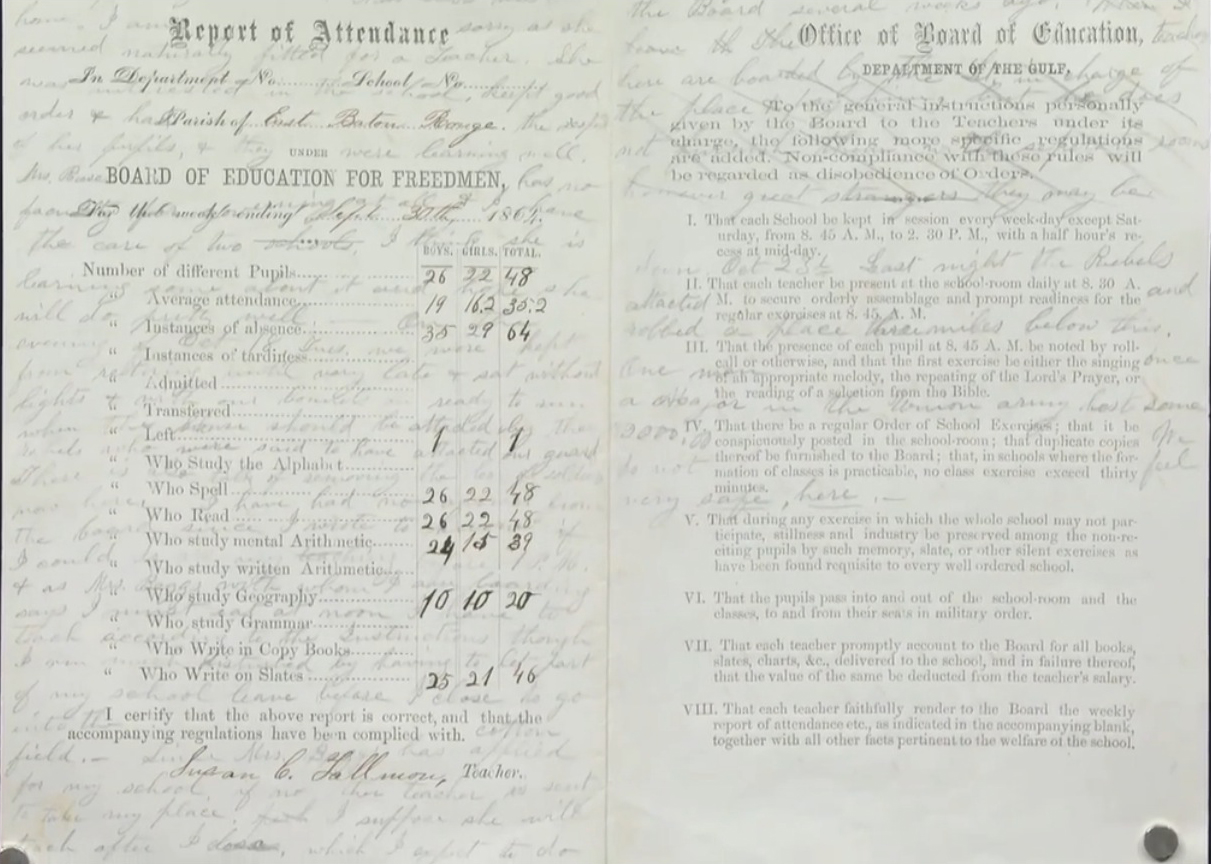
When I posted the drawings of the twelve students from the 1864 school for freedmen in Baton Rouge , I said I was working on transcribing the narrative that the teacher, Susan Carhart Tallman, wrote over a school form.  I had several deadlines pop up over the weekend, but I made time to finish the transcription tonight.  I was able to read most of the handwriting, but four words have continued to elude me, and I'm unsure of a few others.  If anyone can figure out what the missing words are, or if you think I've made a mistake somewhere, please post and let me know.  I will be happy to update the transcription as necessary.

I think I captured all the close-ups shown in the segment.  Normally I make graphics smaller for my blog, so posts will load more quickly, but I've left these images as large as possible, to help facilitate legibility.


Here's my transcription.  I did both Tallman's narrative and the form itself.  I figured I might as well do it all while I was working on it.

-- >< -- >< -- >< -- >< --


Susan (Carhart) Tallman’s handwritten note over the school form:

Left page:

[At?] my place

Oct 21, during this week Miss(?) Davis(?) was called home.  I was sorry as she seemed naturally fitted for a teacher.  She was interested in the school, kept good order + had the respect of her pupils, + they were learning well.  Mrs. Reese(?) has no faculty for [illegible] at all + I have the care of two schools.  I think she is learning some about it and hope she will do pretty well.  ——  On the evening of Oct 18, Tues. we were kept from returning until very late + sat without lights + with our bonnets on ready to run when the school should be attacted [sic] by the rebels who were said to have attacted [sic] our guard   There is also talk of removing the last(?) of soldiers now here.  I have had no answer from the board since I wrote to [illegible] if I could do any teaching before 1 P.M. + as Mrs. Boggs with whom I am boarding says I must eat at noon I have to teach according to the instructions though I am much disturbed by having to let part of my school leave before I close to go into the cotton field.  ——  Since Mrs. Boggs has applied for my school, if no other(?) teacher is sent, [illegible] I suffer she will teach after I close(?), which I expect to do


Right page:

on the first of November, as I wrote to the Board several weeks ago.  When I leave, the teachers here are boarded(?) by the Lt. in charge of the place + [illegible] him, but he does not furnish them with separate room however great strangers they may be.  [In the narrative, Tallman had crossed out with Xes this section I have marked with strikethrough.]

Sun. Oct 23d Last night the Rebels attacted [sic] and robbed a place three miles below this.  One man once a Major in the Union army lost some 2000.00  We do not feel very safe, here. —

===


School attendance form:

Report of Attendance
In Department No ……..… School No …………
Parish of East Baton Rouge.

UNDER
BOARD OF EDUCATION FOR FREEDMEN,
For the week ending Sept. 30th, 1864.

                                                     BOYS.            GIRLS.            TOTAL.
Number of different Pupils                26                22                    48
“ Average attendance                        19                16.2                  35.2
“ Instances of absence                       35                29                     64
“ Instances of tardiness
“ Admitted
“ Transferred
“ Left                                                   1                  1
“ Who Study the Alphabet
“ Who Spell                                       26               22                    48
“ Who Read                                       26               22                    48
“ Who study mental Arithmetic        24                15                   39
“ Who study written Arithmetic
“ Who study Geography                   10                 10                   20
“ Who study Grammar
“ Who Write in Copy Books
“ Who Write on Slats                        25                21                    46

I certify that the above report is correct, and that the accompanying regulations have been complied with.
Susan G. Tallman, Teacher

===


Board of Education rules:

Office of Board of Education
DEPARTMENT OF THE GULF.

To the general instructions personally given by the Board to the Teachers under its charge, the following more specific regulations are added.  Non-compliance with these rules will be regarded as disobedience of Orders.

I.  That each School be kept in session every week-day except Saturday and Sunday, from 8. 45 A. M., to 2. 30 P. M., with a half hour’s recess at mid-day.

II.  That each teacher be present at the school-room daily at 8. 30 A. M. to secure orderly assemblage and prompt readiness for the regular exercises at 8. 45 A.M.

III.  That the presence of each pupil at 8. 45 A.M. be noted by roll-call or otherwise, and that the first exercise be either the singing of an appropriate melody, the repeating of the Lord’s Prayer, or the reading of a selection from the Bible.

IV.  That there be a regular Order of School Exercises; that it be conspicuously posted in the school-room; that duplicate copies thereof be furnished to the Board; that, in schools where the formation of classes is practicable, no class exercise exceed thirty minutes.

V.  That during any exercise in which the whole school may not participate, stillness and industry be preserved among the non-reciting pupils by such memory, slate, or other silent exercises as have been found requisite to every well ordered school.

VI.  That the pupils pass into and out of the school-room and the classes, to and from their seats in military order.

VII.  That each teacher promptly account to the Board for all books, slates, charts, &c., delivered to the school, and in failure thereof, that the value of the same be deducted from the teacher’s salary.

VIII.  That each teacher faithfully render to the Board the weekly report of attendance etc., as indicated in the accompanying blank, together with all other facts pertinent to the welfare of the school.
 
-- >< -- >< -- >< -- >< --

Something I hadn't picked up on while watching this, but that became clear to me while transcribing the document, was that even this early the school was under the auspices of the military.  The Board of Education was part of the Department of the Gulf, the students were to go everywhere in military order, and the person in charge of "the place" (the school, I believe) was a lieutenant.

One thing I'm wondering about is how Mrs. Tallman could have a partial student.  The average attendance for girls was 16.2.  I suppose it would make more sense if I knew what the average was computed from — daily attendance over the week, perhaps?

Tuesday, December 29, 2015

The Giving Spirit of the Season: Irish Immigrants, Apollo Missions, Shakespeare's Lifetime, and More

As we are nearing the end of the year and the "season of giving", I thought it would be a good time to post information about several projects that are looking for volunteers with time or information.  Not all of them are directly related to genealogy, but I figure that anything involving people could have information about someone's family member.

Harbor of Hope, a project I have written about before, is a documentary based on archival film footage of Holocaust survivors arriving in Malmö, Sweden, primarily on April 28, 1945.  In the ongoing search for information from and about survivors who arrived in Malmö in Spring 1945, lists of passengers arriving on April 28 have been published on the documentary's Web site.

-- >< -- >< -- >< -- >< --

Martin Sugarman, the archivist of the Jewish Military Museum in the United Kingdom (founded and launched by the Association of Jewish Ex-Servicemen and Women), is researching Israeli, UK, and Commonwealth Jews who served in the Merchant Navy (not the Royal Navy) in World War II.  If you have any photographs or any stories about the experiences of such men or know families who do, Martin will be honored to receive them by e-mail.  His address is martin.sugarman@yahoo.co.uk.

-- >< -- >< -- >< -- >< --

The United States Holocaust Memorial Museum has launched a project called "History Unfolded:  U.S. Newspapers and the Holocaust."  Volunteers around the country are being sought to research how their hometown newspapers reported on Holocaust-related events during the 1930's and 1940's.  Data about relevant articles will be submitted online to a centralized database, which will permit analysis of trends in U.S. news reporting during the Holocaust.  The project has begun with ten events, and more events will be added during 2016.

-- >< -- >< -- >< -- >< --

The Emigrant Savings Bank was founded in 1850 by the Irish Emigrant Society in New York City to help Irish immigrants trying to establish themselves in their new country.  In a project called Emigrant City, the New York Public Library has digitized mortgage and bond records which were previously available only on microfilm and is now looking for volunteers to help transcribe the information on these records in order to create a searchable online database.

-- >< -- >< -- >< -- >< --

The Encyclopedia of Greater Philadelphia, which a year and a half ago put out a call for authors for a series of articles, has reached a milestone of 250 published topics and is now looking for authors for its new expansion.  The scope of the project includes the city of Philadelphia and the surrounding region of southeastern Pennsylvania, southern New Jersey, and northern Delaware.

As before, prospective authors must have expertise in their chosen subjects, as demonstrated by previous publicitions and/or advanced training in historical research.  Authors can choose to volunteer or receive modest stipends.  All submissions will be peer-reviewed.  The list of topics is available as a link from the new call for authors.

-- >< -- >< -- >< -- >< --

If you had any whaling men in your family, this should be of interest.  The U.S. National Oceanic and Atmospheric Administration (NOAA) is leading a project called Old Weather:  Whaling, where you read through whaling ship logs to look for information about weather and climate.  (And of course you'll also be able to read names as you go along.)  The ship logs available, 300 so far, have been digitized and transcribed by the New Bedford Whaling Museum.  The Guardian has an informative article about the project.

-- >< -- >< -- >< -- >< --

Shakespeare's World is a collaboration between the Folger Shakespeare Library in Washington, D.C. (home of the world's largest collection of materials relating to William Shakespeare and his works), Zooniverse.org at Oxford University, and the Oxford English Dictionary (OED).  Their mission is to transcribe manuscripts created by Shakespeare’s contemporaries in the 16th and 17th centuries to learn more about that period in history.  The first phase includes letters and recipe books; documents later will encompass family papers, legal and literary documents, and more.  "New" words that are documented may be included in updates to the OED.  The instructions on how to contribute emphasize that you can work at your pace and that all contributions are welcome.

-- >< -- >< -- >< -- >< --

The U.S. National Air and Space Museum, part of the Smithsonian Institution, has recently publicized two crowdsourcing projects.  One is to transcribe Apollo spacecraft stowage lists in order to create a searchable database.  Not only will this information be interesting to the public, it will help in efforts to authenticate whether artifacts truly were associated with the space program.

And along with space artifacts, the Smithsonian wants to crowdsource some rock and rollSmithsonian Books and Smithsonian Media launched Smithsonian Rock & Roll on December 1. They are asking the public to look through their "attics, basements, boxes, drawers, digital cameras, photo albums, cell phones, cloud, photo-upload sites, and computer hard drives for pictures that show the greatest moments in the history of rock ’n’ roll."

Thursday, July 16, 2015

FamilySearch, Otto Frank, the British Library, and the Sartorial Splendor of Viennese Jewish Men

Did you participate in FamilySearch's 2014 Worldwide Indexing Project?  That was an organized effort to have as many people transcribe (because the volunteers aren't actually doing any "indexing") at least one batch of records from FamilySearch over a two-day period.  This year the effort is being called the Worldwide Indexing Event, it has been extended to one week (August 7–14), and the goal is to have 100,000 volunteers submit at least one batch each.

Remember, all of the free searchable databases on FamilySearch.org are there because volunteers donated their time and transcribed digitized microfilm.  This year there is a particular emphasis on transcribing records in languages other than English.

We're talking about having a group of staff members come in to the Oakland FamilySearch Library for another brunch and indexing party, as we did last year.  Why not get your friends together and do the same?  I hope we have chocolate again!

-- >< -- >< -- >< -- >< --

Anne Frank
The Sydney Jewish Museum and the Netherlands' Anne Frank House are searching for letters from Otto Frank, father of Anne Frank.  The father of the famous diarist received a large amount of correspondence in the years following the English publication of The Diary of Anne Frank.  Most were written by girls the same age as Anne or older.  While the Anne Frank House has retained all the letters sent to Otto, his replies were not copied or archived.

If you or someone you know wrote to Otto Frank and still has his letter written in response, please contact Anne Slade in Australia at 0418 670 352 or by e-mail.

-- >< -- >< -- >< -- >< --

Dr. Wilhelm Solf was the first governor of German Samoa and later was the German ambassador to Japan under the Weimar Republic.  After his death in 1936, his widow, Johanna Solf, presided over the Solf-Kreis, a circle of anti-Nazi intellectuals, in her salon in Berlin.  Solf and her daughter, the Countess So'oa'emalelagi "Lagi" von Ballestrem-Solf, hid many Jews and provided them with documents to emigrate to safety.

Most members of the circle were arrested and executed after attending a tea party in Berlin on 10 September 1943.  The guests had been betrayed by a Gestapo spy.  The Solfs were interned in Ravensbrück and narrowly avoided death because of delays in their trial and the subsequent approach of the Red Army, which led to their liberation.

Now, New Zealand author Michael Field is seeking survivors or descendants of survivors who escaped the Holocaust through the Solf Circle.  Michael wants to tell the story to a wider English-speaking audience and is seeking more information.  Anyone with information should e-mail him.

-- >< -- >< -- >< -- >< --

Weinberg and Applebaum families in Macclesfield
The short-lived Macclesfield Hebrew Congregation flourished from 1941–1946 in Cheshire, England, following the arrival of evacuees, refugees, and firms which moved up from the London area. The firms included Belmont Textiles (the Belmont/Lazarus families), Osband Knitwear, Offenbach, BJ Friend, H&I Franklin, V&E Friedland, A. Goldstein, and possibly Halle.  The congregation was the most northerly outpost of the United Synagogue and had its own rabbi as well as its own branch of the Women's International Zionist Organization.

Basil Jeuda of Macclesfield is currently researching the congregation.  He hopes to mount an exhibition in 2016 for the 70th anniversary of its end, to celebrate Jewish life in the area during World War II. If you have any information, photos, memories, or other memorabilia, please contact Basil via e-mail or write to him:
Basil Jeuda
Sandringham Road,
Macclesfield SK10 1QB
United Kingdom

-- >< -- >< -- >< -- >< --

Jonathan Kaplan, a first-year Ph.D. student at the University of Technology in Sydney, New South Wales, Australia is focusing his research on the social, sartorial, and aesthetic roles of Jewish men in Vienna (and other towns in cities in the former Austro-Hungarian Empire) during the late 19th and early 20th centuries (roughly 1890–1930).

He is trying to create a digital database of photographs and ephemera from this era for his research.  If you have family photographs, advertising materials, or other relevant items that you are willing to share with Jonathan, please contact him.

-- >< -- >< -- >< -- >< --

Would you like better access to knowing about the holdings of the British Library?  The library has launched LibCrowds, a platform for crowdsourcing library projects.  The first project, Convert-a-Card, is dedicated to the retro conversion of printed card catalogs into electronic records in order to make them available to a worldwide audience via the ExploreBL catalog, which already includes nearly 57 million records.  The initial focus of Convert-a-Card is the Asian and African collections.  (But I still like hard-copy card catalogs . . . .)

Tuesday, June 30, 2015

Freedmen's Bureau Records Events at Oakland FamilySearch Library

On June 19, 2015, the 150th anniversary of Juneteenth (when the Emancipation Proclamation was finally enforced in Texas), a major media event took place in Los Angeles to announce that all records of the Bureau of Refugees, Freedmen, and Abandoned Lands (commonly called the Freedmen's Bureau) have been digitized and placed online at FamilySearch.org.  The event also was used as a platform to encourage participation in FamilySearch's indexing (transcription) of the records to create a searchable database, which will make the records far more accessible than they have been in the past.  The digitization project was a joint effort of FamilySearch, the Smithsonian National Museum of African American History and Culture, the Afro-American Historical & Genealogical Society, and the California African American Museum.

The records are extremely important in black family history research because they are the contemporary primary source that indicates the last slave owner of a formerly enslaved individual.  In many of the records created by the Freedmen's Bureau, one of the questions asked was "What was the name of your last owner?"  That owner's name is critical to finding more information about the individual prior to Emancipation.

The difficulties with using the Freedmen's Bureau records to date have been numerous.  Very, very few of the records had indices.  Though the complete collection is available on microfilm at every branch of the National Archives, the quality of many of the records was poor when they were microfilmed, and searching on microfilm was tedious and headache-inducing.  And that was after you figured out in which part of the collection you should start your search, an adventure in and of itself.  Some of the records had been digitized previously — some were on Ancestry.com, FamilySearch.org, and the Internet Archive — but no one site had all of them, and not all of them were searchable.

I'm on staff at the Oakland FamilySearch Library.  The people putting together the June 19 event actually wanted our library to be part of that event, but our director thought we needed a little more lead time to make sure we would be prepared.  Well, we've gotten organized, and now we're going to have a media event.

On Thursday, July 16, 10:00 a.m.–12:00 noon, the Oakland FamilySearch Library, 4766 Lincoln Avenue, Oakland, California, will host the Northern California event to celebrate the completion of the digitization of the Freedmen's Bureau records on FamilySearch.org.  All members of the genealogical community are welcome to attend the event.

In addition to the celebration event, the Oakland FamilySearch Library (OFSL) has scheduled five sessions to explain how to transcribe the digitized records to create searchable databases and to sign up volunteers to help with the transcription project.  This is the same class being offered five times; you only need to attend one.  Genealogists in particular are being encouraged to join in transcribing the records, though everyone can help.  You will have choices about the records you work on, and maybe you will discover your own ancestors in the process!  You will also be helping make it easier for other researchers to find their lost family members.

The scheduled sessions are:
Thursday, July 16, 11:30 a.m.–12:30 p.m. (same day as the celebration event)
Friday, July 17, 2:30–3:30 p.m.
Saturday, July 18, 10:00–11:00 a.m.
Wednesday, July 22, 7:00–8:00 p.m.
Tuesday, July 28, 7:00–8:00 p.m.

All sessions will be taught by Kim Miller, OFSL staff member.

Please help make these records searchable for everyone.  I cannot overstate the importance of the records for helping identify enslaved ancestors' former owners, a key piece of information needed to be able to trace those ancestors prior to Emancipation.  Tony Burroughs, the well known black genealogist and author of Black Roots, mentioned in a recent keynote presentation that in all the research he has done, only about 15% of emancipated slaves took their former owners' last names.  That means that 85% of us need the information that can be found in Freedmen's Bureau records.

You don't have to wait for the library event to help; you can actually start transcribing records today if you want to.  Information about the indexing project and how to contribute is available at

http://www.discoverfreedmen.org/

The purpose of the July 16 event is to help publicize the importance of the records and the effort to transcribe the records and create the index.  The transcription work itself is an ongoing effort.

If you want to watch a recording of the June 19 event, it is available on the Freedmen's Bureau Project Web site.

In addition to all the regular media coverage of the digitization and transcription projects, Judy Russell, the Legal Genealogist, explained how the records are important to everyone doing Southern research, not just those with formerly enslaved ancestors.  And Danica Southwick wrote a great article about the project for the Jackson Sun prior to the media launch.

Sunday, May 3, 2015

"Who Do You Think You Are?" - Bill Paxton

Slowly but surely working my way through the last two episodes of this season of Who Do You Think You Are?  Only one more after this!  It's rewatching to catch details that gets me every time.

The opening voice-over for the Bill Paxton episode says that he would uncover a war hero — we hear Paxton saying the word "spy" — bloody battles, and the shocking truth about an ancestor.  We then hear that he is a celebrated actor and director with an outstanding career spanning four decades, and that he has starred in some of the most celebrated films of all time.  The only films they mention, however, are Apollo 13 and Titanic.  (I haven't seen Apollo 13, but I have seen Titanic, and let's face it, it was not well known for the quality of its acting or script.)  He also appeared in HBO's Big Love and a mini series, The Hatfields and the McCoys, for which he earned an Emmy nomination.  I was surprised they didn't mention The Terminator, Aliens, or Predator 2, probably much better known movies, but the film I always think of first for Paxton is the vampire cult classic Near Dark, a favorite of a former housemate of mine.

Paxon and his wife, Louise, live in Southern California with their children, James and Lydia.  We see Lydia in passing for a very short scene, and that's it for family member appearances.

Paxton says he was born in Fort Worth, Texas, and that his parents are Mary Lou Gray and John Paxton (who was in three movies with his son).  Paxton had a close relationship with his father, who died three years before the episode was filmed.  They shared many of the same interests:  theater, books, movies, and history.  Paxton credits his success to his father.

Because he was so close to his father, Paxton already knows quite a bit about that side of the family.  He had a great-great-grandfather who was a Confederate general and a great-grandfather who was an attorney in Independence, Missouri.  He's hoping to learn more about that side and maybe to gather strength from what he finds.  He also hopes he discovers some "savory bits" (ah, don't we all).

For the third time in seven episodes, the celebrity begins by meeting a researcher at the downtown (main) branch of the Los Angeles Public Library.  (Maybe the show sent out a casting call in the L.A. area?)  Paxton connects with Ancestry.com employee Kyle Betit, who earlier this season worked with Josh Groban.  Paxton has told Betit he wants to learn more about the roles his family played in history.

Betit has done some initial research and hands Paxton one of the famous "here's your family, already done" tree rolls.  He insists that Paxton be the one to unroll it, though.  He also says that he found the tree to be pretty impressive, but he's an Ancestry employee, so it's hard to tell if that's his real opinion.  The tree goes back to at least one 5th-great-grandfather, but he's on the Paxton line, and we have no way of knowing how much of the information in the tree was already known to Paxton from his family's prior research.

Paxton starts reading the names in the Paxton line, starting with himself.  His father, John, was born July 14, 1920 in Missouri and died November 17, 2011 in California.  Paxton comments that "he passed, it'll be three years next month", so we know this was shot in October 2014.  Next is grandfather Frank Paxton, born June 10, 1887 in Missouri, died May 16, 1951 in Missouri.  Great-grandfather John Gallatin Paxton was born September 17, 1859 in Virginia and died September 24, 1928 in Missouri.  He was the attorney in Independence.  Second-great-grandfather Elisha Franklin Paxton, the Confederate general, was born 1828 in Virginia and died March 4, 1863 in Virginia (at the Battle of Chancellorsville).  Third-great-grandfather Elisha Paxton was born about 1784 in Virginia and died November 24, 1867 in Virginia.  Fourth-great-grandfather William Paxton was born about 1733 and died in 1795 in Virginia.  The last name is John Paxton, Bill Paxton's fifth-great-grandfather, who was born about 1692 and died about 1746 in Pennsylvania.  No women's names are shown as we travel up the Paxton line.

After revisiting the names of his ancestors, Paxton says that he knows he has a family connection to the Civil War but wants to find someone in the American Revolution.  Three of his fourth-great-grandfathers were alive and of appropriate ages during 1775–1783, the years of the war:  William Paxton; Frank Wyatt, born 1757, died 1824 in Kentucky; and Benjamin Sharp (who married Hannah Fulkerson, born 1769, died unknown), born 1762 in Pennsylvania, died unknown.  The question is, did any of them serve?  When they show these names on the family tree floating in the sky, we finally see more women's names.  John Gallatin Paxton married Mary Neil Gentry, whose mother was Mary Neil Wyatt.  Her father was John Wyatt; his father was Francis Wyatt (as opposed to Frank, as he is shown in the family tree scroll).  John Wyatt was married to Attossa Pinkney Sharp, whose father was Benjamin Sharp.

In one of those rare occurrences on WDYTYA, the first computer site we visit is not Ancestry.com.  Betit suggests Paxton use the Ancestor Search on the Daughters of the American Revolution site.  Paxton appears to be familiar with the name of the organization and knows it is in Washington, D.C.  He uses his spiffy iPad to look first for William Paxton and then Frank Wyatt, both of whom give results of "No ancestor records found."  (This doesn't necessarily mean those men didn't serve in the Revolutionary War.  It could simply mean that no one has applied for membership in DAR and proven service by either man.  In fact, the Wikipedia page for Elisha Franklin Paxton says that William Paxton was an American Revolutionary War veteran but gives no further information.)  When he enters Benjamin Sharp's name, however, he is successful and says service Virginia, rank private, and spy — and then we cut away to a commercial.  When we return, the narrator says Paxton has "just discovered a record" about an ancestor, which is absolutely not correct.  What Paxton found was an index entry with transcribed notes, nothing more.  And when you find transcribed information, you should always look for the original document.

What they don't mention on the program is that a search for Benjamin Sharp actually gives two results.  The second one is Paxton's ancestor.  The first one includes a notice to treat as a new ancestor, which means he was used by someone in the past for membership in DAR, but since then there's some question about his service, and anyone wishing to claim him as her Revolutionary War ancestor must reprove his service before membership can be approved.


That said, now that he has found the entry, Paxton of course wants to track down more information.  He notes that Sharp died in 1842 in Warren County, Missouri, where John Paxton was from, and asks Betit where he should go next.  The surprise is that Betit tells him he needs to go, not to Missouri, but to the DAR library, where the people there should be able to help him find some more documents about Sharp's life and service.  Yes, the average person would probably just write to DAR, but on TLC and Ancestry's budgets, it's easy to fly across the country.

In the interlude, Paxton says that he knew his father's side goes back to the late 17th century in this country and that he had family alive during the American Revolution, but didn't know anything about Sharp.  Now he's wondering for whom Sharp was a spy.

As he drives around Washington, Paxton says he loves D.C.  His first trip there was in 1968 with his father and he has good memories.  As he arrives at the DAR library, he comments that it has one of the largest collections of genealogical documents relating to Revolutionary War patriots.  He is going to meet historian Jake Ruddiman (of Wake Forest University in North Carolina), whom he has asked to find information on Benjamin Sharp.  Ruddiman wastes no time in laying a folder on the table in front of Paxton.  In it is what appears to be a letter (but we are told is a deposition) written by Benjamin Sharp.  Dated May 7, 1833 in Montgomery County, Missouri, Sharp was making an official record of his military service during the war.  He was about 71 years old at the time and a resident of Warren County.

Paxton reads excerpts from the document, which is shown in short shots on screen.  In June or July of 1776 Sharp was living in Washington County, Virginia.  He volunteered with Captain Andrew Colville at Black's Fort (now Abingdon, Virginia).  He was about 14 years old.

Ruddiman interjects that Sharp was serving with a Virginia militia group, which would have consisted of family members and neighbors.  Militia were local men tied to their town or county, who defended their homes and land when the war came to them.  This was in contrast to the Continental Army, which was composed of men serving with George Washington who went to the British to fight against them.  At times, militia might fight with the Continental Army, if the army came to their area.

Paxton continues to read the deposition.  Sharp said he was a spy, and the deposition said "ranging."  He was at Glade Hollows Fort.  Ruddiman explains he was probably a scout and tracked enemy movements on the roads and trails.  It was an important role, because if the British surprised the local people, they could die.  Ruddiman adds that Sharp's position was important but dangerous, and that Sharp was expendable because he was young, unmarried, and had no children and no farm.  It would be tragic for his family, but if he died, it would not have been very disruptive to the community.

In 1778 or 1779, Sharp wrote, his detachment took several Tories.  This prompts a discussion about how the men knew who was a Tory.  Ruddiman admits that it was by roughing people up, often at sword point.

Sharp wrote that in 1780, Colonel (Charles) McDowell of North Carolina was driven by British and Tories over the mountains.  Sharp volunteered in early September and marched with other men to the Carolinas.  They overtook the British and Tories in South Carolina at Kings Mountain.

The narrator says that Patriot militiamen began in Virginia (the map shows them leaving from Abingdon, which was still Black's Fort at the time) and marched more than 200 miles over two weeks, on foot and horseback, to Kings Mountain in South Carolina.  The men, including Sharp, walked the last 24 hours in rain, arriving in October 1780.

Ruddiman explains that Kings Mountain was a pivotal battle of the Revolution in the South.  Even though he just read it in the deposition, Paxton asks where Kings Mountain is and is told South Carolina.  Ruddiman adds that the battle site has been preserved as a national military park and that Paxton needs to go there.

As he leaves, Paxton says he wishes his father were there because he would have enjoyed hearing about the history connected with the family.  He is astounded at the first-hand account he's just read and really feels his ancestor talking to him across time.  He hopes to find details about the battle and learn how it started and ended and how many casualties there were (all the gory details).  Now he is off to Blacksburg, South Carolina, the location of Kings Mountain National Military Park.

As Paxton drives to Kings Mountain, he sees a welcome sign (not the one shown on the program) and apparently reads, "Enjoy your visit," which he follows with, "I will.  I had a relative who was here!"  At the park he is looking at one of the informational signs when Chris Revels, the Chief Park Ranger, walks up and asks if he can show Paxton the battlefield.  Revels tells Paxton that at the time of the battle here the war had been going on for a few years, and this battle came at a brutal point.

The narrator returns, telling us that after having suffered several defeats in the north, the British had moved their efforts to the south, where they recruited Loyalists to fight with them.  They then won significant victories and played havoc with the Continental Army.  British Major Patrick Ferguson, leading a group of Southern Loyalists, threatened to attack frontier Patriots.  Southern Patriots planned their own attack.  The militiamen, including Sharp, confronted Ferguson and his men at Kings Mountain in a battle that changed the course of the war.

Revels calls the battle the first civil war in this country, with American versus American, about 1,000 men on each side.  He confirms that Sharp marched about 220 miles to get here from Virginia.  He points out that he and Paxton are standing on a ridge crest to the left of where Colonel (William) Campbell and Benjamin Sharp would have come up the ridge.  Paxton, of course, decides that means they are standing on the exact spot the men came up the ridge.  The Patriots (Revels says Americans, but since he's already told us that both sides were Americans, that doesn't help to identify which side he means, does it?) made three charges uphill, so it must have been a bloody battle.  Then Revels says he has a first-hand account of the battle, if Paxton is interested in reading it.  Coincidentally, it's by Sharp.

Sharp's account (click the "next result" link at the top) was first published in American Pioneer in February 1843; it was written when he was about 80 years old.  He mentioned the low gap the men had come through, which is now the road up which Revels and Paxton walked to reach the crest.  Sharp talked about how the Patriots surrounded the British and Loyalists, and Sharp's militia led the charge.  Major Ferguson, when he realized his side would lose, essentially committed suicide by breaking his sword and charging into the midst of the Patriots.  Shortly after that the British surrendered.  The battle lasted about an hour.  After the battle it was near sundown, and the men camped on the battlefield, among the dead and dying.  Sharp's signature is at the end of the article.

Revels says that about 28 men died on the Patriot side and 225 on the British.  Thomas Jefferson called the battle the turning point of success in the American Revolution.

Paxton wants to know what happened to Sharp after the battle.  He was only 18 years old at the time, and he had a lot of life left.  Revels says that Paxton can probably find some answers at the Library of Virginia, the home of the Virginia State Archives, and tells him that the archives are in Richmond.  As the two men walk off in different directions, I noticed that Revels has the book in his hands.  What, they couldn't afford a copy to give to Paxton?

It was somewhere around here that I got tired of hearing Paxton say "amazing."  I counted:  nine times in the episode.  He needs to find a new word.

In this interlude, Paxton admits he's very emotional about what he has learned.  He's proud of his ancestor and knows his father would have been also.  He thinks about Sharp's experiences at the age of 18 and can't conceive of his own son, who is 20, doing similar things.  Learning about his ancestor's experiences is really bringing the American Revolution alive for him (which is a great thing!).  Now he wants to know what Sharp did with the rest of his life.

Maybe Paxton understands how the celebrities on this show are led around, because he says, "So you guessed it — I'm off to Richmond, Virginia," to introduce the next segment.  The more he learns about Sharp, the more he wants to learn.  He's convinced that Sharp's life continued to be remarkable.

At the Library of Virginia, Paxton meets Gregg Kimball, one of the library's historians.  Kimball says that he found Sharp in southwestern Virginia and has a document from the executive papers of James Monroe (the one who became president) when he was Virginia's governor.  Paxton finds Sharp's name among the 60 or so on the document, which is a list of commissioners appointed to oversee the 1800 presidential election.  The candidates in the election were Thomas Jefferson and John Adams.  Sharp was then about 38 years old (I guess they didn't have any interesting documents to show for the 20 years in between) and had a prestigious position.  He was working on the state level in politics, and Monroe would probably have known who he was.

The next item Kimball brings out is an 1804–1805 attendance book for the Virginia General Assembly.  He directs Paxton to look in Lee County, where Benjamin Sharp, Esq. is listed.  He had moved up a little more in status and was then a member of the House of Delegates, the lower house in the Virginia state legislature.  Kimball points out that Sharp probably was an independent landowner and a man of some means; all assembly members were substantial landowners.

Paxton wants to know if the library has records of Sharp's personal property or land transactions (wanting to know just how much he owned?).  Kimball says indeed they do, and the two move to a microfilm reader.  First Kimball has Paxton scroll to the year 1804, the year Sharp was in the assembly.  He then has Paxton note what the row labels are so that he'll be able to interpret the numbers later.  The categories Paxton writes down are number of white males over 16, number of blacks over 12, number of blacks over 16, and number of horses/mares/mules.  Paxton understands that blacks would refer to slaves but not why there's a differentiation between age 12 and 16; Kimball explains that they were taxed at different rates, children versus adults.  Kimball does not have Paxton write down the categories of retail store license, ordinary license, stud horses, and rates of covering per season, so I figured Sharp wasn't going to have been taxed on any of those.  But he did have him write down the two slave categories, so I knew what I was expecting to see.

And indeed, when Paxton finds Sharp's entry on the tax list, it includes 2 white males over 16, 1 black over 12, 4 blacks over 16, and 9 horses/mares/mules, though the animals are never discussed.  When Kimball confirms that the five blacks listed were slaves, Paxton says, "Unbelievable."  Kimball adds that Sharp could have owned more slaves — women and children younger than 12 — who wouldn't appear on the list because they weren't taxed.  Paxton:  "Well, that's unfortunate."  From a modern perspective, this is horrible, and now this man whom he has considered to be so great doesn't seem quite as nice.  But he then adds, "Good and bad, it's your history."  At least he's honest about it and didn't ask the producers to take that part out, à la Ben Affleck.

Whether they talked more and it was edited out we don't know, but that was the extent of the slavery discussion in the segment.  Paxton wonders where he should go from there and recalls that Sharp died at the age of 71 (from the information we have at this point, he was actually about 80) in Warren County, Missouri.  Then was another one of those comments that makes me think he gets the joke:  "So something tells me I'm going to Missouri now."  Kimball concurs, and Paxton leaves.

This interlude is a little more somber.  Paxton recalls how his father told him that all idols have feet of clay; everyone has foibles.  Learning that Sharp owned slaves seems to have thrown him off, and he admits he hasn't had a chance to process the information yet.  But in Missouri he figures he'll find out the rest of the story.

Paxton is happy to be in Missouri, the land of his father, and his father, and his father before him.  He's heading to the town where Sharp spent the last part of his life.  He's going to meet historian Gary Kremer, who has already let Paxton know that he found a significant document about Sharp.

Kremer greets Paxton at the Warren County Historical Society.  Kremer starts out by saying that some of the great social history documents available to researchers are probate records.  He then brings out Sharp's original will, dated June 19, 1845, not long before Sharp died (which means that the death date in the DAR database is off!).  Paxton compliments the beautiful handwriting (which looked really similar to the writing in the 1833 affidavit we saw near the beginning of the episode, but it didn't generate any comments then) before beginning to read.  Sharp wanted to have his estate divided equally among his children.  He also wrote, "My faithful servants, Bill and Judy, shall not be separated, but shall be left in the possession of all the livestock that may belong to them."  Servants in this instance is a euphemism for slaves.

Now we get some heavy-duty rationalization of Sharp's mores.  Kremer admits that Sharp still believed in the institution of slavery but emphasizes that he obviously cared about Bill and Judy, because he wanted them to be taken care of.  He wanted them to have land; he included a clause in the will stating that they were not to be sold against their will to strangers but should stay with Sharp's children.  He asked his descendants who inherited his slaves to treat them with humanity.  But guess what?  He didn't say anything (or at least we sure didn't hear anything in the episode) about actually freeing them.  So personally, I'm not buying the rationalization.  I don't think Paxton did, either; his comment was, "[T]hat's a tough one there."  Major understatement, Mr. Paxton.

To his credit, though, he again does not apologize for his ancestor.  He finds it disturbing to learn that his ancestor owned other human beings.  He does not understand how they could have been so blind.  This segues into a broader discussion, led by Kremer, of how even "enlightened" men of the period — Jefferson, Washington — owned slaves and the conclusion that slavery would end up tearing the country apart.

Kremer has no more documents on Sharp, but he "suggests" to Paxton that maybe they should try to trace Bill and Judy.  He says they can look at the 1850 census and "perhaps" find them and learn what their status is.  Paxton quite reasonably says they don't know Bill and Judy's last names.  Unfortunately, Kremer adds, "It's very likely — not a certainty . . . that they might have taken the Sharp name?"  Well, no, Mr. Kremer, it isn't that likely in most circumstances.  Shame on you for continuing to spread this misinformation, when modern scholarship has indicated that the majority of former slaves did not take their former owners' names.  But TLC and Ancestry have to pretend that these records are just being discovered, when in fact the researchers behind the scenes found them months ago.  And that means you have to give Paxton a reason to search on the names you already know they're listed under.  Feh.

The only positive thing to say about this part is that the ubiquitous Ancestry.com search (I am convinced that a celebrity will not be approved if there's no document on the site) did not appear until 48 minutes into the hour.  Kremer has Paxton search for William Sharp (why not Bill?  oh, because that's not how he's listed) in Warren County.  There are two results, both born in Virginia, one about 1780 and the other about 1811.  Though either man is plausible, Kremer has Paxton choose the one born in 1780, saying that would be about the right age.  We haven't heard anything prior to this about how old Bill was, however, or exactly when Sharp came to Missouri.  Surprise, surprise, we see Bill and Judy, now William and Judith, listed in the census of free inhabitants; Bill is a farmer.  We know they're the right people because they are mulattoes (the only people on the page who are not white, in fact).  The fact that both of them were born in Virginia means they came as slaves with Sharp when he moved from Virginia to Missouri.


Kremer points out to Paxton the significance of Bill and Judy being enumerated on the census of free individuals.  Kremer says that Sharp's sons were fulfilling his mandate by providing protection and watching over Bill and Judy, but this is beyond Sharp's instructions.  Not long after after Benjamin Sharp passed away, someone, most likely one of his descendants, took the extra, humane, step and actually freed Bill and Judy.  Kudos to him.  But couldn't the research team find the manumission document?  I guess it wasn't Paxton's ancestor who did it, because then they surely would have shown it.

Paxton asks what else there is and accuses Kremer of holding out on him.  Kremer admits that Sharp is buried about 20 miles from where they are at the moment.  The grave is on private property, but the owner has given permission for Paxton to visit the gravesite.  Naturally, he wants to see the grave, so that's where he'll head next.

Now Paxton does some rationalizing.  He says how amazing it was to hold his ancestor's original last will and testament and adds that Sharp was a very fair man who was concerned about the people in his life.  That's a big stretch.  Seriously, if he were that concerned and that fair, he would have freed Bill and Judy himself.  Paxton is looking forward to visiting Sharp's grave and standing on land that Sharp once owned.

We see Paxton driving on an unidentified highway, with no signs to indicate where he's headed.  I'm sure if you're from the area you could probably recognize some landmarks, but for the rest of us, the location of Benjamin Sharp's grave will never be known.  I guess they couldn't commandeer the highway they do repositories; at one point a car passed by him going in the other direction.  Next we see Paxton driving down some sort of side road.  Then he is suddenly walking through trees trying to find the gravestones.  He even comments, "Wow, it really is in the woods."  Obviously, the cameramen know where the graves are (did they have to cut a path for the equipment?), but either Paxton wanted to try to find them himself or they were told to let him do so, because he wanders around a little before getting there.  Unlike the new, replaced stones that Tony Goldwyn found, these stones really look to be more than 150 years old.  The text on them is barely readable.  Paxton traces his fingers over the letters:  Benjamin Sharp, died January 1, 1846, and Hannah, whose stone is next to Sharp's.  Paxton has brought some stones from Kings Mountain and places them on Sharp's tombstone, saying, "You are not forgotten."  I found that very touching.

In the outro, Paxton talks about how the journey he has taken during the past week has given him a lot of food for thought, and he becomes philosophical.  Seeing the Sharps' gravestones has brought everything home to him in a different way.  He will make sure his children know the stories of how their ancestors blazed a trail before them and learn that history.  He says his father taught him that prejudice is based on fear and ignorance, a lesson he also wants his children to know, and he wants them to know more about their family history.  People tend to want to hide the less pleasant parts of their history, but it's important to look at those parts also to understand who you are.  It isn't what your ancestors did that defines you, however, but what you do yourself.  Are you going to leave the world a better place than how you found it?

One final note:  Sometimes I find transcripts of television shows online, often generated by closed captioning systems.  A transcript of this episode is here, complete with hmms and ahs.