Showing posts with label Emile Petit. Show all posts

Thursday, June 29, 2017

Treasure Chest Thursday: Fraudulent Conveyance!


This piece of paper is 5" x 6 1/2".  It's a dark cream in color, with one section on the back that's orangish, where something, probably a business card based on the size, was pinned previously.  It has no watermark but seems to be of decent quality.  It might be writing paper, such as people used to use when letter writing was more common, although it's perhaps a little small for that.

There is handwriting on both sides, although the writing on one side is minimal, only numbers.  That side also has some names typed on it.  The handwriting appears similar to that of Jean La Forêt from his journal entries.  It also would seem to be his writing because it refers to Emma in the third person.  As some of the writing is a little difficult to read, I'll transcribe the entire side:

-- >< -- >< -- >< -- >< --

Fraudulent Conveyance
Section 1931 - Page 564 - I -

Emma was german thru
her marriage with Petit
(Foreigner)

The mother was adminis-
tratrix – Her husband
bought and returned
property to her -

Fraudulent conveyances all
over, since the marriage of
Mrs. Shaefer with Curdt,

-- >< -- >< -- >< -- >< --

This appears to be more information that Jean had noted for his and Emma's fight against Emma's half-siblings in the dispute over the split of Elizabeth Curdt's estate.  The reference to fraudulent conveyance seems to be from The Revised Statutes of the State of Missouri, 1899, which was cited on a document discussed a month agoSection 1931 is "Fraudulent conveyance" and does appear on page 564 in that edition.  I don't know how useful of a tool it was going to be in the La Forêts' fight, however, as it carried only a misdemeanor conviction.

It was not necessarily true that Emma became a German citizen through her marriage to Emile Petit.  Until the law was changed in 1907, whether a woman's citizenship status changed to that of her foreign husband was decided on a case-by-base basis.  What would have caused her to lose her citizenship was leaving the country.  When the act of March 2, 1907 went into effect, Emma's divorce from Petit was already in process; it was finalized in March 1908.  But even if she was considered a foreigner based on that marriage, her subsequent marriage to Jean in 1908 (a mere two months after her divorce) made her an American citizen again, because he had naturalized in 1890.  So well before the time Emma's mother died and all these disputes over the estate arose, Emma was no longer a foreigner.

The broad overview of the Schafer estate included the information that Elizabeth had been the administratrix of her deceased husband's estate.  That same document mentioned that Louis Curdt had sold the property back to Elizabeth after they were divorced.

The accusion of fraudulent conveyances since Elizabeth married Louis Curdt is interesting, primarily because it's so open-ended.  I'm guessing he was referring to the pressure to have Emile Petit and Emma sign away their rights to the Schafer property.  It's hard to tell if the punctuation mark at the end of the sentence is a period or a comma, as Jean seems to have used them almost interchangeably.  If it was intended as a comma, this thought does not continue on the other side of the paper.

That other side doesn't have much information on it.  Typed at one end are three names:  Miss Rosita La Foret (daughter of Jean and Emma), Overland, Missouri; Miss Ethel Schaefer (first time we've seen her name; perhaps the daughter of Charles and Alvina [Curdt] Schaefer?); and Mrs. E. M. La Foret (Emma).  Nothing else is there, so there's no way to tell why the names were typed.

Written in the middle of the page and upside down from the names are some numerals with absolutely no context.  Jean must have been trying to figure out some amounts connected with the estate, but he left no clues to follow up on.

Thursday, May 18, 2017

Treasure Chest Thursday: Another Copy of Emile Petit's "Interrogation"


This document is two sheets of paper attached to each other in the upper left corner by some sort of paste or glue, a technique we have seen several times.  The first page is 8 1/2" x 10 15/16"; the second is 8 1/2" x 11 1/16".  The third image is the reverse of the second page.  The first page is about 20# in weight but not high-quality paper; it has no watermark.  The second page is of better quality and has a watermark:  "BERKSHIRE SOUVENIR BOND USA."  Almost everything on these pages is typed, with the exceptions of the dates on the top of the first page, a handwritten "s" at the bottom of the first page, and the words "Questions to Petit" on the back of the second page.

In case this sounds familiar, it should.  This is another copy of Jean La Forêt's questions posed to Emile Petit, which I posted on March 16.  Those copies were in an envelope, while this one was separate.  The sizes of the pages are different, but the types of paper are the same.

Now that I have all the copies together in one place, it's clear that the one above is the original typed version of the second set in the March post.  The letter impressions on the page are crisper, and the indentations in the paper are deeper than in the March copy.  Shame on me for not noticing in March that the pages I had in hand had the fuzzy look of a carbon copy.

As these pages are the original typed copies of the set from March, they unfortunately add no new information to our ongoing narrative.  They do, however, reinforce that Jean La Forêt wanted to make sure he had plenty of copies of documents.  Maybe he was worried that one of Emma's siblings would try to destroy papers and derail his investigation.

Thursday, May 11, 2017

Treasure Chest Thursday: Revisiting Louis Curdt's Legal Waiver


In March, I posted three transcriptions of Louis Curdt's 1885 waiver of dower of Elizabeth (Walz) Curdt.  At the time I came up with a couple of ideas for where the original might be.  It turns out that I have one and didn't know it. Apparently when I sorted through all the documents, I didn't notice that I had two different sets of these waivers.  Well, now I know!

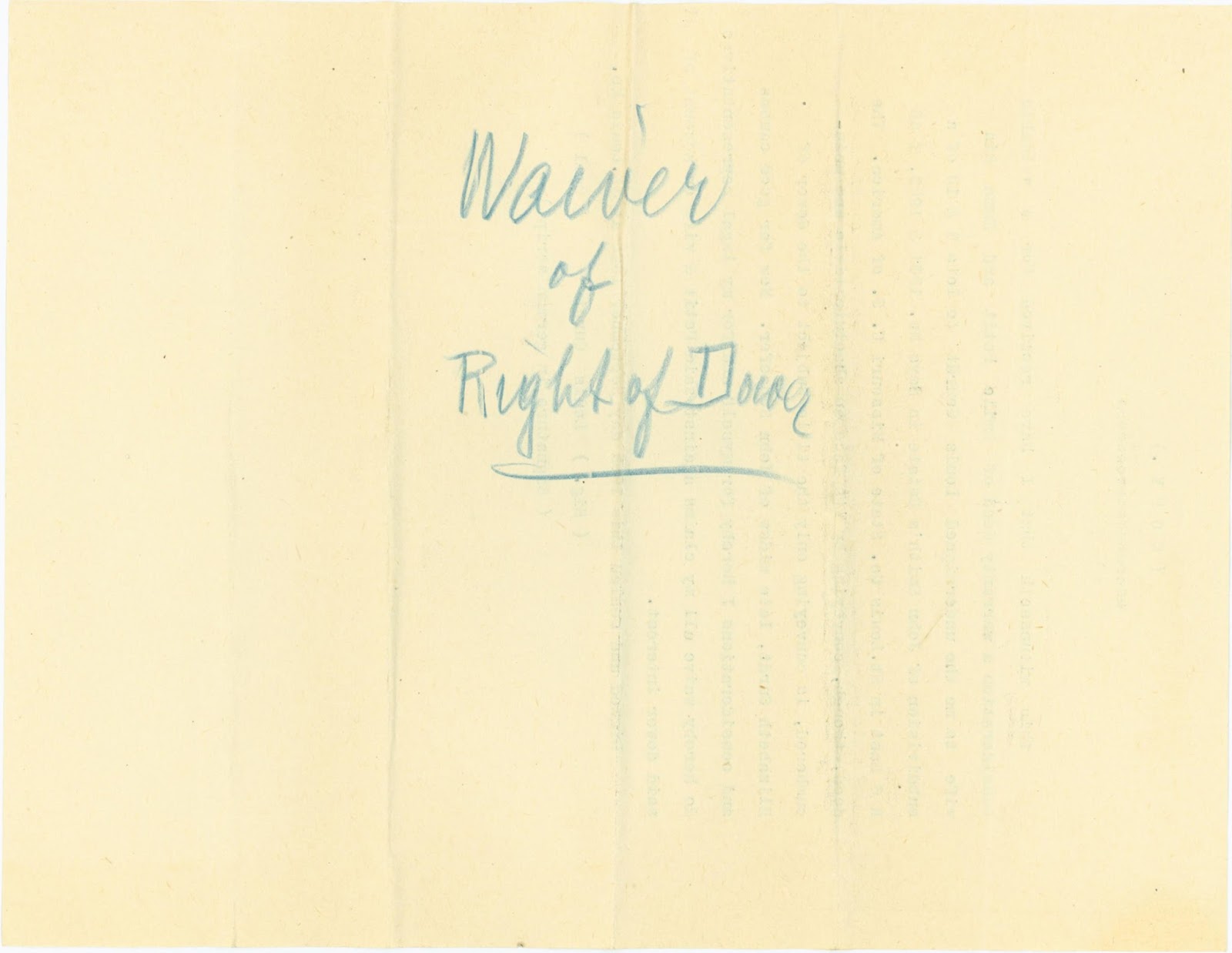
This sheet of paper is 7 1/2" x 12 1/2".  It's about 20# weight.  It has an embossed logo of some sort in the upper left, but I can't read it.  (I'm going to scan it at 600 DPI and see if that helps.  If not, I'll go for 1200.)  The embossing was so strong that it cut through the paper in one place.  The sheet has been folded multiple times, in different places.  On the main text side, the only ones that seem to be visible in the scan are the two horizontal lines that divide the page into approximate thirds.  On the reverse side, which has only "Waiver of Dower rights" in blue pencil, the folds framing the text and one that bisects that section can be seen clearly.


These are copies of two of the three transcriptions I posted in March.  The upper one is the original typed version of the third transcription from March (which now that I have this one in hand I've looked at again, and it is a carbon copy).  This sheet also has a "DEPOSIT BOND" watermark and is the same size and color as the March item.  The page has two more folds than the carbon copy does.  The only difference between the two transcriptions is that the name "Louis" in the signature line is slightly lower in the carbon copy.  The name was typed directly with the typewriter.  It looks as though the carbon copy name was erased first, but I'm not totally sure.  One other difference is that this page has "Waiver of Right of Dower" in blue pencil on the reverse side.

The lower image is a carbon copy of the second transcription posted in March.  This sheet is the same size, 8 1/2" x 12 1/2", appears to be the same weight and color, and has folds in the same places.  The differences between these two documents are the handwritten word "Sections" in blue pencil on the original typed page (the March copy) and slightly different placement of the words "all my" in the next to last line of the long paragraph.  Now that I have the two pages next to each other, I can see that the original typed version had something else typed there that was removed and then "all my" typed in.  On the carbon copy, it appears that whatever was typed with the carbon paper was erased and "all my" typed in its place.

So altogether I have an original handwritten copy of the waiver from Louis Curdt, three typed transcriptions (all differing slightly in wording), and carbon copies of two of the transcriptions.  Someone in this family (I'm still guessing Jean) was just a little obsessive about having extra copies.  Of course, now that I have a handwritten copy, I just have to transcribe it and compare it to Jean's work.

-- >< -- >< -- >< -- >< --

This witnesseth that I have received for a valuable consideration a warranty deed of of Louis Emile Petit and Emma his wife to me the undersigned Louis Curdt to lots 9 & 10 of a Subdivision of John Smith's Estate in Seys[?] No 1901 & 1902, T 46 R 6 East in StLouis [sic] County State of Missouri U. S. of America.  The deed, though, convoying [sic] by its face an absolute title and unincumbered [sic], is conveying only the title subject to the dower of Elizabeth Curdt, late widow of John Schaefer  Now for good causes & considerations I hereby for myself and for my ligal [sic] representatives do hereby waive all my claims against said Petit & wife on account of said dower interest

Signed and sealed this 19th day September 1885 at StLouis [sic] Mo

[signed] Louis Curdt [seal]

-- >< -- >< -- >< -- >< --

Even though this might be Louis Curdt's original signature (it does seem to be different handwriting from that on the rest of the page, although I don't know if it's "German" script or writing, as Jean typed in his transcriptions), this does not appear to be the original document.  The word "seal" surrounded in curlicues suggests that this is a handwritten copy of an original that had a seal on it.  Unfortunately, this copy is not dated, so there's no way to tell if it was made around the time of the 1885 waiver or when Elizabeth Curdt died in 1919.

At least now we know why Jean had "Seys" in one of his transcriptions — that is certainly what it looks like to me in this original.  At first I thought that the "y" didn't look like other "y"s in the document, but then I found a couple that looked at least similar.  And if it isn't a y, I have no idea what it could be.  Maybe there is yet another "original", which might be more legible.

Overall Jean's transcriptions are all very close to the handwritten copy, although he did correct the spelling of "legal" every time.  Certainly no significant deviation was made, and the meaning is the same across all three.  The only major difference is still Seys versus Sections versus Surveys.

Thursday, March 16, 2017

Treasure Chest Thursday: Emile Petit Answers Questions about Events in Missouri


This is a set of three pages linked together.  The first page is a small piece of white paper, 5 1/2" x 6 5/8".  It feels like 20# bond; it has no watermark.  It has some typed information at the top and a clipped newspaper article that has been glued onto it sideways.

The second page is 8 1/2" x 10 7/8".  It is also white, feels like 20# bond, and has no watermark.  It has typwritten and handwritten material on both sides.  What are labeled as "ANSWERS TO QUESTIONS" were typed, while they were numbered by hand.  At the top of the front page in the upper left is "Rec'd 2-2-1920" in handwriting.  On the reverse, in handwriting at the bottom of the page, are "I state these answers are true to the best of my knowledge" and the signed name of Emile Petit, and "Witness" with the signed name of Daniel J. Kelly.

The third page is 8 1/2" x 12 3/4".  This is a grayish-yellowish off-white paper.  It's about 20# in weight and has no watermark.  It's a lesser quality paper than the previous two.  It is typed on the face with "Answ'd Jan. 26-20" in the upper left and "January 19-1920" in the upper right in handwriting.  The reverse has "Questions to Petit" handwritten in blue pencil.  The handwriting is similar to that in Jean La Forêt's journal.

This must have been part of Jean's investigation into what happened to Emma's inheritance.  When Emma wrote, "It took my husband a good while to get all the information in the case", I was not expecting to see that he had created an actual questionnaire.  He obviously approached the situation as a serious matter.

It appears that Emile Petit was still living in Vallejo.  At least, that's the location given on the answers page.

The second and third pages are held together by a rusted straight pin in the upper left corner.  The small first page has been glued onto the the second page.


These scans are of two sheets of paper, one represented by the first image and one by the second and third images.  The first page is 8 1/2" x 11" and is a grayish off-white.  It feels about 20# in weight.  There is no watermark.  It is all typewritten except for the dates in handwriting at the top of the page:  "January 19 - 1920"; "Answ'd Jan 26 - 20"; and "Rec'd Answers - 2-2-20."  The writing is again similar to that of Jean La Forêt's from his journal.

The second page is 8 1/2" x 11 3/8".  It is whiter than the first page.  It has a watermark:  BERKSHIRE SOUVENIR BOND USA.  The reverse side of the page has "Questions to Petit" in what appears to be Jean's handwriting in blue pencil.  These two pages are glued to each other in the upper left corner.

These pages appear to be copies of the first set.  The headers on the pages differ, and the second set is not a verbatim copy, but the bulk of the text is the same.  On the copy of the answers, the names of the signatures are typed.


This envelope is 9 1/2" x 4 1/8".  It is yellowish and somewhat stained in the lower left corner.  It's sturdy, apparently heavier than 20# paper.  As with the envelope holding the transcription of Louis Curdt's statement, I believe the printing was by Jean La Forêt.  The documents shown above were folded and in this envelope when I received everything.

These two sets of documents are reminiscent of the Louis Curdt set in that Jean made an extra copy.  I wonder if he was afraid that someone was going to try to take the original?  Or he may have just taken this type of precaution all the time.  After all, he kept all sorts of items that I've written about previously, even empty envelopes.  He was very good at saving things.

We've seen the response to one of the questions posed of Emile Petit previously.  In the first part of Emma's handwritten narrative, she quoted Petit's answer to question #10 (although she had an incorrect given name for the witness).  So that narrative must have been written after February 2, 1920, the date Jean wrote that he had received Petit's answers.

The rest of the questions and answers don't make a totally damning case against Louis Curdt, but he doesn't come off looking very good.  Neither does Emma's mother, Elizabeth.  Actually, neither does Petit, who said "I don't know" a lot.  On the other hand, he probably really didn't know.

When I posted the certificate for Emile Petit and Emma Schafer's marriage, I wondered at the time who the witnesses were, and now we have the answer:  Fortin, who was Petit's landlord at the hotel in which he was staying in Clayton, and Claud, a restaurant owner in Clayton.  Petit doesn't really seem to have known either one, and of course he didn't know how Curdt knew them.

Emma wrote in the second part of her narrative that she and Jean had taken "legal advice", and that is referenced here:  "The case is good and a good result can be expected.  This is the honest belief of several good lawyers."  Unfortunately, Jean and Emma did not have the money to press the case, and it would appear that Emma's children either could not or would not help her as was suggested:  "the children would help her in proportion in the expenses of the Court and the lawyers."  I'm guessing no court case was ever filed.

Four of Petit's responses to Jean's questions referred to Pete Bruno.  Bruno was the only person Petit knew who could verify Petit's information about what really happened at the time of Emma's marriage, and who might know more about what was going on.  Jean included a copy of the newspaper clipping about Bruno's death in this packet.  There's nothing in the description of the accident in which Bruno died to suggest that it was anything but an accident; maybe the fact that Bruno had died and was therefore unavailable to provide any additional information was the ultimate reason Jean and Emma did not pursue a court case.

Thursday, March 2, 2017

Treasure Chest Thursday: A Legal Waiver from Louis Curdt


This piece of paper is 8 1/2" x 12 1/2", which seems an odd size now but which might have been a standard early in the 20th century.  The paper is yellowed with age but was probably white or off-white originally.  It feels about 20# in weight but not of great quality.  There is no watermark.  The sheet was folded somewhat in thirds and then had one additional fold about an inch in depth.  The images above are of the two sides of the page.  The main body of text is typed.  The reverse has three handwritten words.

This appears to be a transcription of a document.  The location of the original document is not noted, but it might have been something that was held by the family.  It's possible that it was filed with the county clerk in St. Louis County, Missouri.

The transcription states that Louis Curdt paid a "valuable consideration" for a deed from Emile and Emma (Schafer) Petit but does not give the amount.  If it were filed with the county, I would expect the amount to be listed.  The focus in this is really the statement that Elizabeth Curdt's dower is being conveyed.

The words "Waiver of Dower" on the reverse of the page remind me of Jean La Forêt's handwriting.


The first of these two documents is also 8 1/2" x 12 1/2".  The paper appears similar in color and in weight to that in the first document described above.  This page also has no watermark.  The sheet was also folded somewhat in thirds and then had one additional fold about an inch in depth.  Unlike the first document, no handwriting appears on the back.

The second document is on a standard 8 1/2" x 11" piece of paper.  This sheet is grayer in color than the other two.  It was folded in thirds.  It's about 20# in weight, but this has a watermark:  DEPOSIT BOND.  It also has no handwriting.

Both of these are typed.  The text is almost exactly the same as that on the first document.  One difference is that the first and second have a long intro paragraph explaining that the typing is a true copy of a waiver, whereas the third document has only the word "COPY" at the top.

The other significant difference is the term used to describe the parts of John Smith's estate being conveyed.  The first document has "Surveys", the second "Sections", and the third "Seys."  The rest of the description of the property is the same.  Other differences are minor, such as a period being dropped.

I'm not sure, but I think this waiver is related to Emile Petit's visit to the United States in 1885.  In the first part of her handwritten narrative, Emma wrote that Emile left Lorraine for Missouri on June 10, 1885.  She didn't state when he returned but did mention that he brought $3,000 with him.  She also wrote that she signed a document which she did not know the purpose of.  It seems to me that Emma and Emile each having signed a document could have created the conveyance of dower which Curdt acknowledged.  If that is the case, then these three copies of the waiver were probably part of the research that Jean La Forêt conducted while investigating what happened to Emma's inheritance.  Wasn't it nice of Louis Curdt to waive his claims against Emile and Emma, now that he'd apparently gotten control of the land.

I don't understand the reference to John Smith's estate.  Why is it John Smith and not John Schaefer?


This is the envelope in which the three copies of the waiver were found by me. It is 9 1/2" x 4 1/8".  As the image shows, it is yellowish and darker around the edges.  It's fairly sturdy, heavier than 20# in weight.  Considering the fancy "f" in "of" and the flourishes and underlines, I suspect this might be Jean La Forêt's printing.

Thursday, April 7, 2016

Treasure Chest Thursday: The Missing Documentation


This week's document is typed and stamped clearly and legibly with almost no handwriting, as were last week's, so I'm opting not to transcribe it either.  It is a letter typed on 8 1/2" x 11" white watermarked ("–OYALTY BOND") bond paper.  It has two holes punched in the top, probably to put in a file folder with those metal holders that I don't know the name for.  It has two folds, as though it had been placed in a mailing envelope.  On the back is a line of rust about an inch long that looks very similar to the one on the letter dated May 17, 1927 from the Bureau of Pensions (the line shows through the paper from the front and can be seen in the scanned image above).  This letter may have been clipped with that letter at some point, though it was not when I received it.

In last week's post about "The Perils of Emma" I described the carbon copies of documents, dated July 27, 1927, that Emma La Forêt sent to the Pension Bureau in response to the letter from the Bureau, dated May 17, 1927 (the one with the rust mark), asking her to supply various forms of proof of her eligibility for the pension she was applying for.  Those documents covered almost all of the points in the May 17th letter.  The one item Emma had left unanswered was #4, a statement from her as to whether any former husband of hers had served in the U.S. Army or Navy.

I guess the Bureau of Pensions did send her a letter or postcard asking where that information was (though I don't have it), because that's what this letter is about.  She said that good old Emil (sic) Petit never served in the U.S. military or naval service (what, the Navy isn't military??!).

Unlike two of last week's documents, this letter does include the case number.  Emma again complied with the requirement that the information be a sworn statement, and again the witness was notary public W. T. Kelley, whose signature and impressed seal are on the letter.  So Emma had now supplied all the information requested by the Bureau of Pensions.

Something interesting about this letter is that it appears to be an original, not a carbon copy like last week's.  The words look like typing ink, not carbon, and some punctuation marks can be physically felt on the back.  It has Kelley's impressed seal.  Kelley's and Emma's signatures and the date ("19th") appear to be pen ink, not carbon.  Below Kelley's signature is his notary commission expiration date stamped in purple ink.  The fact that it looks like an original, coupled with the holes punched in the top suggesting it was in a file, make me think that this was sent back to Emma from the Bureau of Pensions.  I don't know why they would do that, though.

Thursday, January 21, 2016

Treasure Chest Thursday: Emile and Emma Petit Separate


Last week's document regarding Emma (Schafer) Petit was an insurance policy dated May 2, 1901.  The third document I have jumps ahead five and a half years to November 1906.  Technically, this could be considered a document about Emile Petit, her husband, but she is mentioned in it, and it seems to be more relevant to her.  The document is on a legal-sized (8 1/2" x 14") piece of lightweight watermarked bond paper.  It does not have a title.  An embossed notary seal is at the bottom of the page.

-- >< -- >< -- >< -- >< --

KNOW ALL MEN BY THESE PRESENTS:

That I, Emil Petit of the City of Vallejo, Solano County California, for and in consideration of the sum of Five Hundred ( $500 ) Dollars, lawful money of the United States of America, to me in hand paid this 19 day of November, 1906, by my Wife, Emma Petit of Vallejo, California, the receipt whereof is hereby acknowledged, do hereby covenant and agree with my said wife, that I will from now, henceforth and forever hold her free from any and all obligations to me, either pecuniary or otherwise, and that I will depart from the said City of Vallejo and take up a permanent residence apart from her, my said wife, and will never again intrude upon her presence, and that I will not incur any debts or obligations that can in any manner be chargeable to her account, and I do hereby absolve her from any all liability for any debts or obligations which may hereafter be incurred by me from this date henceforth.

Emile Petit

---:---

State of California.
                                 )-ss
  County of Solano.

On this 19 day of November in the year one thousand nine hundred and six, before me, W. T. KELLEY, a Notary Public in and for the County of Solano, personally appeared Emil Petit known to me to be the person whose name is subscribed to the within instrument, and he duly acknowledged to me that he executed the same.

IN WITNESS WHEREOF, I have hereunto set my hand and affixed my Official Seal at my office in the County of Solano, the day and year in this certificate first above written.

                                                                                   W. T. Kelley
                                                                                                            NOTARY PUBLIC
                                                                                                        In and for the County of Solano, State of California

-- >< -- >< -- >< -- >< --

We already knew from Emma's handwritten narrative that she had divorced Emile Petit, so this official statement that they are separating their financial responsibilities is not surprising in and of itself.  I have seen similar items in newspapers, where one half of a married couple announces publicly that he (or she) is no longer responsible for the debts and obligations of another.  This is the first time I've seen a stand-alone document that accomplishes the same, and this one is even notarized.  (I'm sure there's a name for this type of document, but I don't know what it is.  If you do, please post a comment!)  Emma was serious about getting her deadbeat alcholic husband out of her life, even being willing to pay $500 to accomplish it.

The way it's phrased in the next to last paragraph, it sounds as though Emile signed the document not in the presence of the notary, even though all the handwritten parts (except for Emile's signature) seem to be in the same handwriting as the notary's signature (keeping mind, of course, that I am most decidedly not qualified as a document examiner, although I do know one).  Maybe it's a standard phrasing that was used at that time?  Nowadays, I'm accustomed to the notary's section saying that the document was signed in the presence of the notary.

I'm used to seeing different spellings of names, but I noticed here that Emile's name is spelled in the document without the final "e" both times, even though Emile signed with the e.  At least he knew how to spell his name.

Emma wrote in her narrative that Emile liked to gamble and drink when he had money.  How long did it take him to go through this $500?

If Emile had visitation rights to see the children, I guess a third party had to help, as Emile said he wasn't going to see Emma anymore.

When Emma took out her insurance policy she was living in Vallejo.  She was still living there in 1906 when this document was signed.

Thursday, December 24, 2015

Treasure Chest Thursday: Narrative of Emma M. Petit


Last week I started working on the "treasure chest" that another genealogist gifted to me, beginning with Emma M. Schafer, the person who seemed to be the focus of the story.  The first document chronologically in the story related the early years of her life, up to her marriage at the age of 16 and departure to Europe with her husband soon after.

The second document is titled "In Lorraine, Germany - Narrative of Emma M. Petit, nee Schafer."  It consists of four sheets of bond paper with no apparent watermark, with handwriting on both sides of each sheet.  Judging by the point of view of the narrative, it seems to be written by Emma herself.  As the letter is so long, this week I will post my transcription of the first four pages and finish with the final four pages next week.  My transcription follows (for ease in reading, I have chosen not to transcribe the text that Emma struck out):

-- >< -- >< -- >< -- >< --

0
——————
In Lorraine, Germany -
——————
Narrative of Emma M. Petit, nee Schafer
——————

On the 23rd of December we reached the little village of Genestroff, near Dieuze, Lorraine, a french speaking country although part of Germany since 1870 —  We were received, more or less enthusiastically, by the parents and two sisters of my husband, belonging to the middle peasant class, small real estate owners of the country —  They only understand french and a french dialect spoken in that part of Lorraine.  I could not speak with them otherwise than by signs, and they could not understand me = my husband had to translate everything.  But he himself did not know much of the English language and we had to get along as well as we could with the little German I acquired at home, which language my husband learned a little while in the german army in 1880 and 1881 —

We did for the best we could awaiting the help promised by mother; my husband worked as a baker's assistant and I helped around the little farm —

But the promised help never materialized and in 1885 it was necessary for me to do something as I was threatened by the parents of my husband to be sent away if I could not procure the means to establish a bakery in Dieuze, the nearby town, as my husband told them we would do –

Under the pression of interested advice I consented, in June 1885 to give my husband Emile Petit a "General Power-of-Attorney" to go to Missouri, armed with this Power-of-Attorney, and request my mother to give me some money to be able to settle down in business, and in case my mother should not be willing to keep her promise to help us, to try to borrow some money on whatever will be coming to me in the future, or even sell part of my father's estate –  We were under the impression that one half of my father's estate was due me at the death of my mother, this belief was stuffed into my head by my mother and interested members of her family –  As never a settlement of my father's estate was made to me neither on the marriage of my mother with Louis Curdt, nor at the time of my marriage to Emile Petit, as should have been done according to the "Revised Statutes of the State of Missouri" — until the death of my mother I remained under these impressions and never knew that the whole of my fathers estate belonged to me.

Thus on the 10th of June 1885 I gave my husband above mentioned "Power-of-Attorney", and he left for Missouri.

What happened in Missouri while my husband was there is a dark chapter, for myself as well as for Emile Petit, my former husband –

Petit reached Missouri O.K., saw my mother who put him off for a few days, during which days Petit came in the hands of some friends of Louis Curdt and his wife Elizabeth Curdt.  These friends formed an iron wall around Petit who trusted them in everything they proposed or said.  They advanced him

2
——————

money for his daily expenses and kept him going, drinking and having a good time.  He never consulted a lawyer and allowed himself to be taken about like an automaton.

While this was going on I received from an agent of my mother, a prepared act for my signature before a public officer and a letter from my mother –  This document was written in English and there was not a single person in the Country of Dieuze, Lorraine, who could translate or explain it.  I, without instruction, having hardly ever been to school, did not understand anything of it, but for me my mother was a holy body, who surely would not and could not rob me.  In her letter she told me to sign this document in presence of witnesses and I signed it, because she told me in her letter that she could not give me any money except if I sign this document, and I signed it, and I remained under the impression that the document was some kind of acknowledgment of having received or our going to receive a certain amount of money, to help me out in Lorraine, money which would later be deducted from whatever should be coming to me – and I signed and returned the document to the address indicated, and wrote a few words to mother –

The document reached its destination all right and Emile Petit was given 3000 dollars and sent back to Lorraine –

Emile Petit, in a sworn statement, says that Emma's mother sent for him from France, but did not give him any information or instruction about any property –  He says also that the property was not sold.  He says textually, under oath and before witness David J. Kelly, a Notary Public, I believe, viz =

     " I did not sell anything, did not know Louis Curdt
     " to speak to, did not have any dealings with him,
     " that he threatened to kill me for my marriage
     " to Emma Schafer.  When I married Emma
     " Schafer Louis Courdt [sic] was in jail at the time.
     " Mrs. Curdt sent for me to get the money because
     " Emma Schaefer [sic] was afraid of being killed
     " by Louis Curdt.
          " Pete Bruno is the only one I know that could
     " testify this in the matter and probably can
     " give information, he resides at 1515, Villa
     " Ave., Wellston, Mo. # – – – – – – – – – – "

As far as I am concerned I never knew what actually happened in Missouri, between Emile Petit and my mother –  Petit came back with part of the money he received, telling me that was what my mother gave him to help us out and soon after bought a backery [sic] in Dieuze, Lorraine, a small town of about 5000 french speaking population in Lorraine.

-- >< -- >< -- >< -- >< --

What an interesting situation:  Emma was married off to a man who spoke almost no English; she spoke no French and only a little German.  Obviously, the two of them being able to communicate was not high on her mother's list of priorities.  Emma points out more than once that she was not well educated, which was commented on in the typed history of her early life.  And she mentions the "Revised Statutes of the State of Missouri", which was quoted in the typed narrative.  I'm starting to wonder if perhaps Emma was the person who typed that.  This narrative is not dated, but Emma seems to have acquired some education since the events she writes about, as her writing for the most part has reasonable grammar and good spelling (relative to the time).

Whereas in the typed history we don't know who the writer was, in this narrative we are starting to hear from Emma herself about how her mother apparently swindled her out of the inheritance due to her from her father.  She isn't saying it directly, but she does seem to be dancing around the edges.

I kind of feel sorry for Emile Petit so far.  He seems to be a pawn on both sides, being told what to do and where to go.  His parents come off as a little harsh — threatening to send Emma away because she isn't coming up with money to open a bakery?  Maybe the only reason they thought the marriage was acceptable was because Emma was supposed to come with a dowry.

I had a little trouble finding Genestroff.  In French (or should I write "french", as Emma does?) it's Guénestroff and has been subsumed, with the community of Kerprich-lès-Dieuze, into Val-de-Bride (sorry for the French, but the English-language Wikipedia entry has practically no information), in the Moselle department of LorraineDieuze, the other town that Emma mentions, also has a seriously deficient entry in the English-language Wikipedia.  According to Google Maps, Val-de-Bride and Dieuze are less than 2 miles apart.

When I read Emma's comment that Lorraine was a French-speaking country but part of Germany since 1870, it reminded me of the J. K. Rowling episode of Who Do You Think You Are?, where Rowling learned that her Alsatian ancestor had become German after Germany took control of Alsace-Lorraine (Elsass-Lothringen, in German) in 1870, after the Franco-Prussian War.  Emile Petit's family was obviously caught in that also, but unlike Rowling's Schuch family, with a name like Petit, they appear to have had a French rather than German background.

Next week, the rest of Emma's narrative!