Showing posts with label Los Angeles. Show all posts

Saturday, May 3, 2025

Was There Really a Ghost?


I grew up believing in things such as ghosts because my mother did.  Ghosts, poltergeists, vampires, hauntings, déjà vu, superstitions, my mother believed in all of it and taught me to also.  But I was always more than a little disappointed because I had not observed nor experienced any of it myself.

Until I did.

I was living in Los Angeles, just on the edge of East L.A., at 459 East Adams Boulevard.  It was a beautiful three-story Victorian house.  The house was owned by my friend's uncle and his partner.  After buying it they needed renters to help pay the mortgage, so five of us moved in:  my friend and three more prior-enlisted Navy, all now attending USC as Navy ROTC midshipmen, and me.  I lived on the uppermost story and had a huge walk-in closet which I loved.

I never heard what made my landlords curious enough to do this, but one day they hired a medium to come and check out the house because they were wondering if it were haunted.  And the medium told them it was.  A young boy who had died in a train accident was haunting it.  He didn't die there — no railroad tracks right next door or anything like that — but he had spent many happy times there visiting his grandfather.  So that's where his spirit was drawn when he died.

After hearing about the results of the seance, my housemates decided we would try to contact the ghost.  We set ourselves up in a room on the second floor with a Ouija board and a candle, and they started asking questions.  Nothing had happened, and they were getting frustrated.  Then someone asked, "If there is a spirit here, show us a sign", or something pretty close to that.  Suddenly the candle went out.  Which normally wouldn't be that big of a deal, but all the windows were closed, and there wasn't any breeze going through the room.  So we took that to be a sign, but it made some people nervous, and we wrapped up pretty quickly after that.

Okay, one little candle goes out.  Not much of an experience, right?

Ah, but there's more.

Some time after that, Bill and I were on the ground floor on a Saturday.  No one else was home.  I was reading a book.  I don't remember what Bill was doing, but he was in another room.  And suddenly I heard footsteps running downstairs from the second floor.

I looked toward the stairs, but I didn't see anyone.  I was starting to wonder where whoever it was could have gone, when I remembered — Bill and I were the only ones in the house, and he was already on the first floor.

It had to have been the ghost!

I ran over to find Bill and asked him if he had heard the footsteps also.  He hadn't, of course, but I knew what I had heard.

My only experience with a ghost.

Today, May 3, is National Paranormal Day, so it's a good day to record that experience.

Nobody seems to know how National Paranormal Day started or who created it, but it's listed by several of the sites that track events.  National Day Calendar and National Day Archives don't say anything about when it started.  Days of the Year, National Today, and There Is a Day for That agree that the observance began in 2013.  But according to Holiday Calendar, it began in 2011.

Image by Aberrant Realities.  Downloaded from Pixabay and used under the Pixabay Content License.

Saturday, May 22, 2021

Saturday Night Genealogy Fun: When You First Left Home

I tend to think of people leaving home when they go to college.  I wonder if that's most of what we'll see with posts for this week's Saturday Night Genealogy Fun exercise from Randy Seaver.

Here is your assignment, should you decide to accept it (you ARE reading this, so I assume that you really want to play along; cue the Mission:  Impossible! music!):

(1) When did you first leave your parents' home?  Why did you leave?  Where did you move to?  What was it like?  What did you learn?

(2) Tell us about it in your own blog post, in a comment to this post, or in a Facebook Status post.  Please leave a link in a comment to this post.

Of course, the main reason I think of people leaving home to go to college is because that's what I did.

I left home permanently in 1979, when I was 17 years old.  I graduated high school in June, and I left in August.  I never again lived with my parents, but I did visit several times over the years.

I graduated from Niceville Senior High School in Niceville, Florida.  (Yes, that's really the name.)

I was accepted to all of the universities to which I applied:  University of Southern California (USC), Los Angeles; University of Chicago; University of Miami (Florida); and Trinity University, San Antonio, Texas.  I restricted my list to universities which would allow me to use my National Merit Scholarship and which offered a sufficient number of foreign languages, because that's what I wanted to study.

For many reasons,  I didn't want to stay in Florida, so that knocked University of Miami off the list.  (I think I applied there only because my mother wanted me to, so that I would stay in Florida.)  I wasn't crazy about the prospect of living in Texas, so there went Trinity.  And my mother talked me out of the University of Chicago, because she didn't think I would deal well with the winters (I have figured out since then that I probably would have been fine).  And that left USC.

My mother traveled with me to Los Angeles for freshman orientation; I think it was in July.  I packed up all my belongings in suitcases and brought them with me on the trip.  (Well, everything except one very large, unique bookcase, which when my parents moved from Florida to San Antonio I begged them to bring with them, because I really, really wanted to keep it.  They didn't.)  From there we went to Las Vegas, where her parents lived.  I stayed with them until the fall semester started in September.  My grandparents drove me and my material belongings (and a bicycle that my grandfather bought for me for $25, so I would have transportation) down to Los Angeles when it was time for school to start.

During my four years of undergraduate school, I lived in dorms.  My freshman through junior years I had roommates, and my senior year I had a room to myself.  In the dorm I didn't do any cooking (although I already knew how to), because the rooms came with meals plans for the cafeteria, which was conveniently downstairs.  The dorm also had laundry facilities, so I didn't have to go anywehre to wash my clothes.  Lounges had TV sets, so I had entertainment.  So my life was pretty self-contained on campus.  When I graduated I continued at USC as a full-time employee and found a place to live near campus.

Why did I leave my parents' home?  Not only did I want to go to college, but I wanted to get out of Florida.  I hate humidity, and I hate 95/95 weather (95°, 95% humidity) even more.  I'm from California originally, and I like that weather a lot better.  Plus the part of Florida that I was in was the first place that I experienced anti-Semitism, and I didn't feel like sticking around for more.

What did I learn?  During my undergraduate years I had the opportunity to meet a much broader range of people than I had known previously, and that even takes into account the fact that I had lived in another country for two years when I was younger.  I had Philippino, Chinese, and Black roommates over the years.  I learned that I can support myself, because after my freshman year I didn't get financial assistance from my parents, even though USC is a grossly expensive private school.  I had scholarships and financial aid through the university, but I also worked 40 hours a week during the school year while carrying a full academic load and 60 hours a week during the summers.  And I learned that I really, really don't think life is worth living without a cat (no cats in the dorm, of course).

Saturday, December 1, 2018

Saturday Night Genealogy Fun: Favorite Winter Activity Growing Up

After a couple of weeks of "classics", Randy Seaver has a new topic this week for Saturday Night Genealogy Fun.

Here is your assignment, if you choose to play along (cue the Mission:  Impossible! music, please!):

(1) Winter arrives this month all over the northern hemisphere, and the daily routines of work, education, and play change along with the seasons.  

(2) What were your favorite winter activities when you were a child and teenager and young adult?

(3) Share your memories on your own blog post, in a Facebook post, or in a comment on this post.  Please leave a link as a comment on this post if you write your own blog post so that everyone can read all about it.

Thank you to Linda Stufflebean for suggesting this topic.

I grew up in warm-weather areas — Los Angeles County; Sydney, Australia; and Florida — so the types of things that people think of as "winter activities" weren't usually something we did.  Sure, we might get some rain (and it actually can get below freezing in the Florida Panhandle, which is where I used to live), but overall not the kinds of locations that come to mind when you say "winter."  Neither of my parents were into ice skating or skiing, so we didn't go anywhere to do that.

But while my family lived in Los Angeles County (we were there until 1971), we did have a tradition for at least a couple of years where my father and Uncle Tony (not really our uncle, but a close friend of my father) drove up to Mount Baldy (which I've just learned is officially named Mount San Antonio; never heard that name before!) in a pickup truck and filled the truck bed with snow.  They then brought the snow back to the house, and we were able to play with it for a while before it melted.  I don't remember if it lasted long enough for us to make anything resembling a snowman, though!

As a young adult I lived in California again, actually in Los Angeles, so it was still pretty temperate in the winter.  I think the closest thing I had to a winter activity was spending Christmas break visiting my parents while I was still in college.  At least that's all I can remember now.

Tuesday, December 27, 2016

The Season of Giving: Mississippi Midwifery, U.S. Civil War Coded Telegrams, Victims of the Grim Sleeper, and a Possible "Righteous" Couple

The end of the year is often called the "season of giving", when people are asked to contribute to worthy causes.  The worthy causes and projects listed below are asking not for your money but for your time, knowledge, and information.  Please read through them and see if you can help.

The American War Cemetery and Memorial at Margraten, Netherlands includes graves for 8,301 American soldiers and an additional 1,722 names listed on the Walls of the Missing.  The “Faces of Margraten” project, sponsored by the Foundation of United Adopters of American War Graves, has collected almost 4,100 photos of service members buried in Margraten or listed on Walls of the Missing since 2009.  The aim of the group is to remember U.S. soldiers buried in overseas American cemeteries and to commemorate the World War II liberators of the province of Limburg and of the Netherlands.

If you have a photo of a soldier buried or memorialized in Margarten, please consider submitting it via the site's contact page.  Information will be stored in the Fields of Honor database, where searches can be made for soldiers buried or memorialized in the American War Cemeteries in Margraten, Ardennes, and Henri-Chapelle.  The next public tribute will be in 2018.

Contributions of photographs are welcome at any time.  Photographs may also be submitted by mailing them to:
Stichting Verenigde Adoptanten Amerikaanse Oorlogsgraven
Loonsevaert 21
5171 LL Kaatsheuvel
Nederland

-- >< -- >< -- >< -- >< --

Gunnar Pudlatz of Hamburg, Germany is looking for witnesses or testimony on actions by his grandparents in the years 1939–1945.  He has about 930 letters his grandparents wrote to each other in the 1930's and 1940's, in which they talk about people being hidden.

Karl Kessler in 1937
Gunnar's grandparents were Karl Anton Keßler (1912–1942) and Gerda (Bertram) Keßler (1911–1983).  They were pastors of the reformed church in Altlandsberg, east of Berlin, and were in Altlandsberg from 1939–1945. According to oral history they hid up to 50 Jews in their home at Bernauer Straße (street) 16.  Jews would probably have arrived through the back yard, entering the garden through a gate in the town wall, and were most likely hidden in the basement.  The garden was used to grow plenty of fruits and vegetables, so there was always enough food to share with those the Kesslers hid.  Karl and Gerda were well connected with other pastors in the area.  Karl had worked at Büro Grüber and was a member of the confession church, whose members helped each other through networking and evidently also built up a chain of shelters around Berlin, so people in hiding could be passed from one hideout to another.  Gerda said that sometimes they hid Jews for "longer periods."  Unfortunately Gerda never mentioned any names after the war, and because her house was one of the few in the city that had burned to the ground, she left Altlandsberg in September 1945.  The hope is that the photographs, names, and circumstances shown here will be found by survivors who spent that time around Berlin or anyone who has information about these people.

Gerda Kessler in 1942
Suche nach Zeugen und Belegen für Hilfsaktionen für Juden durch Karl Anton und Gerda Keßler in Altlandsberg (1939-1945).  Karl Anton Keßler (1912-1942) und Gerda Keßler (1911-1983), geborene Bertram, halfen in der Nazizeit/im zweiten Weltkrieg als junge evangelische Vikare der Bekennenden Kirche im Pfarrhaus der von ihnen betreuten reformierten Schlosskirchengemeinde von Altlandsberg (östlich von Berlin) mehreren Menschen, die als Juden verfolgte waren. Ihrer Tochter Johanna – meiner Mutter – hat Gerda Keßler nach dem Krieg davon erzählt. Karl Keßler arbeitete zusätzlich zu seiner Arbeit in der Gemeinde im Berliner „Büro Grüber“, wo bedrängte Menschen betreut wurden und von wo aus Ausreisemöglichkeiten vermittelt wurden. Während Karl in den Krieg zog und bei Stalingrad starb versteckte Gerda noch bis zum Kriegsende verfolgte Juden im Pfarrhaus in der Bernauer Straße 16 in Altlandsberg, unter ihnen gelegentlich auch Kinder. Gerda Keßler verließ Altlandsberg im September 1945. Sie erwähnte gegenüber ihrer Tochter nie die Namen der Versteckten. Sollte sich jemand an Hilfsleistungen der beiden erinnern, diese bezeugen, mündliche oder schriftliche Belege dafür haben, würde ich mich über Informationen und Kontakte sehr freuen.

For questions and more pictures Gunnar can be contacted via e-mail at schuwoe@gmx.de.

-- >< -- >< -- >< -- >< --

Was your Irish ancestor a Mountbellow Workhouse girl who immigrated to Australia in 1853 aboard the Palestine?  The Mountbellow Workhouse Project is tracing the descendants of 33 Mountbellow girls who left on that ship.  The project wants to tell the girls' stories, establish from where in Galway they came, and connect descendants with their Irish cousins.  Some of the girls' siblings immigrated to the United States, so there are relatives there also.  Background information and the story of Mary Dooley, one of the workhouse girls, can be read in an article on IrishCentral; more information about Mary Dooley can be found in a follow-up article.  You can contact the Mountbellow Workhouse Project via its Facebook page.

-- >< -- >< -- >< -- >< --

The Mississippi Link recently published an article about an effort to collect information and stories about the history of midwifery.  The oral histories conducted have included people who were birthed by midwives and women who used the services of midwives when they had their children.  The article noted that black midwives delivered white babies and white midwives delivered black babies, and the oral history collection will include stories of both races.  More stories of midwives are being sought, but it is unclear whether only stories relating to midwives in Mississippi are desired.  To share stories and for more information on this project, e-mail Alferdteen Harrison, Ph.D., at alferdteen@aol.com or call (601) 953-4060.

-- >< -- >< -- >< -- >< --

Did you know that you can help decode and transcribe U.S. Civil War messages and telegrams?  Thomas Eckert, who was in charge of the U.S. War Department's Civil War telegraph program, saved almost 16,000 telegrams that helped direct the course of the war.  Eckert kept the telegrams, including many in code and the accompanying cipher books.  These have now been digitized and are being transcribed through a crowdsourcing effort.  The Huntington Library, which holds the collection, announced the project on its blog.  You can learn how to participate and sign up on Zooniverse, which is hosting the project.

-- >< -- >< -- >< -- >< --

As part of its 50th anniversary commemoration, the British housing charity Shelter is trying to make contact with children and families who appear in 1960's and 1970's photographs depicting postwar run-down housing conditions.  This article discusses the history of the original photography project and includes commentary from the photographer.  Images of all of the photographs are available online.

-- >< -- >< -- >< -- >< --

Why do you want to research your family tree?  Dr. Tanya Evans of Macquarie University in Sydney, New South Wales, Australia wants to hear only from residents of Great Britain and Australia about this question.  She is interested in learning the motivations behind your research and the emotional impact of your family discoveries.  Evans has written a book on the history of Australia's oldest surviving charity and has acted as a consultant for the Australian version of Who Do You Think You Are?  You can contact her at Tanya.Evans@mq.edu.au.

-- >< -- >< -- >< -- >< --

This is an update to an effort I have written about previously.  The Jewish Community of Nuremberg is in possession of the so-called Stürmer or Streicher Library, a collection of approximately 10,000 books the Nazis took from Jews, Catholics, Freemasons, and others.  The books were taken primarily from Nuremberg, Franconia; Strasbourg, Alsace-Lorraine; and Vienna, Austria, but provenance research has indicated that more than 2,200 owners were from other parts of Europe or from overseas.  The Jewish Community is asking for assistance in finding the former owners or their descendants so that the books may be returned.  Restitution is free of charge.  So far more than 700 items have been returned to ten different countries.

More background on the collection, a list of known owners, and photos of identifying information from the books are available on GenTeam.  Additional background information is available here.  Contact Leibl Rosenberg, representative of the city of Nuremberg for the Jewish Community, with questions and research results.

-- >< -- >< -- >< -- >< --

Front:  Dawson, Gordon, Moss
Back:  McFaden, Taylor, Cooper
The Canadian Letters and Images Project, which began in 2000, is an online archive of the Canadian war experience—from any war—as told through letters and images of Canadians themselves.  Contemporary letters, diaries, and photographs are digitized, permitting Canadians to tell their stories through words and photographs.  This is the largest such collection online in Canada, about 20,000 letters and growing.

A YouTube video about the project may be viewed at https://www.youtube.com/watch?v=X0g2VFdYfIg. To search the project site go to http://canadianletters.ca/search/site.

The project wants to borrow correspondence, diaries, photographs, and other personal materials connected to Canadians at war, on the home front and the battlefront.  The documents are digitized in their entirety, with no editing, and the originals are returned to their owners.  The project makes arrangements—at its expense—to have materials picked up and returned by courier to ensure the materials' safety.

If you are interested in sharing your family's war letters, diaries, etc. with the project, visit http://canadianletters.ca/content/about-us and scroll down to “Contact Us.”  The materials must be about Canadians, but anyone, whether in Canada or not, may contribute letters, diaries, and other memorabilia.

-- >< -- >< -- >< -- >< --

Lonnie Franklin, Jr., was convicted on May 5, 2016 of being the serial killer nicknamed the "Grim Sleeper."  Part of the evidence that connected him to deaths that occurred in Los Angeles between 1985 and 2007 was a collection of photographs hidden in his home.  Franklin had apparently been in the habit of taking photos of each of his victims.  While the photos helped gain Franklin's conviction, not all of the women in the photos have been identified.  A page on the Los Angeles Police Department's site shows photos of 33 women whose identities are not yet known.  Some of the women appear to be unconscious or possibly dead, so his list of victims may be longer than is currently known.

Tuesday, October 27, 2015

Urgent: An Archive in Danger

How some of the archival materials
are currently being stored
The Port of Los Angeles created an archives program in 2010 to preserve its historic documents.  About 25,000 linear feet of archival materials have been identified, including photographs, ledgers, maps, blueprints, promotional material, and ephemera.  In early 2015, the Port closed its archives without notice and moved the historic materials to a facility that is not climate-controlled and is not appropriate for storage of important documents.

Please read more details about this situation and sign the online petition calling on the Port and the Los Angeles Harbor Commission to preserve the archives.

Sunday, April 5, 2015

"Who Do You Think You Are?" - Sean Hayes

This episode of Who Do You Think You Are? was about Sean Hayes, whose name I vaguely recognized.  The teaser said that he would learn about dark mysteries connected to his father's lineage, an estranged ancestor living in squalor, and patterns of dysfunction going back generations.  Sounds like one happy family, doesn't it?

In the introduction, we hear that Hayes is an Emmy-winning actor known for his role on Will & Grace (at least I've heard of that, though I've never watched it).  He was nominated for a Tony award for his performance in Promises, Promises.  He also has been a producer of Hollywood Game Night and Grimm (now there's a show I watch!).  He lives in Los Angeles with his husband, music producer Scott Icenogle.

Hayes tells us his full name is Sean Patrick Hayes and that he is "named after no one I know of."  He was born in Illinois and at the age of 1 his family moved from Chicago to the suburbs (known to many as Chicagoland).  He is the youngest of five children.  He had a rather tumultous life growing up, as his mother worked all the time and his father was mostly not present.  He concedes that his father probably has some good qualities, but he doesn't know any of them.  He's never had a relationship with his father, as the man left when Hayes was 5 years old.  He doesn't know anything about his father's side of the family.

Hayes has always been drawn to comedy, probably as an escape.  It's a way of enjoying life without dealing with the real world.  Now that he's older, he has started to wonder about his family history and wants to learn about his father's side.  He knew his grandmother and was told that his father was in an orphanage at one time.  His parents met when his father had just come out of the Army.

We get some more information about the family through a letter from Hayes' brother, Dennis, which Hayes reads to Icenogle.  As background, Hayes doesn't know his grandfather's name, but his sister told him that the grandfather died literally in the gutter.  Hayes comments that his family history has been mostly full of bad luck.

From Dennis' letter we learn that the father (whose name is never used in the entire episode) was born in Chicago in 1936 and that his parents were William and Barbara.  Hayes notes that Dennis' middle name is William, so that appears to be a connection.  In 1947 the four children in the family were placed in an orphanage.  At some point Barbara broke both of her hips and was in the hospital; it wasn't clear to me if this was the same time that the children were in the orphanage (and therefore maybe the cause of the latter).  Dennis doesn't know if William was around, though it appears he was out of the picture.  He says their father's grandfather was from Ireland but doesn't know his name.  He ends by saying that he has run into lots of dead ends and hopes that Hayes has better luck than he did.

Included with the letter is a photograph of Hayes' grandparents, and it's actually labeled!  The photo is of four people; the person on the left is unknown, and then come William Hayes, Aunt Sally, and Barbara Hayes.  The photo is supposed to be from 1941.  Hayes has never seen a photograph of his grandfather before.  Going by the year, this was taken six years before the children were placed in the orphanage.  There is also a photo of Barbara in the hospital (just how did she break both of her hips, anyway?).  Hayes hypothesizes that maybe William wasn't able to take care of the children with Barbara laid up but then also says that "we know" he was out of the picture at that point.  Um, how do we know that?

The Hayes family in the 1940 census:
William, Barbara, Patricia, Ronald, and Kathleen
We go straight from the letter to "Let's see what we can find out about William on Ancestry.com!"  For someone who has had little to no interest in his family history, that was a fast turn-around.  He apparently even has an account, because he's logged in.  He has also already figured out how to do searches and looks for William Hayes with a wife's name of Barbara, then finds them in the 1940 census.  The image shown on screen carefully does not include Hayes' father's name.  William is listed as a photo engineer (at an engineering company, though that was not stated), with an income of $3,400.  Hayes comments that his own father was also a photographer, and then that William was the richest guy on the block (well, actually just this one census page), so what happened?  That segues directly into how it seems that everything happened in Chicago, so he should go there.  (Boy, when he decides to do something, he jumps right on it, doesn't he?)  In the outro he wonders whether his grandfather was alive or dead when the children were in the orphanage.

Two things struck me with the census page showing the family.  The first is that Hayes' father, he of no name, must be Ronald, as he is not only the correct age but also the only boy in the family.  The second is that Aunt Sally does not appear to have been born yet (unless Sally is an unusual family nickname for Patricia or Kathleen).  With the family photo dated 1941, that would mean Sally shouldn't be more than 2 years old.  Admittedly, we didn't get the world's greatest view of the photo, but she didn't look that young to me.

Moving on to Chicago (I love Chicago!), Hayes heads to the Chicago History Museum to meet historian Mark Largent (an associate professor of social relations and policy at Michigan State University), whom Hayes has asked for "anything he can find out" about his grandfather.  Largent tells Hayes that he has found a document, and right before they cut away to a commercial, we hear Hayes exclaim, "Oh my god!  That's really, really sad."  When they come back to the program, we learn that Largent found the death certificate for William Hayes, who died November 16, 1951 in Chicago.

I have to admit I was pretty impressed with the way that Hayes appeared to be reading all the details on the certificate.  He noted that William was 40 years old when he died and said that he had to go back to his makeshift timeline.  His big question had been whether William was alive when the children went to the orphanage, and the answer is definitely yes.  Now he knows that his father and his grandfather were living in the same city but with very different lives.  William's address at the time of his death was 66 West Van Buren, which is now totally different but at the time was a slum. 
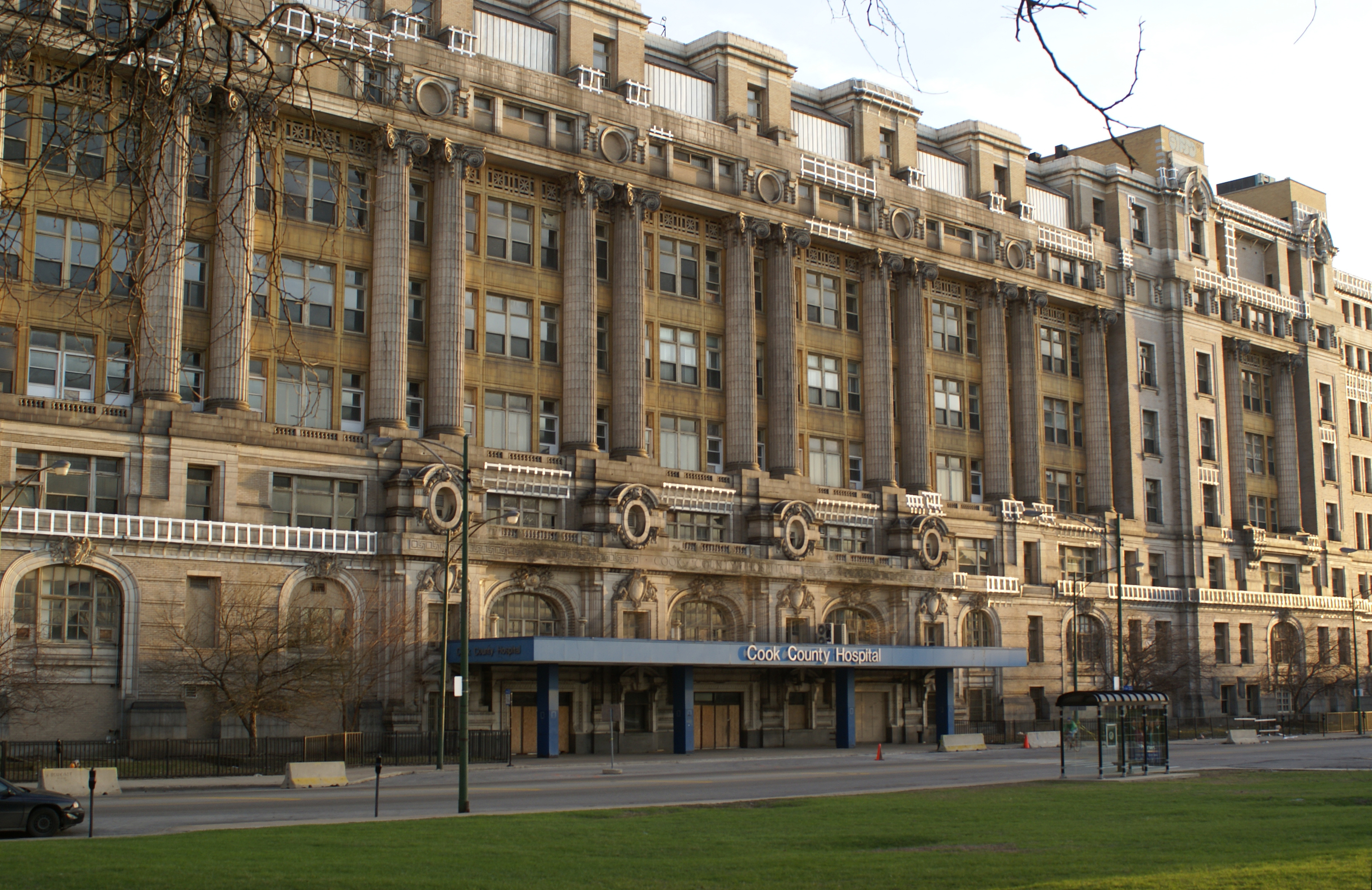
Cook County Hospital facade
Largent explains that in 1951 it was populated mostly by single men, a lot of whom were unemployed and/or suffered from mental illness.  William didn't die in the gutter, as Hayes' sister had claimed, but in Cook County Hospital.  He died from advanced pulmonary tuberculosis.  Of all things, Hayes asks if the hospital is still around.  (Is that something you would think of?)  Largent says it was shut down but the facade still remains, and that's where they go next, to look at what remains of the hospital.  (On the other side of the facade there is now a sports field, of all things.)

Hayes sees powerful parallels between his father's and his own experiences.  He says he was the same age when his father left as his father was when his grandfather left (though I don't know how he knows his grandfather left when his father was 5).  He doesn't understand how his grandfather could have gone from seemingly being the richest man in his neighborhood to skid row.  After the thrill of seeing the hospital facade, he asks how he can learn more about his grandfather's final days, and Largent says they can go to the medical library.

At the library (I couldn't figure out where exactly they went for this segment) Largent has a file folder with the police department report on finding Hayes' grandfather.  The page shows the report was for dealing with sick or injured persons.  Dated November 1, 1951, it shows that an officer went to 66 West Van Buren, found William, and took him to the hospital.  Hayes notices that nothing is entered in the field for relatives or friends.  Elsewhere on the report the officer noted that William could answer his questions intelligently, so apparently William simply had nothing to say in response to the question about relatives.

William's hospital admission record (I wish these types of records were available and accessible for more locations!) says that his father's name was Patrick, which Hayes seems surprised to realize is also his middle name, indicating he was likely named for his great-grandfather.  (It also seems to indicate that Hayes' father still had some feelings for his own father.)  Since an address was given for Patrick, he must have been alive at the time, but he does not appear to have been at the hospital.  (And now we have Patrick, William, and Ronald, all living in Chicago but apparently totally disconnected from each other.)  The doctor's synopsis says that William was suffering from anorexia; he hadn't been eating regularly for four to five months.  The report also says that William's liver was 3FB, meaning three fingers below median, a possible indication of alcohol abuse.  Largent is quick to emphasize it's only one piece of evidence that could support that.  William was noted as being extremely emaciated, pale, and having a red nose — another possible indicator of alcoholism.

Hayes wants to know if Patrick was an absentee father or if he just didn't know what was going on with William, but Largent says there's no way to know from the records they have.  Hayes then asks if Patrick was an immigrant.  Largent tells him that information about immigrants is in the Cook County court archives, so that's where he should look next.

As he leaves, Hayes talks about how this is the end of William's story.  He feels sorry for William and how he must have felt alone, and that his story was sad and frightening.  He now sympathizes more with his own father and what he must have gone through with William.  He wonders if some of the same issues were at play with Patrick.  He also wonders about a pattern of absentee fathers.

Still in Chicago, Hayes goes to the Cook County Clerk of the Circuit Court archives.  There he meets Margaret Garb, an urban historian from Washington University.  He says he had sent her the information he had and asked her to look for his great-grandfather.  Garb begins by showing him the 1930 census page which has William living with his father Patrick; Patrick's wife is Jennie.  William, at the age of 18, is already a photography engineer (which is what, exactly?).  Patrick is 48 years old, meaning he was born about 1882.  He owned his home and was a motorman for the street railway.  Garb explains he worked on the streetcars, which was a good, stable job, so during the Depression (or at least the beginning of it), he was working and the family was doing well.  (The program didn't show Patrick in the 1940 census, but he was at the same address, widowed, and the census taker gave the extra information that he was from County Kerry.)

Patrick and Jennie were both born in Ireland (the census actually says Irish Free State, meaning the Republic of Ireland, as opposed to Northern Ireland), and all the children were born in Illinois.  Hayes is excited to identify his great-grandfather as the first person in the Hayes family to come to the U.S.  The census says he came in 1900.  Hayes reads the naturalization column as "no", and Garb corrects him, saying that it actually says "na" for "naturalized."  Hayes asks about finding those records, and Garb tells him they are in the same building, so that's the next search.  They look through index cards for men named Patrick Hayes.  Hayes uses a magnifying glass to read the cards on the microfilm reader.  He finds one Patrick with a birth year of 1879 and arrival year of 1901; Garb explains that the years could be off a little bit and tells him to write down the certificate number, 54916 (gee, I guess it must be the right guy).

From the microfilm reader the two walk to a shelving area with lots of stacked books.  It reminds Hayes of the end of Raiders of the Lost Ark (what a great analogy!).  They walk down the aisle looking at the spines of the books, and Hayes spots the one that has 548–553.  They bring it to a table, and Hayes pages through until he finds 54916.  He almost sounds in awe when he's told that this is the original paper, with his great-grandfather's actual signature on it.  It shows that Patrick Francis Hayes, a streetcar operator, was from Ballylongford, Ireland.  His wife's name was Jennie.  Hayes declares this "has to be the guy!"  He had brown hair and blue eyes, just like Hayes.  He came to the United States on the Umbria, arriving in New York about April 1901.  He signed his Declaration of Intention on February 11, 1918.  (I have to wonder why they didn't show his Petition.  Maybe it didn't have as much information, or wasn't as accurate?)

Hayes is thrilled to see all this information and wants to know how he can learn more about Patrick's life in Ireland.  Garb, of course, tells him that he should go there.  Hayes responds, "I'll go to Ireland!  Thanks, Maggie!"  He sounds genuinely enthusiastic.

As he leaves the archives Hayes says he feels as though he has now met Patrick.  He's enamored of Patrick's drive and ambition.  He finds it inspiring that Patrick wanted a better life for his family.  It's a contrast with William's story, which was a great tragedy.  (On the other hand, he didn't follow Patrick all the way to his demise, so we don't know what happened to him later.)  Patrick seems to be the opposite of Hayes' own father.  He wants to go to Ireland to learn more about Patrick's surroundings and why he would have wanted to leave.

In Ireland, Hayes says he had a bizarre feeling when he landed that he was connected to the country.  (Maybe he's very suggestible.)  He's going to the National Archives of Ireland (in Dublin, which is where I thought he was, though they don't tell us that for quite a while) to speak with historian Shane Kilcommins (head of the School of Law at the University of Limerick).  Of course, Hayes has "asked" Kilcommins to look into Patrick's life before he left Ireland.  The first document Kilcommins has for Hayes is a 1901 census page.  It's for a prison in County Kerry, which causes Hayes to say that "my great-grandfather wasn't as great as we thought."  The page doesn't show full names but only initials, so Hayes looks for PH, whom he finds on line 12.  That person is from Ballylongford and is the right age.  His crime was assault.

Hayes asks if there's any more beyond that, and Kilcommins brings out a book and has Hayes put on conservator gloves.  The book is for Tralee Prison records for 1901–1905.  Patrick shows up on page 1.  His entry shows he was 21 years old and from Ballylongford.  He was sentenced on January 30 to hard labor for three counts of assault.  The sentencing options were a fine, bail, or hard labor.  The narrator pops in at this point to explain that prisons in Great Britain and Ireland commonly used hard labor as a punishment.  Examples were to repeatedly carry a cannonball around, turn a crank, or walk on a treadmill endlessly.  The labor was exhausting, monotonous, and deliberately unproductive.  (Obviously, there was no concept of rehabilitation at this time.)  Kilcommins continues to explain Patrick's record, which shows that he was "entered into recognizance" on March 1, 1901, which meant that he promised to behave himself.  He accomplished that by leaving the next month for New York.


Now Hayes appears a little confused.  He had thought his great-grandfather was ambitious and driven, but it seems he may have just been running away from trouble.  He asks Kilcommins if there's more.  Kilcommins says that they can go back to previous criminal records.

The general register for Tarbert(?) Prison for 1896 shows that Patrick Jr.—which Hayes realizes implies that his father was Patrick Sr., so now he knows his great-great-grandfather's name—was 17 years old when accused of assault.  Right above Patrick's entry is one for a William Hayes, also accused of assault.  Both Patrick and William were from Ballylongford and posted bail on the same day.  Were they related?  It looks like they probably were, but right now they don't know how.  Kilcommins says that the Tarbert petty session records can probably shed more light on the subject.  Tarbert is a small town in northern County Kerry.  Hayes asks if the courthouse is still there, and Kilcommins tells him that the building is.  They arrange to meet the next day at the old courthouse.

Hayes has found this information on Patrick to be enlightening (to say the least!).  Patrick served his time, then left Ireland.  (But what happened to William?)  It does look as though he made a good life for himself in the U.S.  Now Hayes is going to Tarbert, where he can stand where his great-grandfather stood when he was sentenced—a very proud moment!

Tarbert, County Kerry, is about 150 miles west of Dublin.  Hayes and Kilcommins meet outside the old courthouse, which Kilcommins points out was also the jail (is it "gaol" in Ireland?), or "House of Corrections."  We see a statue of a guard as they go in.  Hayes admits it's weird to be excited to see where Patrick met his judgment.  (Some books were on the judge's bench, but they were not used during the segment, so they may have been only window dressing.)  Hayes stands in the dock and says it doesn't feel very comfortable.  Kilcommins tells him that since it was an assault case, he would have been only two feet away from the person who was accusing him.  Patrick might have been there with William, possibly his brother.

Moving on to the research, Hayes asks if Kilcommins has been able to glean more information, which of course he has.  And of course, he also has the records.  He takes some large printouts from the bench and brings them to a table to show Hayes.  The records show that two complaints were registered by Patrick Hayes, Sr. against defendants William and Patrick Jr., both for assault  (William and Patrick Jr. were laborers; Patrick Sr. looked like a farm something, but I couldn't read it, even after multiple attempts.  They lived on Kilcolgan Lane.)  Hayes is astonished to learn that a father filed assault charges against his sons and says, "This is one f-ed up family," but admits it's consistent with the other information he's been learning.

Specifically, on August 11, 1896, the record says that William "did unlawfully assault said complainant by attempting to stab him with a knife."  The complaint against Patrick Jr., filed the same day, says that he assaulted his father "by throwing a stone at him."  These revelations engender a "Holy <pause> moley!" and "This is crazy!" from Hayes, who asks what the fight was about.  Kilcommins says "another <something>" that I did not understand.

Then we learn about Patrick Sr., not exactly an upstanding citizen himself.  Kilcommins has compiled a list of his criminal infractions from the petty sessions from 1864–1914.  There was a crime of some sort almost every year, but Hayes notices that from 1878–1888 there was nothing.  After that most of the crimes were drunk and disorderly.  He wonders what changed, and Kilcommins produces a death certificate for Patrick Sr.'s wife, Bridgett, dated May 22, 1888.  Apparently the ten years Patrick Sr. was married (we didn't actually get to see anything that said when he and Bridgett married) were happy ones, and everything fell apart when Bridgett died.  It affected the children as much as it affected their father.  Patrick Jr. was born about 1879, so that would have been the beginning of the good years for Patrick Sr.  He had about ten years of a calm environment, and then his mother died.  Hayes says, "No one knew how to deal with it, they just drunk about it."

Hayes asks if there's anything more about Patrick Sr., but Kilcommins says that was all he could find.  (He couldn't find the death?)  He suggests that Hayes can go to Ballylongford to see the area, which hasn't changed much. As he leaves the courthouse, Hayes says he's been fortunate to learn this information.  It's proven that history repeats itself, and his family has had an endless chain of chaos.

Hayes goes to Ballylongford (Beál Atha Longfoirt) and simply walks around.  It's special to walk in the footsteps of his ancestors, but he hopes he doesn't follow their later paths.  He recognizes more connections now to his family.  His name, Sean Patrick Hayes, has new meaning now that he knows his great-grandfather and great-great-grandfather were named Patrick.  Patrick Jr. left Ireland at the age of 21 because he couldn't take it anymore, looking for something better.  Hayes himself left home at 24 because he had to get away, and went to Los Angeles.  He feels a kind of camaraderie with Patrick Jr.

Hayes realizes the knowledge of his ancestry he's been given is a great gift.  His family has a clear cycle of leaving, albeit for different reasons.  He can't excuse his own father but what he's learned has maybe helped him understand a little better.  He can't forget what his father did, but he can forgive him.

And just to prove how obsessive I can be, I watched and rewatched the scenes with the list of Patrick Sr.'s infractions until I could construct this list.  I'm sure I still missed a couple.

1900 Drunk and disorderly on the public highway
1900 Refusing to pay the poor rate
1899 Refusing to pay the poor rate
1899 Trespassing cows
1899 Refusing to pay debts
1898 Refusing to pay the poor rate collector
1898 Refusing to repair boundary fence
1898 Unpaid debts
1897 Drunk on the public highway
1897 Refusing to pay debts
1896 Assault
1896 Assault
1896 Assault
1896 Unpaid debts
1895 Trespassing cows
1895 Unpaid debt for trespassing cows
1895 Drunk on the public highway
1894 Drunk on the public highway
1894 Unpaid debt
1892 Assault
1892 Unpaid debt
1891 Assault
1891 Assault
1891 Drunk and disorderly on the public street
1890 Assault
1890 Drunk and disorderly on the public street
1890 Unpaid debts
1889 Cruelty and torture toward someone's donkey
1889 Violent threats
1889 Drunk and disorderly on the public street
1889 Refusing to pay the poor rate
1888 Drunk and disorderly
1878 Dog off leash
1875 Trespassing donkey
1874 Cow and goat trespassing
1873 Dog off of leash
1871 Assault
1865 Drunk and disorderly
1864 Assault
1864 Attemped assault with an iron bar
Friday, March 27, 2015

I Was Interviewed on "A Savory Spotlight!"

Tina Sansone, whom I know from the Council for Advancement of Forensic Genealogy and its Forensic Genealogy Institute, and her colleague Sheri Savory cohost an Internet radio talk show called A Savory Spotlight.  They interview guests from a variety of backgrounds — travel, DNA analysis, entertainment — including genealogy.  Tina invited me last year to be a guest on the show, and we finally synched our schedules for March 24.

It was a lot of fun!  Tina and Sheri are very gracious hosts, and I was able to do something I enjoy a lot — share my enthusiasm for the work I do as a professional genealogist.

Tina has let me know that the interview is now available online in a variety of formats.  So if you missed the original broadcast and want to hear a little about my work and background, you have options:

• A synopsis of the March 24 program and links to listen online or download the audio file are here.

• The Podcast version of the broadcast is here.

• And if you use the Stitcher app, the link you want to use is here.

My segment runs from about 22:10 to 42:18.

A Savory Spotlight airs regularly on LA Talk Radio on Tuesdays at 10:00 a.m. Pacific time.  Tina and Sheri have guests representing a wide range of interests.  Some recent guests were from the Museum of Danish America, LeafSeeker.com, a high school competitive robotics team from Mississippi, and a running team participating in the Los Angeles Marathon.

If you are interested in being on A Savory Spotlight, Tina and Sheri will be happy to talk to you.  Information about the program and how to contact them is on the Web site for A Savory Spotlight.  Then I'll be able to listen to you!

Monday, March 23, 2015

"Who Do You Think You Are?" - Josh Groban

It seems like I'm always running behind lately.  I was desperately trying to finish my write-up about last week's episode of Who Do You Think You Are? just hours before this week's was set to air.  I obviously was not able to make it this time.

This episode was about Josh Groban (another celebrity I had not heard of!).  The teasers said we would be researching his mother's side of the family and going to 17th-century Germany, there to witness brilliance and the torment of prediction.  Groban is a multiplatinum singer, songwriter, actor, and record producer.  He graduated from the Los Angeles County High School for the Arts.  He has sold more than 25 million records and has been nominated for numerous awards.  He started his own charity, Find Your Light, to bring music, the arts, and cultural awareness to school children.

Groban was born and grew up in Los Angeles.  He lives in Los Angeles just a few miles from the home he grew up in.  To start his research, he goes to visit his parents, Jack and Melinda (Lindy) Groban; he has a brother, Christopher, who does not appear in the episode.  Groban says that both of his parents are intelligent and that they took their sons to music performances.  His mother was (is?) an art teacher, and education was always important in the family.

From a family history perspective, both of Groban's parents were only children, so he didn't grow up with any aunts, uncles, or cousins, and family trees never came up in conversation.  That said, someone apparently has done research on his father's side of the family, because he says it has been documented.  No research has been done on his mother's side, however.  He knows that his mother was born in Los Angeles and that his grandmother lived in L.A. for many years.  His maternal grandfather, Grandpa Lee, died before Josh turned 1.  He is curious because he doesn't really know much about him.

Lindy (Melinda) says that her father was one of five children.  The Great Depression had a big impact on the family, and her father had to quit school to go to work to help support the family.  Her father's father died when she was very young, and doesn't know much about the Johnston history.

Groban says that he is doing this research mostly for his mother.  He would like to find out when and why the relatives on her side came to the U.S.  The research will be a gift for the whole family but especially for his mom.

Groban begins his fact-finding mission by heading to the main branch (downtown) of the Los Angeles Public Library, where he meets professional genealogist Kyle Betit (pronounced "Beatty"; we have seen him previously on WDYTYA, on the Trisha Yearwood episode, where he was able to show off his French research specialization).  He had asked Betit to research his mother's father's side of the family "as far back as possible" (oh, I love requests like that!).  Betit explains that he used wills, deeds, newspapers, and other records to help create the tree that he obligingly has posted on Ancestry.com.  What struck me immediately was that Groban's mother is listed on the tree with her married, nor her maiden, name, which is something you should never do.  I also noticed that Groban was squinting at the screen.  He went back and forth during the episode between wearing glasses and not, and when he didn't, he squinted.  Vanity, thy name is Josh Groban!

Lindy's father is shown on the tree as Merril L. Johnston (Grandpa Lee; 1909–1982), who was married to Dorothy Z. Blumberg (1906–2001).  Lee was the son of Merrill Willis Johnson (1882–1954) and Lulu Christine Winslow (1888–1969).  Groban comments on the spelling difference between Johnston and Johnson (very observant of him, but he didn't say anything about Merril [one "L"] versus Merrill [two "L"s), and then the subject is never brought up again.  (Does that mean the Ancestry researchers couldn't find out when or why the spelling changed?)

Betit clicks on great-grandpa Merrill Willis Johnson for more details.  He was born July 6, 1882 in Algona, Kossuth County, Iowa and died August 30, 1954 in Oakland, Alameda County, California.  Moving up the tree, his parents were George M. (maybe Merrill?) Johnson (1844–1899) and Mary Ann Zimmerman (1845–1914).  Betit clicks on Mary Ann, and we see that she was born in January 1845 in Cass County, Iowa and died in Algona, Kossuth County.

After showing Mary Ann's details, we jump from Ancestry.com to the floating family tree in the sky.  On this tree, Grandpa Lee was Leander Merrill (two "L"s) Johnston, instead of Merril L.  We then fly through several generations:  Mary Ann's father was John Zimmerman; his father was Samuel Zimmerman; his father was another John Zimmerman; his father was Jacob Zimmerman; and his father was Jacob Christopher Zimmerman, Groban's 7th-great-grandfather.  Jacob Christopher is shown as being born before 1694 and dying in 1759 in Philadelphia County, Pennsylvania.  He was married to Sibilla Van Fossen (1691–1745). When we arrive at Jacob Christopher Zimmerman, Groban jokes that he was the "original Jay Z."

Groban asks if there's more, and Betit shows him an index entry on Ancestry.com that has Jacob Christoph Zimmerman arriving in Pennsylvania in 1694 (which actually means he was born before 1695, because without more information, he could have been born in 1694 and been a babe in arms).  The entry says that he arrived with the primary immigrant Maria Margaretha Zimmerman.  Groban wants to know what that means, and Betit explains that Maria Margaretha was the main passenger and that Jacob Christoph was traveling with her.  Some discussion ensues about how Maria Margaretha was probably Jacob Christoph's mother, making her Groban's 8th-great-grandmother. Groban wants to know where her husband is:  Did he take a hike?  Did he die?  Were they divorced?

Betit points out that what is displayed on the screen is only a transcription.  To learn more, they need to go to the source of the information, which is the book William Penn and the Dutch Quaker Migration to Pennsylvania.  Groban wonders why they would have gone to Pennsylvania, and Betit explains that people of many religions were going there because it was a haven for freedom of religion.  Groban wonders whether Zimmerman would have been German or Dutch.

Betit conveniently has a copy of the book at hand and has Groban look up Maria Margaretha.  The Ancestry.com reference is for page 409.  (Betit does not mention that the book is also only transcriptions.)  The entry for Maria Margaretha shows she came from Bietigheim (east of Pforzheim), Würtemberg [sic], now part of Germany.  (Betit is surprised that Groban pronounces Bietigheim correctly.)  She was the widow of John Jacob Zimmerman (Groban's 8th-great-grandfather) and came with four children.  John Jacob died in or after leaving Rotterdamn, en route to Pennsylvania.

Unfortunately, page 409 of the book is not shown in the preview on Google Books, but I did find two other references to Zimmerman:


(William Penn and the Dutch Quaker Migration to Pennsylvania, William Isaac Hull, originally published Swarthmore, 1935, as Swarthmore College Monographs on Quaker History, Number 2; reprinted by Genealogical Publishing Company, Baltimore, 1970, pages 337 and 338.)

But they couldn't show the first section this early in the episode, because it would have given away some of our "surprises" later.

Now, of course, Groban wants to know how John Jacob died.  He also asks why Zimmerman would have wanted to leave Württemberg and go to North America.  Betit tells him he'll need to look in Germany and says the best archive is in Stuttgart, the capital of Württemberg.  From this point on, the episode is focused on this one ancestor and his story.

In the outro to this segment, Groban says that something is telling him that Zimmerman must have had a desperate need to make his journey.  Unless he's psychic, I don't know how he could have gotten that from the information Betit provided him.  But since WDYTYA is always heavy on foreshadowing, we can take that as a sledgehammer hint that not everything goes well for John Jacob.

After arriving in Stuttgart, Groban meets archivist Peter Rückert at the Württemberg state archive (Hauptstaatsarchiv Stuttgart).  Prof. Dr. Rückert was subtitled throughout this segment, though I did not find him difficult to understand.  After Groban says he is there to find information about his 8th-great-grandfather John Jacob Zimmerman, Rückert pulls out a book of marriage records covering 1630–1749.  He has Groban put on conservator's gloves, but then lets him page through the book until he reaches page 1671.  If you're that worried about the book, why have him page through it?  Anyway, on page 1671 they find the marriage of Johan Jacob Zimmerman, the only words Groban can read on the page.  (They go through some pronunciation gymnastics here, as Groban says "Jo-hon" and Rückert is polite and says that's ok.  Later Groban correctly pronounces the name as "Yo-hon.")

Rückert kindly provides a translation of the entry, which says that on February 22, 1671, "Mister M. Johan Jacob Zimmerman, Deacon at Bietigheim, legitimate son of M. Mattheus Zimmerman, citizen and hospital cooper at Vaihingen on the Enz, married Maria Margaretha, legitimate and left behind daughter of Mister M. Philipp Henrich Schaal, late faithful Deacon here."  (I'm guessing that "left behind" is a poor, literal translation that should have been "surviving.")  Groban asks what religion this is for, which Rücker says is Lutheran.  Groban then latches onto the word Deacon, totally ignoring the fact that the entry also identifies his 8th-great-grandfmother's maiden name and the name of his 9th-great-grandfather on that line.  (Maybe he did ask about it but it ended up on the cutting-room floor.)  Rückert says that a deacon handled marriages, burials, and baptisms in the church.  He also explains that a hospital cooper was a craftsman who worked at the hospital (pretty vague, I know), and that Mattheus' father and grandfather probably also did the same kind of work.  The abbreviated title of "M." stands for Magister or Master, indicating that someone had a university degree.  (But does that mean Mattheus had a university degree, since his name was styled the same way in the translation?  If so, why was he still a hospital cooper?  Or was this another translation error?)  Johan Jacob studied Lutheran theology for his degree.

Rückert next produces a book recording visitation protocols, which were visits made by higher-ups in the church where they checked on your work and how everything was going (Big Brother looking over your shoulder).  The book is for Bietigheim from 1601–1809, and this time it has a bookmark.  An entry in 1676 for Deacon Johan Jacob Zimmerman indicates his birthday was November 25, 1642.  He had one little son and one little daughter.  The entry continues that Zimmerman had studied well and was a good preacher, and that the family was "holding themselves" very well.  (Ancestry really needs to hire better translators.)

Johan Jacob studied at the university in Tübingen, Württemberg, for eight years.  Usually four years would be enough, but he apparently was a great thinker and believer.  Rückert says that if Groban is interested in learning more about his ancestor's education, he can go to Tübingen, as the university is still there and has lots of great records.

As he is leaving, Groban comments that history repeated itself in his family.  His mother is a teacher, and her father had worked with his hands; she had broken the cycle.  (Guess what?  That's a common theme in lots of families.  Nothing special here.  In fact, since Johan Jacob had a university degree, the family had gone backward and then regained ground.)

Tübingen University Old Hall
And on we go to Tübingen.  Groban walks through the town and to the university, where he finds head archivist Beate Martin.  She points out that one of the buildings is a student dormitory where Johan Jacob lived while he was there.  They then go to the archives, which look cramped and which Groban calls very "cozy."  Martin says that the archive has documents for all the students who studied there.  She has a book for 1624–1748 which has a bookmark on a page with candidates for Master in 1664.  Johan Jacob is second on the list, which she explains was his ranking in the class.  Groban asks what he studied besides theology.  Martin has a document that is essentially Zimmerman's "report card" from 1668.  He had been a math and music instructor, in fact the only music instructor.  The report says he "supervises music with care", which Groban says gives him chills, and "not just because it's cold down here."

Martin then shows Groban a book she says that Zimmerman used for teaching music.  Groban revels in the fact that he is holding a book that his ancestor actually held.  He flips through pages showing music theory and some practice pieces.  (Wow, 17th-century music theory!)  Groban is excited that his ancestor was passionate about music, as he is.

Martin says that the library also has other documents and shows a book that Zimmerman wrote.  This is not about music but about the theory of movement of the planets.  From this they extrapolate that Zimmerman was studying the planets and could effectively be called an astronomer.  He was studying the planets to be closer to God and to understand God.  In all, he wrote twelve books about astronomy.  (And I looked on Google Books, Gutenberg.net, HathiTrust, Archive.org, and WorldCat but couldn't find a single one of them online.  There are several variations of the spelling of his name, however, and I didn't search under all of them.)

Martin also shows Groban a copy of Newton's Principia, in which Newton mentioned Zimmerman.  Zimmerman witnessed a comet on November 23, apparently in 1680.  Since Zimmerman seems to have spent quite a bit of time studying the stars, Groban wonders how he managed to do that and have time to be a deacon.  Martin says he can visit the church in Bietigheim to find out more.  (I've commented before that WDYTYA reminds me of those computer games where you have to find one piece at a time before you are led to the next . . . .)  Groban wonders why someone who seemed to have everything going for him would want to leave and says that something must have happened.

The Duke of Württemberg
to whom Zimmerman wrote
And so we finally head to Bietigheim, where we have already heard the Zimmerman family was living before they began their journey to Pennsylvania.  Dr. Jonathan Clark, a historian at Concordia College, meets Groban at the church where Zimmerman was a deacon.  Groban says he has asked Clark to research Zimmerman's work at the church.  Groban starts here by asking why Zimmerman would go to America when he was so involved in his studies and being a deacon.  Clark shows Groban a document from January 28, 1678 with Zimmerman's signature.  The translation shows that the document is a letter addressed to the Duke of Württemberg, imploring the Duke not to transfer Zimmerman elsewhere but to spare his family; his wife was pregnant at the time.  Clark explains that the cause of the tension was that Zimmerman had rubbed his pastor the wrong way and had previously been warned.

Clark then shows Groban a book, Neue Comet Stern, from 1682.  Zimmerman saw Halley's Comet in 1682 and was profoundly affected by it, and wrote the book.  He believed the comet foretold future calamaties on Earth.

Another book, from 1684, has an author's name of Ambrosius Zehman von Caminiez.  Zehman means "seer", and the name is a play on words with Johannes Jacobus Zimmerman's name.  Clark says that the two names have the same number of letters (I think he said 27?), but I count 24 in Zimmerman and 26 in Caminiez.  When you remember that I and J could be substituted for each other, all the letters from Zimmerman's name are accounted for, but you end up with a V and a Z left over from Caminiez.  Maybe it works with a variant spelling of Zimmerman's name?  Either way, Caminiez was a pseudonym of Zimmerman.  He didn't want to use his real name because the book dealt with heretical predictions that the church would fall.  Many people, including Newton, have seen comets in religious contexts and as signs from God.  Zimmerman actually put his predictions about the destructions of buildings and Christ coming to earth in writing, however, and then he was caught.  Groban was amazed and said that Zimmerman was "mad by candlelight", a phrase I've not heard before.  (It only shows up six times on Google, so it isn't common.)

Some of what Zimmerman wrote in the book was that something would destroy the churches and that it would be the "fault of the ordinary ministry."  Zimmerman was part of a movement called Radical Pietism, which emphasized a personal relationship with God and a belief that the church was unnecessary and corrupt.  This was obviously not looked on kindly by the established church.

Zimmerman prophecied that 1693 would be a year of real change.  He apparently believed that the stars had revealed that date to him.  Historically it was not uncommon for people to believe that astronomical events could foretell tragedy.  A comet in 1618 was believed to have presaged war in Germany.  Zimmerman would have made his astronomical observations from the steeple in the church the two men are standing in.

Groban quite reasonably wants to know how Zimmerman could have maintained his decorum in church if his beliefs had become so radically different, and what would have happened if these heretical materials had been found in his possession.  Clark says he should go to the Evangelical Lutheran Church archives in Württemberg to see what records might exist.

The Evangelical Lutheran
church in Bietigheim
Groban has had an extraordinary experience being in the church where his ancestor worked.  He goes up to the steeple to see the sky as Zimmerman would have.  He wonders if Zimmerman's heresy is the reason the family left Württemberg.  Maybe they had feared for their lives if they stayed.

Groban now goes to Stuttgart, where the archives of the Evangelical Lutheran Church in Württemberg are housed.  He heads to the central library (Zentral Bibliotek), where he is met by Jan Stievermann, a church historian at Heidelberg University.  Groban asks why Zimmerman would have begged the Duke for permission to stay if he no longer liked the church.  The answer is simple:  He had a family to support.  Stievermann has records from the Württemberg consistory, the ruling body of the state church.  If something official had happened to Zimmerman, it would be in those records.  It's possible he could have been called in and interrogated about his beliefs.

The book Stievermann has contains minutes from consistory meetings for 1680-–1688.  On page 577 the name of Johan Jacob Zimmerman of Bietigheim appears, from an action in 1684.  He had been discovered.  Even though he had published his book under a pseudonym, Stievermann asks, "How many troublesome theologians with astronomical training were in Württemberg?"  I guess it didn't take long for them to figure it out.  After Zimmerman was summoned, he confessed that he had written the book.  He pled that his conscience should not be constrained and said that he would quit rather than recant his words.  He believed that all European state churches were so corrupt that they would fall when the judgment of God came.  He was unequivocally a radical, which Stievermann says meant he could be expelled from the state.

Interestingly, the researchers lost track of Zimmerman in Württemberg after this.  (I guess that means he left before the church kicked him out?)  They don't know where he was; he just seems to have disappeared for several years.  The next mention of him was found in a letter from the St. Petersburg archives.  The letter was written by Zimmerman and was dated February 1688.  He was writing from Frankfort, but it was not stated which one.  He had been relying on his Pietist connections.  One child had died, and he was in debt.  He "recommend[ed] everything to the divine power."  (No explanation was given as to how the letter ended up in St. Petersburg, which I was really curious about.  Stievermann also didn't say to whom the letter was written.)  He was really hoping his beliefs would carry him through.

Groban asks if there would have been a community to help him.  Stievermann explains that other Pietists would have helped as much as possible.  They gathered in private homes, outside church authority.  Everything would have been very clandestine.

The last item after the letter from Zimmerman was one from a pastor in Hamburg, who wrote that Zimmerman had died in September 1693 and was buried in Rotterdam, where the family had gone to board a ship to Pennsylvania, but there is no information about how he died.  So Zimmerman actually died the year he had predicted would be a year of change; he just hadn't realized exactly what the change would be.  Other people hadn't wanted him to leave, but Pennsylvania would have acted as a magnet, as it was a safe haven for people with different faiths and unusual convictions.  The translation of the pastor's letter ends, "May God have mercy on his widow and children."

Groban is fascinated by what he has learned about Zimmerman.  He says that Zimmerman was honest about having written the heretical book (but conveniently forgot that he only did so after he was caught), even though he had everything to lose.  Zimmerman had seen a beacon of light in Pennsylvania and committed to taking his family there.  It was sad that he hadn't made it himself, but Groban sees it as a triumph for his ideas that his family did.

Walking in his ancestor's footsteps has obviously been a special experience for Groban.  His ancestor has gone from being a name on a page (one he only just found out about, no less) to someone he learned about as a person.  Because Groban himself is a musician, he particularly identifies with the fact that Zimmerman taught music "with great care" (gotta love those translations), but also appreciates that Zimmerman studied math and became a scholar and someone great.  He of course ties this into his own beliefs that education is important.  He appreciates the opportunities that he has had and is glad he is able to offer opportunities to young people.

I'm kind of surprised that Ancestry.com is still airing the commercial where the woman says she found her grandfather's World War I draft registration but the image displayed is from World War II.  Personally, I think it makes them look unprofessional.  Would it be that difficult to edit it?

And of course, since I mentioned in my post about the Julie Chen episode that I found Long Island Medium questionable looking, when I tuned in to TLC to watch this episode, what were they talking about on Long Island Medium, which was just ending?  Genealogy!  Apparently they're getting into family history also!