Showing posts with label slavery. Show all posts

Saturday, May 18, 2024

Saturday Night Genealogy Fun: Use FamilySearch Full-text Search

The challenge today from Randy Seaver for Saturday Night Genealogy Fun is valid for varying definitions of the word "fun."

Come on, everybody, join in and accept the mission and execute it with precision.

1.  Use the FREE FamilySearch Full-Text Search (https://www.familysearch.org/search/full-text) to find a record for one of your ancestors that is new to you.

2.  Share your results on your own blog or in a Facebook post.  Please share a link in Comments on this post if you write your own post.

I'm going to be a party pooper again, sorry.

Non sequitur:  Have you ever heard the party pooper song?
"Every party needs a pooper, that's why we invited you.
"Party pooper!  Party pooper!"

Okay, back on track.

First, I admit I had not tried to use the full-text search yet.  I hate blindly fishing around in records and much prefer to have an actual research plan.

That said, I did as Randy suggested and tried to find a new record for one of my ancestors.  I would have been happy to find a record for a relative on a collateral line.

No such luck.

I went to the link that Randy provided.  I noted that it said I would be browsing "US Land and Probate Records, Mexico Notary Records, Australia Land and Probate Records, New Zealand Land and Probate Records and US Plantation Records."  (I also noted that to the left it said, "Only two collections are currently available to browse . . . .", so something is out of date.)

I decided I would try to find something in the plantation records by using as a keyword one of the locations I am researching in the part of my family that was enslaved.  So I typed in "upatoi" (a location in Georgia) and let 'er rip.

I got a total of 24 results.  Okay, that's pretty manageable.

Then I looked at the filters.

I had options of Collection, Year, Place, and Record Type.

The first one I tried to use to narrow down my hits was Place.  The only option was United States of America, which applied to all 24 hits.  Okay, that's useless.

I looked at Collection.  That gave me choices of "Alabama, Wills and Deeds, ca. 1700s-2017 (1)", "Georgia, Wills and Deeds, ca. 1700s-2017 (4)", "Pennsylvania, Wills and Deeds, ca. 1700s-2017 (1)", and "United States, Indenture Records, 1600-2001 (18)."

As I was hoping to find information about plantation records, I chose the Georgia wills and deeds.

Boy, was I disappointed.

Nothing about plantation records.  Nothing even in the 19th century.  "Muscogee, Georgia, United States Will 1949", "Muscogee, Georgia, United States Will 1955", "Marion, Georgia, United States Deed, Mortgage 1965", and "Marion, Georgia, United States Deed, Mortgage 1960."

Okay, let's look at the indenture records.

Of the 18 records, 16 are titled "Riverdale Cemetery, Columbus, Muscogee, Georgia, United States Enslavement, Cemetery" followed by a year ranging from 1881 to 1952.  Two are "Georgia, United States Enslavement, Cemetery 1921", and you can see from the teaser text that they're the same item.  So none of these years is during the period of chattel slavery in this country, which officially ended in 1865.  And I don't understand why cemetery records are listed under indenture records.  But I gamely clicked on the first result to see what it would show me.

The first link said it was for 1881.  The page told me it was a full transcript from "Riverdale Cemetery.  Cemetery Records 1866–2000, Enslavement Records 1866–2000."  Um, say what?  What enslavement records begin in 1866, the year *after* slavery officially ended?  And the record itself was an obituary for a man born in 1881 in Alabama.  The obit mentioned he had celebrated his 50th anniversary, so figure he was at least 70 years old; that means that he died about 1951.  Sure, it's a record having to do with Riverdale Cemetery, but saying it's for 1881 is misleading at best and a train wreck at worst.  How is this supposed to be helpful to me?

I clicked on the first link for "Georgia, United States Enslavement, Cemetery 1921" to see if it was any better.  It was listed as a full transcript from "Georgia.  Cemetery Records 1866–2000, Enslavement Records 1866–2000."  Okay, same logic problem as the previous one.  This was also an obit.  This man was born in 1877 in Upatoi and died at 82, so it's from about 1959.  The 1921 that shows up in the link name?  "The aldermanic form was government was abandoned in Columbus in 1921."  Even less relevant than the first link I tried!

I then tried to cut down on the number of hits.  I had "upatoi" as my keyword, so I added "crawford" (one of my family names).  Silly me, I thought the search engine would search for records where both words appeared and cut down the number of hits, maybe even to zero.

I was wrong.

Instead of 18 results, I now had 6,760.  It would appear that adding a term causes the search engine to return results with either of the search terms, not both of them.  I did note that if you add a plus sign in front of a term, it will include that term.  When I searched for +upatoi and +crawford, I had no results.  Well, I did cut it down to zero!

I tried one last search.  I used "slaves" as my keyword.  I had 446,052 results.  I restricted the place to Marion County, Georgia, and the number of results dropped to 41.  The links were to wills and deeds ranging from 1846 to 1862 as far as the period of slavery was concerned, but several titles listed years after 1865 and even into the 20th century.  I clicked a link to one that was titled "Marion, Georgia, United States Deed, Mortgage 1936."  The image was said to be from "Marion.  Deeds 1845–1965, Mortgages 1845–1965."  It was actually from 1858–1859.  I did not find "1936" anywhere in it; the closest was "one hundred thirty six."

I went back to the search results page and added "kinchafoonee" (another location associated with the family), and the results stayed at 41.  Since my previous attempt at adding a name appeared to indicate that the search engine was returning results with either search term, I interpreted this to mean that none of the records for Marion County include Kinchafoonee in the text, or at least not with that spelling.  When I added a plus sign in front of each term, I had no results, so my interpretation appeared to be correct.

I never even saw anything with results that said they were from plantation records.  I suspect that the only way to get those is with the plantation owner's name.  Since I still have not found the name of a single slaveholder in my family, I guess I won't be getting far with those.  I did not see a way to focus my browsing on just one set of records included in the full-text search.

Obviously, the advantage of the full-text search is that it's creating a searchable database of words from handwriting, which is very cool, and that you don't have to wait for a real index.  On the other hand, it's like putting a search term into Google, which used to be great but has been getting worse for quite some time.  You get results with your search term (well, if you're lucky; nowadays Google routinely returns results with no appearance of your search term anywhere on the page), but the context could be anything.  An index gives you context.  And yes, I admit I am very biased, because I'm an indexer.

After this dismal experience, I am reminded of a study I read about many years ago.  Researchers observed people searching for information.  The people searching used an index or did a general text search, such as by using Google.

Even though search results were consistently better and desired information was found more quickly when using the index, the majority of searchers, when allowed to choose the search method, defaulted to doing a general text search the majority of the time.  When it was pointed out to them that the results were better with the index, the response was that it was simply easier to do the general search, and they didn't care that the results were not as good.  Me, I care.  My time is valuable.

I am very happy for Randy that he found five new records for his ancestor.  After seeing my search results, I think I'm going to wait for actual searchable indices for these record collections.  I get tired of beating my head against the wall after a while.

Addendum:  I decided to try one last time, with one of the unique surnames I am researching.  My aunt's paternal grandfather changed his name when he became a U.S. citizen.  He made up a name, which is unique to that family.  If I find that name, it's my aunt's family.  I searched for that name in the database and got a grand total of two hits:  my aunt's great-grandmother's will and her probate.  The reason the name showed up is because my aunt's mother (the granddaughter of the deceased) was named in the will under her married name.  Because it's a unique name, it allowed me to find the will, so that's a new record!  Yay, I found one, even if for my aunt's ancestor and not mine!  And now I know when her great-grandmother died, which is new information.

Friday, June 23, 2017

Double Issues for Two Journals

Sometimes real life has an annoying way of intruding on volunteer activities.  That's what happened to me earlier this year, and it's why issues of ZichronNote and The Baobab Tree did not appear in the spring, as they should have.  But I've been dancing as fast as I can, and I managed to catch up.  Both journals have recently been published as double issues, with more pages and stories than usual in an effort to atone for the delay.

In the February/May 2017 issue of ZichronNote (from the San Francisco Bay Area Jewish Genealogical Society), Fred Hertz wrote about his successful efforts to contact cousins from other branches of his family tree and his thoughts on the different paths family members took.  Martin Gewing was fortunate to see a torah from the town his mother's ancestors lived in.  Judy Vasos shared a special photograph from World War II, of an entire wedding party in Germany wearing the required yellow stars of David, and shared her discovery of a second photo from that day.  Alan Silverman related one Sephardic family's journey, over several generations, from Spanish expulsion to Dutch sanctuary to British establishment.  In the third article in a series, Kevin Alan Brook described documentation proving that Sephardic Jews resided in central and northern Poland.  Sheri Fenley, the Educated Genealogist, graciously allowed us to reprint her story (with new material!) about David Nathan Walter, an early Jewish pioneer in San Francisco.  One of our members wrote about her pleasant surprise at discovering that her 10-year-old grandniece is actually interested in family history.  And the SFBAJGS Treasurer, Jeff Lewy, went over the society's financial performance in 2016 and explained how we were able to help several genealogy projects around the world.

The Winter/Spring 2017 issue of The Baobab Tree (published by the African American Genealogical Society of Northern California) led off with an article by Patricia Bayonne-Johnson about the Georgetown Memory Project, which grew out of the public revelation that Georgetown University survived an early financial crisis through the sale of slaves.  This article is a follow-up to one Pat wrote in 2008, also published in Baobab, about her family members that were among the Georgetown slaves.  Veola Wortham contributed her hard-learned lesson not to take everything family members tell you as gospel.  In the first half of a two-part article, Ellen Fernandez-Sacco discussed her discovery that her early ancestors in Puerto Rico owned slaves and how her research has changed due to learning that.  Richard Rands eloquently explained why your family tree should be on your computer at home, not online.  Janis Minor Forté didn't let one adverse piece of information define the legacy of her grand-uncle.  In addition to her first article, Veola Wortham also reviewed the book Black Indian Slave Narratives and discussed its relevance to genealogical research.  There is also a review by Sharon Styles of this year's Sacramento African American Family History Seminar, where the keynote speaker was Paula Madison.

That sounds like a lot of interesting genealogical reading, doesn't it?  Wouldn't you love to see how those stories turned out?  All you have to do is be a member of the respective societies, and you can happily receive issues of the journals.  Visit the San Francisco Bay Area Jewish Genealogical Society (for ZichronNote) and the African American Genealogical Society of Northern California (for The Baobab Tree) for membership information, and all your problems will be solved.  Well, at least those relating to being able to read the journals.

Another way to obtain a copy of either journal in the future is to have a story published in it.  (In fact, for Baobab, you will receive five copies!)  You do not need to be a member to submit a story.

Have you had a breakthrough in your research, solved a family mystery, discovered a different way to use resource materials, or walked where your ancestors walked?  Do you have an interesting story about your family?  Other people would love to read about it!  Submission guidelines for The Baobab Tree (including deadlines) are online, or you can send me a message regarding a submission to ZichronNote.  Let's talk about it!

Sunday, March 26, 2017

"Who Do You Think You Are?" - Julie Bowen

I suspect I will be running behind all season with my Who Do You Think You Are? commentary, but I'll continue to forge ahead.  Onward to the second episode!

I had not heard of Julie Bowen before the advertising for the new season started.  The teaser for her episode said that she would investigate family lore and learn about two ancestors cut from very different cloth.  One made a daring choice and earned his family's pride.  Bowen was going to need to find a way to forgive the other.

The opening shot told us we were in Los Angeles, and the view looked to be from the Hollywood hills.  Bowen is in her home making guacamole, which even she admits is "so California."  For her intro she sits on a stool in a room in her house.  She was born in Baltimore as Julie Bowen Luetkemeyer (what?  that's not a good name for a marquee?).  Her mother is from the Midwest and always told her and her sisters to go outside and play in the fresh air and sunshine, so being naturally dramatic the girls created plays in the back yard.  Bowen always knew she wanted to be an actor.

Bowen moved to New York to realize her dream and went through lots of auditions.  Her significant roles have been on Ed (2000–2004), Boston Legal (2005–2008), and Modern Family (2009–present) (none of which I have seen, which apparently is why I didn't know who she was; her Wikipedia page mentions that she appeared on an episode of Jeopardy!, which I think is pretty cool).  She feels lucky to have her career and loves what she does.  She shot the pilot for Modern Family while she was pregnant with twins, who were born on the day the show was picked up for production.  She says that was when her life changed, and her family suddenly became the most important thing in the world to her (um, why didn't that happen when her older son was born?).

Bowen's parents are John Alexander Luetkemeyer, Jr. and Suzanne Frey.  She wants to learn about one ancestor on each side of her family.  On her father's side, her father's grandmother, Granny LeMoyne, said they had an ancestor whose home was a stop on the Underground Railroad.  On her mother's side, she knows that her great-grandfather Charles Daniel "Big Charlie" Frey was an illustrator for the Chicago Post.  He died before she was born, but she visited his apartment once and was impressed by how glamorous it was, with smoked mirrors, a black and white marble floor, and two grand pianos.

While Bowen talks about her ancestors, several photos and home movies are shown.  Unlike a lot of the celebrities who have appeared on this program, it seems that the Luetkemeyer family has no shortage of images of its ancestors, which is wonderful.

In the now-standard foreshadowing part of the intro, Bowen says that history is history and she doesn't want to claim any Nazis or slave owners.  It would be incredibly sad to find out she had those in her family, but if it's true she wants to know.  History is important because we repeat it if we don't know about it.  (True!)

Bowen starts with her mother's side of the family.  Her mom has sent Big Charlie's obituary, which was published November 12, 1959 in the Chicago Tribune.

"Charles Frey, Ad Executive, Dies at Age 73", Chicago Daily Tribune, November 12, 1959, page W13

Charlie was born in Denver, Colorado and was 73 years old when he died.  Bowen is looking forward to learning more about him because he's the other "artist" in the family.  No one else was as exotic or exciting.  Because Charlie died in Chicago, that's where she's going to start finding out about him (of course).

In Chicago, Bowen heads to the School of the Art Institute of Chicago (identified by the "SAIC" on the outside of the building).  She tells us she sent the information she knew about Big Charlie to a genealogist, who told her to meet there.  The genealogist in question is Jeanne Larzalere Bloom, CG, whom Bowen asks why Charlie would have gone to Chicago from Denver, where he was born.  Bloom immediately says they should look on Ancestry.com (these plugs are geting more and more obnoxious in their heavyhandedness; this was 7 minutes into the episode).  She adds that normally one would search in the closest census but that they'll have to search in the 1900 census, because the 1890 census was burned.

(I am flabbergasted that a Certified Genealogist would state this inaccurate information.  She must know that the greatest part of the loss of the 1890 census came about due to the paper being waterlogged after the fire and left to become moldy.  I can't think of any reason that someone on the production crew would require her to say it was burned.  On the other hand, Ancestry.com used to have an article on its site titled "A Fire Destroyed the 1890 Census, but It Doesn't Have to Destroy Your Search", so maybe an Ancestry rep asked her to phrase it that way?  The article, by the way, is no longer on the Ancestry site, but this 2008 blog post might be close to it in content.)

So Bowen somehow finds the search page for the 1900 census and enters "Charles Daniel" for First and Middle Name(s), "Frey" for Last Name, "1886" for Birth Year, and "Denver, Denver County, Colorado" for Birth Location, with Exact Search turned off.  Big surprise, she finds Charles "Frye":  born November 1886 in Colorado, living in Denver, Arapahoe County, Colorado (first hit on the page, no less).

United States 1900 Federal Population Census, Precinct 7, Denver City, Arapahoe County, Colorado,
June 4, 1900, Enumeration District 70, page 3B, lines 73–82

After clicking through to see the image, Bowen comments on the spelling of the last name as "Frye."  Bloom responds that the census taker probably spelled the name phonetically.  (That's not the best explanation.  If that were the case, it more likely would have been spelled "Fry", not "Frye.")  Bowen then proceeds to read all the information on the form, which is nice to see.  The two women note that Charlie's father, Daniel, was born in New York and that Daniel's parents were born in Germany (but don't mention that Charlie's mother's parents were from Ireland, so it must not be relevant for the episode).  There's also a comment about Daniel being a plumber and Charlie's "humble beginnings", with nothing said about the fact that Daniel did own his home, nothing to sneeze at in 1900.  (Also not mentioned were the twins in the Frey family, the 11-year-old brothers Harvey and Harry, born in December 1888.  Maybe twins run in the family?)

So why did Charlie go to Chicago?  No hard facts or documentation is available, but Bloom says that if Charlie wanted to be an artist, his opportunities would have been limited in Denver.  The places to go would be Chicago or New York.  And Charlie was in Chicago by 1908, as evidenced by his appearance in the city directory (which is not online anywhere, unfortunately).  He is listed as Charles D. Frey, artist Post h Ill Athl Club.  Bloom explains that Post was his employer, i.e., the Chicago Post, and "h" means home, so he was living at the Illinois Athletic Club.

Suddenly the significance of meeting at the Art Institute of Chicago is made clear:  This very building used to be the Illinois Athletic Club.  The room in which Bowen and Bloom are sitting was the main dining room, and Bloom points out a stained glass window with "I A C" in the pattern.

Bloom explains that in the early 20th century, men's clubs were a big thing.  You could dine and exercise where you lived, and they were outstanding places for networking.  It was the perfect place to be if you were trying to make your mark.  It wasn't cheap, however.  In 1908 the membership fee was $100, about equivalent to $2,500 today.  At the same time, the average hourly wage in publishing was 42¢/hour.  Bowen says that the fact that Charlie made joining the club a priority (which is an assumption on her part) meant that he was an up and comer and was making his career a priority.

Charlie's obituary said that he started his ad agency in 1910, only two years after he was living in the club.  He was young but ambitious.

Bloom takes out a book, Selected Writings of Elbert Hubbard.  The book has an entry for Charles Daniel Frey, which Bloom says was written about 1912:

Selected Writings of Elbert Hubbard, Volume 10:  Hundred-Point Men,
New York:  Wm. H. Wise & Co., 1922, page 380

The piece about Charlie runs for four and a half pages.  It reads a lot like a puff piece in a county history or "mug book", but more sycophantic.  It would be interesting to see how the original writings from which these were selected were put together.

Bloom produces a print ad from Charlie's ad agency for Bowen to look at.  It's very art deco.  (This is the poster that was shown.)  They talk about how Charlie helped transform advertising from merely showing a product to suggesting a future lifestyle.  He was a poster boy for the American dream.

Bowen says that Charlie's obituary said that he had served in World War I.  Bloom points her to Ancestry again and says she should start with the draft registration.


Bowen reads everything on the card, as she did with the 1900 census, but nothing is said (at least not on air) about the birthdate Charlie supplied, which was October 1988, two years off of that on the census.  Charlie said that he had a wife and two children, and Bowen comments that one of them was her grandfather.  She then hits the line where Charlie claimed a draft exemption because he had dependent relatives and judicial service.  She wants to know what that service was.

In another blow against good dialogue, Bloom tells Bowen she should go to Newspapers.com (plug alert!  plug alert!  Ancestry.com product being featured!) and "see if [she] can figure out what's going on in 1917."  (I hope we can blame the show's writers; I'd hate to think that Bloom came up with that on her own.)  For her search terms Bowen uses Charlie's full name, Charles Daniel Frey, and restricts the search to Chicago in 1917.  When she clicks on the result the name of the paper is not stated, but it's the Chicago Tribune again, for August 25, 1917.  (They couldn't show Charlie's obituary on Newspapers.com, because the site has the Tribune only up to 1922, the end of the public domain period.  After that, you need to have access to the ProQuest database.)  The article header certainly catches Bowen's eye:  "200,000 U. S. Secret Agents Cover Nation."

"200,000 U. S. Secret Agents Cover Nation", Chicago Daily Tribune, August 25, 1917, page 1

The article is about the American Protective League.  Charlie's name does appear, as the head of the League's Chicago division.  Based on information in the article, he was claiming exemption from the draft based on his work with the Secret Service.  But what exactly was the American Protective League, and what were they doing?  Bloom defers answering that question herself and tells Bowen she should speak to a historian who specializes in that topic.

As she leaves, Bowen talks about the kinship she feels with Charlie.  He worked at the intersection of art and commerce.  Creative types such as Bowen and Charlie push the envelope and are outside the norm.  But Charlie wasn't a government man, so something is missing in the story she has learned so far.  She needs to find out what the American Protective League (APL) was.

Bowen's next visit is to the Pritzker Military Museum & Library, just one block from SAIC.  The historian who talks to her there is Christopher Capozzola, a World War I historian at MIT.  (We saw him in the Bryan Cranston episode.)  He tells her that APL was founded in Chicago at the beginning of World War I as a national voluntary organization.  Charlie was involved from the beginning.

When the United States entered the war in April 1917, it was a controversial move, and not everyone agreed with it.  There had been sabotage by Germans in the U.S.  APL investigated a lot of people, but it was particularly interested in Germans and people of German descent, who were treated as enemy aliens.  Aliens were also required to register with the government.

Bowen points out that Frey was of German ancestry.  He was the second generation born in the U.S., but all Germans could be considered suspicious.  She wonders if he might have had a vested interest in joining APL early, and Capozzola agrees that it would have helped him look even more all-American.

At this point the narrator steps in to explain that Germans were the enemy in our midst.  They were told where they could live and work.  The American Protective League worked with police to keep tabs on Germans.  During Frey's tenure, APL rounded up more than 10,000 Germans and interned them in detention camps.  Many internees were not released until after the war was over.  The graphics playing during this segment included a man listed as "Henkel Arnold" in what looked like a mug shot.

Capozzola explains that a lot of things APL did are now not constitutional:  tapping phones, getting information from banks.  APL was a citizen surveillance army, and the largest chapter was in Chicago.  The League created a soapbox for Frey's patriotism, who could use his advertising skills to sell domestic fear.  To Bowen, this sounds like mob mentality, and it frightens her.

Capozzola concedes the organization is a dark chapter of U.S. history, but he has found a few documents relating to Charlie.  The first thing he shows Bowen is a photograph of the American Protective League National Headquarters, with Charlie standing in front of the building.  He is wearing a military-type uniform.  Bowen thinks he looks like a jerk, but she admits her grandfather looks just like him.  She wonders about the military-style garb, and Capozzola says he has another document to show her.

This document is a two-page letter on APL letterhead, dated March 22, 1918 (the one-year anniversary of the founding of APL).  I was able to transcribe most of it; I've put in dashes where I couldn't read the text or sections were not shown on screen.

-- >< -- >< -- >< -- >< --

March 22nd, 1918

Captain Chas. Daniel Frey,
1537 "I" Street, N.W.,
Washington, D.C.

Dear Captain:

One year ago today [——]
[—] the formation of the American [Protective League ——]
[three lines I could not read]
build this [——]

As an American [——]
you built the first efficient company in the [—]
of your success as a Company Commander you were made [—]
the Chicago Division, and in that office you built the most efficient American Protective League division in the League and made of it a model on which we are still building all other divisions.

Because of your success as Chief of the Chicago division, you were made a National Director and I congratulate you on the excellent work you are now doing in helping to bring all other divisions of the League up to the standard of the Chicago division, as well as the other and even more important work you are now so efficiently handling as National Director.

At great personal sacrifice you have given your all to your country in your unselfish and untiring work for the Leagueand [sic] in the name of the League and its 250,000 members I extend to you their thanks and appreciation.

Yours very truly,

A. M. Briggs [signature]
Chairman, National Directors

Charles Daniel Frey, A. M. Briggs, and
Victor Elting (left to right), National Directors,
American Protective League
-- >< -- >< -- >< -- >< --

Charlie is addressed as "Captain" in the letter, which Capozzola only addresses in passing, but this page says that was commissioned as an Army captain.  Bowen reads parts of the letter, particularly focusing on the "other and even more important work" Charlie was credited as doing.  Capozzola points out that Charlie had moved to Washington, D.C. and was one of the most important people on the home front in the U.S. at this time.  He thought he was doing good work.  But what exactly was he doing?  As stated in the letter, APL had about 250,000 members in 1918, and everyone reported up the chain, so he was monitoring the efforts of the entire organization.

Bowen wonders why we don't hear about the American Protective League nowadays.  Capozzola says that it became a lightning rod of controversy.  Ordinary people were interrogated over the slightest things.  There was a backlash, and some people started pushing back, asking the APL members who they were to question things and just what kind of country the U.S. was becoming.  In late 1918 Congress debated the situation.  It eventually shut down APL but increased funding for the Bureau of Investigation, the precursor organization to the Federal Bureau of Investigation.  APL became a forgotten chapter in American history.

Bowen then goes off about how someone is villainized in every war and people act unconstitutionally.  Currently the anti-Muslim sentiment in the country follows the same pattern.  She finds it more than a little disturbing that her ancestor was involved in this, but she would rather know it than not.  She hopes it helps start a conversation about the situation.

Leaving Pritzker, Bowen says that it's ok that families have dark corners.  Learning about Charlie doesn't determine who she is.  People need to look at history, but it's scary that mistakes are forgotten so quickly.  If people don't look, they are doomed to repeat the errors.  As a society, we need to remember that this happened and learn from it.

Now that she's learned about an interesting ancestor on her mother's side of the family, it's time to turn to her father's side.  She had asked her father if he had anything to share.  Bowen reads (most of) his response aloud from her mobile phone.

-- >< -- >< -- >< -- >< --

Jack Luetkemeyer

"My side of the family"

Dear Julie

I hear from Mom and others that you are getting enlightened on our ancestors on the Frey side of the family, so I thought I would throw in a few words on my side of the family.  The first name that comes to mind is the Lemoyne's [sic].  My grandmother, Granny Lemoyne, whose real name was Romaine LeMoyne, before marrying my grandfather, Austin McLanahan, was the real matriarch when I was growing up.  Her father's name was John Valcoulon LeMoyne, and his father was Francis Julius LeMoyne.  They were from Washington, Pennsylvania so you may want to start there.

I miss you XO

Dad

-- >< -- >< -- >< -- >< --

Bowen remembers having heard the LeMoyne names before.  The family lore is that Francis LeMoyne was some kind of doctor and that he had been involved with the Underground Railroad.  She hadn't wanted to check on it previously in case it turned out not to be true.  It's been nice to believe the story.  She doesn't know anything else about the story and decides (i.e., was told) she should go to Washington, Pennsylvania to find out more.

In Washington Bowen goes to the Washington County Historical Society.  Over a door inside the building is a sign:  "LEARN FROM HISTORY Or Be CONDEMNED TO REPEAT IT."  With that as a reminder of the theme for this episode, Bowen sits down to talk with Dr. Erica Armstrong Dunbar of the University of Delaware.  Dunbar starts out by saying that the "Washington Historical Society" has a lot of documents about the LeMoyne family because the building is the family's former home.  The two women are sitting in the former apothecary.  Francis LeMoyne was indeed a physician/surgeon, and he ran his practice out of his home.

Then Dunbar tells Bowen that some of the documents are fragile, so Bowen will have to wear gloves.  (No!!  If the documents are really that fragile, using gloves means you lose most of your tactile sensitivity, which is worse for the documents.  Oh, bother.)  Dunbar then brings out a large certificate.  At the top is printed "American Anti-Slavery Society Commission."

-- >< -- >< -- >< -- >< --

American Anti-Slavery Society
Commission
to Dr. Francis J. Lemoyne

Dear Sir:

You have been appointed and are hereby commissioned, by the Executive Committee of the American Anti-Slavery Society, instituted at Philadelphia in 1833, as their Agent for the space of Twelve months commencing with 20 day of December 1837.

The purpose of this Commission is to authorize you to deliver, in the name of the American Anti-Slavery Society, public lectures and addresses in support of the principles and measures set forth in its Constitution and Declaration of Sentiments.

Given at the Secretary's office No. 143 Rassan[?] Street, New York, this 12 day of December in the year of our Lord eighteen hundred and thirty seven.

-- >< -- >< -- >< -- >< --

p
partial image of LeMoyne's commission paper

Bowen is very excited — her ancestor was an abolitionist!  She has never heard of the society before.  Dunbar explains it was the first national society calling for the end of slavery.  LeMoyne signed up in the society's early days.

As an agent and lecturer, LeMoyne would have helped share the society's stand that not only should slavery end, there should be no compensation for slave owners and people should boycott Southern goods, such as cotton and sugar.  His goal would have been to educate people through his lectures, in the north and the south.  Bowen is surprised that he would have traveled to the south and asks if it would have been dangerous.  Dunbar confirms that it was:  Abolition was still considered a radical idea, and when this commission was given, the country was still 27 years away from outlawing slavery. Bowen asks what inspired LeMoyne to become an abolitionist.  Dunbar doesn't have an answer for LeMoyne specifically but says that she believes that for most people it came from within themselves.

Bowen wants to know more about how LeMoyne would have traveled for his lectures.  Would he just get on a horse and go?  Dunbar says he wouldn't have gone alone, because there were great risks to antislavery speakers.  They could be tarred and feathered, and some were killed for speaking.

The historical society has several oral histories that detail what the townspeople said about LeMoyne.  Dunbar brings out two very yellowed typed pages and says it's a copy.  Bowen reads most of the second paragraph transcribed below.

-- >< -- >< -- >< -- >< --

Starting in 1841 the abolitionist party in Washington county had a complete ticket every year for county offices and for governor.  In 1841 Dr LeMoyne was the candidate for governor, polling 85 votes in the county.  In 1843 he was a candidate for Congress receiving 410 votes.    Erichsen

For a long time the abolitionists did not dare to hold their meetings in any public places.  One of the most popular places to hold them was the side yard of the LeMoyne place.  This was the most natural place for them as the lecturers were entertained by Dr. and Mrs. LeMoyne.  On one occasion a large crowd gathered in a threatening manner in front of the house.  The Abolitionist[s] were gathered in the garden.  Dr. LeMoyne took his son John up to the little balcony which used to be reached from the attic on the front of the house.  Here Dr. John Julius LeMoyne kept his bee=hives under the front eaves, and here on pleasant evenings the old Doctor was to be found playing his flute and admiring his bees.  On the evening Dr. LeMoyne told his son, young John:  "If those people try to break up the meeting just throw one of these bee-hives into their midst."  The young man had the advantage and angry though they were the crowd was forced to disperse.

On another occasion the meeting was in progress in another place but was threatened so violently that the speaker was forced to seek refuge at the LeMoyne home where he was staying.  Mrs. Le Moyne herself was his guide through back yards and over fences.  The route was so devious that it took about a half hour to arrive.  It was on this occasion, perhaps, that Mrs. LeMoyne's white bonnet was spotted with the egg missiles.

For the last thirty years of the Doctor's life he was unable to rest in his bed at night, but sat upright in a large easy chair which he kept in his office.

LeMoyne Institute was founded about 1871.    Erichsen

-- >< -- >< -- >< -- >< --

Bowen pauses when she reads the name of Dr. John LeMoyne and says that she named her son John after this part of the family.  Dunbar points out that this Dr. LeMoyne was the father of Francis Julius LeMoyne, and Bowen realizes John LeMoyne was her 4x-great-grandfather.

After Bowen finishes reading the paragraph, the women discuss just what was happening.  Dr. John LeMoyne had told his son to throw a beehive into the angry crowd to protect the people who were at the meeting, so he must have been an abolitionist also.  Dunbar says that John the son did throw the beehive, but I'm not sure that's clear from the text.

Bowen is stunned that this happened in Pennsylvania, which she thought no longer had slavery by that time.  Dunbar explains that slavery in Pennsylvania was almost but not quite gone.  (The account is undated, but Pennsylvania did not fully free all slaves until 1847.)  Even though it was almost gone, there was obviously still great animosity about the matter.

It occurs to Bowen that freed slaves would have been part of society.  Dunbar confirms this and adds that fugitives would have been there also.  Many people were concerned that these fugitives were in competition for their jobs.  This sets off Bowen, who talks about people who feel threatened by "others" who are different from them.  It sounds old and new at the same time, and she sees parallels in today's society.  Dunbar says that Francis LeMoyne fought against that type of thinking and said he "will not agree to the moral bankruptcy of slavery."

The discussion of fugitives brings Dunbar to show another document; she says that this letter and the other documents are all copies.  (But if that's the case, why bother with the conservator gloves?)

-- >< -- >< -- >< -- >< --

Altho, unacquainted with you personally, I feel it my duty to acquaint you (confidentially) of a circumstance which transpired here this morning, trusting my information may save a brother man from slavery.

Mr. McClean, former editor of the Argus, of Wheeling, Va., was in my office this — Wednesday — morning, & in conversation enquired who was U. S. Commissioner in Washington, Pa.  I did not know — He said "I suppose if you did you wouldn't tell me, as one of our citizens wants to seize a slave of his there "?"  He wouldn't tell me who the master was, but I feel it my duty to warn you that if there is no US Com. there the "master" will soon be there himself, in search ——

Please put your colored folks on their guard, especially fugitives from the neighborhood of Wheeling, Va.  The bloodhounds are on the scent. . .

Yours in haste,
(Yrs)
J. Heron Foster

-- >< -- >< -- >< -- >< --

An interesting thing about this letter is that I found a published transcription of it, but it differs from what was shown on the program.  I was able to read and transcribe the entire letter as shown on screen, so I'm confused about the differences.  In addition to differences in punctuation, the published version has an extra sentence between the end of the program's version of the letter and the closing.  I wonder if the original of this letter even still exists, whereby someone could verify what it truly said.

F. J. LeMoyne et al., "Anti-Slavery Letters of Dr. F. J. LeMoyne, of Washington, Pennsylvania",
The Journal of Negro History 18:4 (October 1933), pages 466–467.

This letter confirms that LeMoyne was part of a community engaged in helped enslaved people find freedom.  The "colored folks" referred to in the letter would be both escaped slaves (fugitives) and free persons of color.  Even someone who had never been a slave could be taken and then enslaved.  Dunbar says that this letter (which is also undated) was written after 1850 and passage of the Fugitive Slave Law, which gave slave owners permission to cross state lines to recover their escaped slaves.

The narrator gives a more detailed explanation of the so-called "Bloodhound Law", given that name because slave owners literally used bloodhounds to try to track down runaways.  The Fugitive Slave Act of 1850 required that escaped slaves be returned to their owners, even if they were in free states.  The U.S. Commissioners determined who was a former slave, but they did so without benefit of trials or defense.  The blacks who were caught were not permitted to speak on their own behalf.  Citizens were pressured to turn in not only fugitives, but also anyone suspected of helping fugitives.

Dunbar says that because it was a federal law, even assisting someone was a crime.  You could be sent to jail and fined.  Being caught could ruin you.  Bowen gets herself in high dudgeon again, realizing that neighbors were encouraged to rat out neighbors, as at other times in history.

For someone like LeMoyne, who was well placed in society, to help and to put himself and his family at risk was a strong statement.  Considering the commission from the American Anti-Slavery Society, the abolitionist meetings held at his house, and how he was a known contact to help fugutives, Dunbar concedes that it is safe to say LeMoyne was part of the Underground Railroad.  Bowen is thrilled and squeals, "So great!"  She is proud to have him in the family.

Bowen wonders if the LeMoyne home is comparable to Anne Frank's situation.  Dunbar says that fugitives were harbored in the home.  LeMoyne helped people gain employment and shuttled others further north.  His son appeared to have been in the middle of it.  Bowen says she likes to think she would have done the same thing in the same situation but admits she doesn't really know if she could.

Bowen asks again why LeMoyne would do what he did.  Dunbar can't help but think that maybe he was modeling the behavior and bravery of the fugitive slaves who escaped and made it north.  Bowen sees the same fight going on; LeMoyne chose a side and stood up against the federal government in the face of adversity.  She cries as she says it's good to have heroes.

She then asks Dunbar when LeMoyne died, which was in 1879.  He lived long enough to see Emancipation and the abolition of slavery.  (He also lived long enough to see the failure and dismantling of Reconstruction, but that wasn't brought up.)

In the wrap-up, Bowen describes how she was shocked to see the documentation about LeMoyne, even though she had heard the stories from family members.  She compares LeMoyne's world to modern society, where moral questions are being asked.  She's proud of her 3x-great-grandfather, who had the courage of his convictions.  (I presume she's also proud of her 4x-great-grandfather, who was also involved in the abolitionist movement, based on what we saw.)

Bowen is glad she looked at both sides of her family.  On the one side she found an abolitionist who stood up for people who had no rights.  On the other side was Charlie and his participation in the American Protective League.  He apparently felt the need to do what felt right to him, which was to protect citizens by violating others' constitutional rights (which smacks mightily of rationalization to me).  She plans to share the information she has learned about LeMoyne, who made hard choices.  She wants to forgive Charlie and his misguided actions as much as she wants to congratulate LeMoyne.  But both are family, and you have to love family.  You learn from them and try to do better.

Now that we've learned more about Big Charlie, the profile written by Elbert Hubbard becomes particularly interesting.  Hubbard was the founder of Roycroft, an arts and crafts community.  Check out the "Religious and political beliefs" section on his Wikipedia page.  Considering the kind of man Hubbard was, I suspect that he profiled people he actually respected and that the pieces were not pay to play or designed to curry favor.  He might not have written such a complimentary piece about Charlie if he had known the activities Charlie was going to be engaged in.  He died in 1915, so he never saw what Charlie became.

Monday, February 6, 2017

Not Everyone Watched the Super Bowl on Sunday

Some of us were focused on genealogy!  In fact, I was at the Sacramento Public Library talking about using Freedmen's Bureau records, specifically focusing on the recently digitized and indexed version available on FamilySearch.org and searchable through DiscoverFreedmen.org.  And we actually had about 40 people show up!

Now remember, these records are extremely important for black family history research because they are the contemporary primary source that indicates the last owner of a formerly enslaved individual.  In many of the records created by the Freedmen's Bureau, one of the questions asked was "What was the name of your last owner?"  That owner's name is critical to finding more information about the individual prior to Emancipation.
 
One big topic I covered was the limitations of the new searchable index.  First of all, notwithstanding all of the publicity, not all of the Freedmen's Bureau records were transcribed.  Most of the field office records still have no index.  So of the 30 Bureau databases on FamilySearch.org, only half have an index.  (One small sliver of hope:  FamilySearch is still considering whether to have the field office records indexed. I really hope they do it.)

Another problem is that the National Archives microfilms of the Bureau records had the records sorted by state.  Now all the labor contracts are in one “United States” database, and the same for school records, hospital records, etc.  So if the state that the freedman was living in didn’t actually appear on the record but another state did (and yes, some of the records are like that, like a contract where the person hiring is in a different state), that record will only appear under the second state, not the one that the person was living in.  Most of the time a researcher isn’t going to check a record that lists the wrong state, so that’s a bunch of people who are now harder to track down.

There are also problems where the location listed on the index is not that on the record.  So someone might be in Plaquemine Parish, Louisiana, for example, but the index says New Orleans.  This is another situation where a researcher probably wouldn't look at that record.

Something else that hasn’t been publicized well is how the search works now for the records.  If you go directly to FamilySearch.org, as I did at first, you will need to search through each database individually.  If you go to DiscoverFreedmen.org, the very, very basic search on that page — which allows you to input only first and last names, so it looks next to useless — actually searches all 15 indexed databases at once, which is a good thing.  But don’t pay attention to the short list of 20 results you’ll see on the DiscoverFreedmen page.  Click the link that says it will show you all the results.   That will take you to FamilySearch.org, and along with the option to see more than 20 results at a time, you’ll get to see which databases the results came from.  You can delete databases if you don’t think the locations will be relevant, but considering the whole location problem discussed above, do so with caution.

And yet another problem with the index:   From the beginning, the instructions given to volunteers were not to transcribe every name on a record.  Yes, someone decided that Bureau employees weren’t worthy of being recorded, and some other people’s names also were not included in the index.  So the index is not really an every-name index for these records.

The good news is that even a flawed index is better than no index, and the Freedmen’s Bureau records are far more accessible than they used to be.  But the flaws need to be understood so that researchers will know when not to put all their faith in that index.

For some additional pointed commentary on the new search, see this post on Nicka Smith's blog.

Wednesday, July 6, 2016

"Online Resources Regarding Enslaved Ancestors", July 30, Oakland FamilySearch Library

Dr. Charles Foy
A new talk has just been scheduled in Oakland!

Online Resources Regarding Enslaved Ancestors
Speaker: Dr. Charles Foy

Oakland FamilySearch Library
Saturday, July 30, 2016
10:30 a.m.-12:00 noon

Often genealogical research regarding African American ancestors ends with the 1870 U.S. census, as earlier records of enslaved peoples rarely contain surnames.  Despite this significant barrier to detailing black life in the Colonial and Antebellum eras, there are online resources that can enable one to develop a fuller picture of one's ancestors.  In this presentation Dr. Foy will discuss and demonstrate such online resources.

Speaker bio: Charles R. Foy is a social historian and an Associate Professor of History at Eastern Illinois University.  He specializes in uncovering the hidden lives of black mariners in the Age of Sail.  He continues to work on the development of a black mariner database that as of 2013 contains records on more than 24,000 black mariners and black maritime fugitives.

Dr. Foy is in the Bay Area for a couple of weeks and generously offered to give this talk while he is here.  The talk is free, and everyone interested is welcome to attend.

Friday, January 22, 2016

SLIG Wrap-up and More Research

It's taken me a while to reacclimate myself to my normal schedule after the week in Salt Lake City.  My class at the Salt Lake Institute of Genealogy had me getting up every morning in time for sessions that started at 8:00 a.m. (8:30 the first day), not even close to what I normally do.  (I used to be a morning person, but that was years ago.)

During Thursday and Friday in my class ("Swing through the South"), the outstanding session was one by Dr. Deborah Abbott.  The main title, "Follow a Case with Land", was not as informative as the subtitle, "Identifying Slaves, Slave Owners through Land Deeds and Other Records."  In addition to demonstrating how land records over several decades showed who the slave owners were, when slaves were manumitted (prior to the Civil War), and the close family relationships between the individuals in the example she discussed (including a slave owner acknowledging his children when he freed them), she also made an excellent point about something to keep in mind before you begin this type of research.  She emphasized that you shouldn't go into it being angry and ready to blame someone; you need to be impartial.  That's the only way you'll be able to interpret the records accurately when you find them.

Judy Russell, The Legal Genealogist, was the speaker for the Friday evening banquet.  Her talk, "Suffer the Little Children", was about making sure that we don't forget to tell the stories about the children in our families, particularly those who died young.  Just because a child didn't grow to be an adult and have a family doesn't mean his story is less important.  It often takes more effort to find information about children who died young, but we need to do so to ensure that those stories are not lost forever.

I'm very appreciative of the scholarship I won to be able to attend SLIG this year.  It was a great educational opportunity.

I closed out my trip with a full day of research at the Family History Library on Saturday.  In addition to some client research, I reserved time to look for records for my own family.  The big success that day was finding the birth registration for my great-grandfather Thomas Kirkland Gauntt (father of the grandmother whose birth record I found on Monday), even though it was indexed incorrectly as Garrett.  I almost didn't look at it, but something kept pulling me back to that entry.  I'm so happy I followed my instincts!

May 23, 1870, Thomas K., male, (parents) James & Amelia Gauntt, (father's occupation) wheelwright

All during the week old snow had been on the sidewalks and rooftops, slowly melting and receding.  On Friday we had a new dusting, just enough to land and not melt in some places.  As I left the library Saturday and walked to the Trax station to go to the airport, a good amount of snow landed on my hair and didn't melt right away.  I figured that was enough winter for me!  I'm glad I live in an area where snow is not a regular event.

Wednesday, December 30, 2015

Top 10 Posts of 2015

Yes, it's that time of the year when everyone looks back, and I'm doing my retrospective look at the past year's posts to see what people found the most interesting and comment-worthy.  Unlike last year, when the posts ranged over a few topics, this year it's much more clear-cut.  Of my top ten most-viewed posts, two were about online newspapers and eight were reviews of Who Do You Think You Are?  Even the next two in popularity, which were very close behind and tied for the same number of views, were newspapers and WDYTYA.  That almost sounds like a mandate!  So, counting down from #12 to the top, we have:

11.  Who Do You Think You Are? - J. K. Rowling

11.  Big Trouble with Newspaper Digitization (which was second for the number of shares)

10.  Who Do You Think You Are? - America Ferrera

9.  Who Do You Think You Are? - Tony Goldwyn

8.  Who Do You Think You Are? - Sean Hayes

7.  Who Do You Think You Are? - Ginnifer Goodwin

6.  Who Do You Think You Are? - Bill Paxton

5.  Who Do You Think You Are? - Julie Chen

4.  New links added to the Wikipedia newspaper archives page

3.  Who Do You Think You Are? - Josh Groban

1.  Who Do You Think You Are? - Angie Harmon

1.  New links added to the Wikipedia newspaper archives page

You'll note that two posts tied for #1 also.  They had the same number of views, but newspapers came out on top because of more shares.

Two seasons of Who Do You Think You Are? aired during 2015:  TLC's season 3 had eight episodes and season 4 had five, for a total of thirteen, nine of which made it into my Top 12.  I was surprised Angie Harmon was the most popular episode for views.  I have no idea whether that was occasioned by interest in the woman or the episode itself.

I mentioned above that "Big Trouble with Newspaper Digitization" came in second for shares.  It turns out the top position in that also had two posts tied:  "Slaves Listed in 1839 Virginia Will", and "Wedding Wednesday", which was about my parents' 1961 wedding.

None of the most-viewed posts was in the list of most-commented on, where this time I had a three-way tie:  my 4th blogiversary, my impressions of the joint FGS/RootsTech conference, and the lovely compliment I received from a family member of one of the WDYTYA celebrities.

I also checked posts from earlier years for most shared and most viewed overall.  The 2014 post about Dick Eastman not posting a comment of mine that he apparently didn't like is still tops in the number of shares.  But whereas last year Lionel Ritchie's appearance on Who Do You Think You Are? was the most viewed, the new leader, now almost 30% higher than Ritchie, is my post about gaining citizenship through descent.  That post also by far has more comments than any other during the past five years.  I think that's what's called a "perennial."

Monday, November 23, 2015

The 1838 Census of Indian Key, Florida

You can find the most interesting things online these days.  Buried in The Senate of the United States, Third Session of the Twenty-fifth Congress, Begun and Held at the City of Washington, December 3, 1838, and in the Sixty-third Year of the Independence of the United States, Volume II, Containing Documents from No. 18 to No. 146 (printed by Blair and Rives, Washington: 1839), is the petition of Thomas Jefferson Smith to have Indian Key, Florida (when Florida was still but a territory) become an official port of entry for the United States (Volume 2, number 71, page 1).  Among the various claims and pieces of information Mr. Smith put forth to support his desire to have Indian Key made an official port of entry is a census of the island as of March 1838 (page 12).  And in that census, along with 98 white inhabitants, were enumerated 29 slaves and 14 free colored persons.


Slaves on Indian Key (in the order presented in the book)
Benjamin Housman
Bazal Housman
James Housman
Billy Housman
Lydia Housman
Dolly Housman
Chenia Housman
Rebecah Housman
Mary Housman
Quashia Housman
David Housman
Paul Fuiler
Peggy Cold
Lucy English
Chasy English
Isaac Spencer
Sophia Spencer
Binah English
Mary English
Ellen English
Alexander English
Betsey Smith
William Howe
March Howe
Samuel Howe
David Howe
Jenny Howe
Hannay Howe
Wm. Henry Howe

All the enumerated slaves save one carry last names that match white inhabitants of the island.  The name of Paul Fuiler, the one slave who does not, is similar to that of George Fowler.  Perhaps the name as published was in error, or perhaps Paul had his own name and was permitted to use it?

I am happy to recover these names and add them to the Slave Name Roll Project.  I hope that sharing these names and making them easier to find will help someone find an ancestor.

In addition to the census, the petition included a list of the landowners of Indian Key.  That list can be found on page 11, right before the census.


Many thanks to Linda Jack for telling me about this census.

Sunday, September 6, 2015

"Who Do You Think You Are?" - Alfre Woodard

I'm still trying to catch up on commentary for this season of Who Do You Think You Are?  The third episode this season (the second new one) was the first one TLC has aired with a celebrity with non-European ancestry (about time!).

The teaser for this episode told us that Alfre Woodard would trace the lost path of her father's family and discover an ancestor born in chains.  She would follow his courageous footsteps to freedom and beyond.

Alfre Woodard is an accomplished actress with a 35-year career.  She has won four Emmys and one Golden Globe and has been nominated once for an Oscar.  Some of her best known work is HBO's Mandela, Spike Lee's film Crooklyn, and the recent movie 12 Years a Slave.  She is a philanthropist and an activist, working for positive social change through the arts in the United States and globally. Woodard lives in Santa Monica with her two children, Mavis and Duncan, and her husband, writer/producer Roderick Spencer.

Woodard starts out very existential.  To her, family is life and the way we learn to be in the world, and we are the manifestations of our fathers' and mothers' dreams.  Her mother was Constance Elizabeth Roberson.  Constance's mother was Big Momma Ada, who had seventeen siblings, and her mother's father had twenty siblings.  When they held family reunions they couldn't invite everyone, because there wasn't enough room.

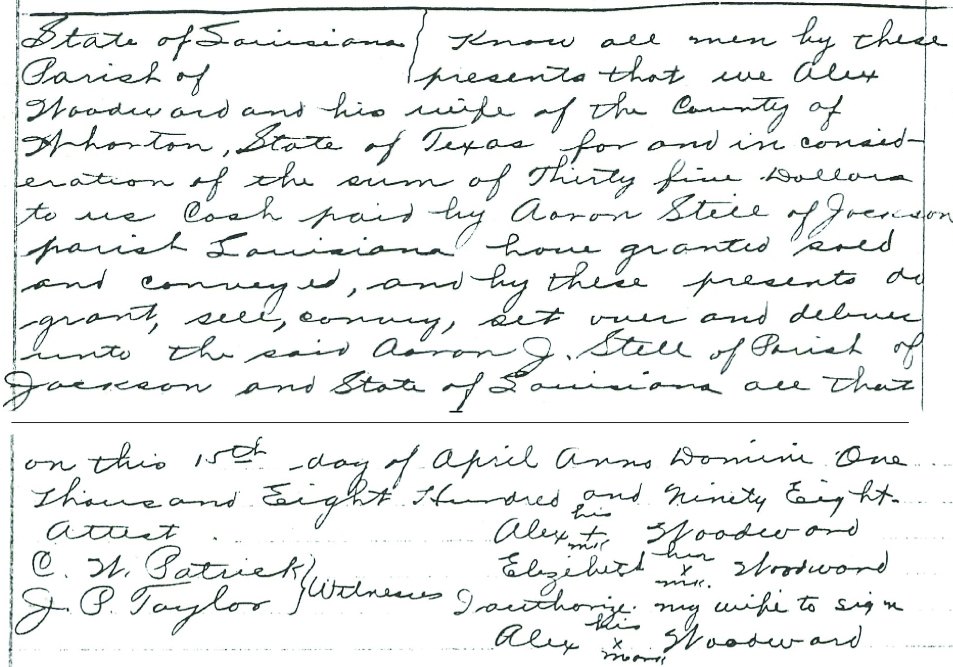
Woodard's father was Marion Hugh Woodard, who was born in Lincoln County, Oklahoma.  His parents were Minnie Minerva, from Tennessee, and Alexander Woodard, from Texas.  Her grandfather died when her father was only 3, so she doesn't know about anything earlier than that.  She's taking this genealogical journey for her father, a self-made entrepreneur and a family man.  She believes she got her daring from her father.  She has no expectations of what she is going to learn and says, "Surprise me!"

Woodard begins her journey in her own home.  She says she has asked genealogist Joseph Shumway (AG; we've seen him on five episodes previously) to help her.  She tells him that her roots are wide but not deep and that she wants to learn about her father's family history.  She knows that her grandfather was Alex and that her father was born June 3, 1920 in Lincoln County, Oklahoma.

Shumway tells her they should start with the U.S. census so they can identify her father's parents.  Her has her go to Ancestry.com (of course) and click on the U.S. census collection link, then look for Alexander Woodard (with exact spelling) from the main census search page.  The top two hits, for 1920 and 1930, seem to be for the right family.  Shumway directs her to look at the 1920 census.  When she brings up the image, she finds the head of household was her grandfather, Alex A. Woodard, and his wife was Minnie H.  (Alexander was one of the children).  She recognizes the names of an aunts and an uncle, but her father isn't there.  The official enumeration date for the 1920 census was January 1, and her father wasn't born until June, so he missed being counted (which is why I would have started with the 1930 census, to try to find the family with her father there, and that way I would know it was the right family).  Shumway states that January 1 tells us the date the family was visited, which is incorrect; per the information on the census page, they were actually visited on January 16.


Alex Woodard was listed as 40 years old and born in Louisiana, Woodard's first surprise, as she thought he was born in Texas. Now Shumway tells Woodard to do something no one should ever do:  go straight from 1920 to the 1880 census to find Alex with his parents.  Under normal circumstances, jumping 40 years at once is a great way to make a mistake and follow the wrong person, who superficially seems to be the relative you're looking for.  By going from one census to the next chronologically, you minimize the chances of picking up the trail of the wrong guy.  So they should have looked at 1910 and 1900 before 1880.  But, of course, they've done all the research ahead of time, so Shumway already knows what they're going to find.

This time Shumway has Woodard search for Alex Woodard born in 1880, and what do you know, there he is.  Woodard's grandfather Alex was 5 months old, born in December 1879, and living with his parents, Alex and Lizzie Woodard, in Jackson Parish, Louisiana.  Alex the father was 39 years old, a farmer, and born in Georgia.  After a few seconds, the meaning of this registers with Woodard, and she looks shocked.  If Alex Sr. was born about 1841 in Georgia, "Mother of God, he was enslaved!"  So when she said, "Surprise me!", she wasn't kidding, even though it shouldn't have come as a surprise that her family had roots in slavery if they were from the South.


The program cuts to a commercial break here, and when it returns, the narrator tells us that Woodard is at her home in Los Angeles.  In the introduction, however, we were told that Woodard lives in Santa Monica.  Sorry, Mr. Narrator, Santa Monica is NOT Los Angeles.

Returning to the revelation that her great-grandfather was born in Georgia, Woodard asks if it's possible to find out where in Georgia he was from.  Shumway says he can do some "extra digging" to "try to narrow down" a more specific place (I despise this pretense that the information hasn't already been found) and that he will get back to her.

In an interlude apparently meant to suggest that Woodard is waiting to learn what Shumway might find out with his "extra digging", she talks about how her people, and all enslaved people, came out of slavery with nothing.  She wants to trace how her family got out, if the footprints are still there.

Shumway reappears with his "new" additional information about where Alex was likely from.  He suggests that Woodard meet with a historian in Houston County, Georgia.

And off to Houston County she goes, to Perry specifically, which is the county seat.  At the courthouse she finds Dr. Daina Ramey Berry, a historian of American slavery.  Berry starts off by telling Woodard, "You know that he would be listed under a white Woodard family," and "Enslaved people often kept the surnames of their owners."  I'm getting really tired of this trope.  Modern scholarship has shown that the majority of former slaves did not take the names of their former owners.  The two most common surnames after Emancipation were Washington (for George Washington) and Freeman (which should be self-explanatory).  Tony Burroughs, probably the preeminent black researcher in this country, has stated that in his many, many years of research, he has found only about 15% of former slaves that took prior owners' names.  It's convenient for WDYTYA to trot it out because it's a lot easier to explain, and it's nice that it's worked for them in the limited amount of research on black celebrities they've done, but from everything I have learned, it just isn't accurate.

Ok, off the soapbox.  After saying this, Berry says they should be able to find some information in white slaveholder records, particularly the annual returns.  Those are for the taxes that were collected on property, including slaves.  As slaves were not taxed by name until they turned about 5, and Alex was born about 1841, Berry suggests Woodard look for a book in the late 1840's.  She chooses 1849, which seems to be the only book in that section that has a big white label on the spine (coincidence?).  (Why not 1846 or 1847, which would have been right about the time Alex would have been listed by name?  Or did they look at those years, and they didn't make it to the final program because there was nothing exciting?)

Woodard searches the index of W names and finds John Woodard, who "could be" Alex's owner.  She goes to page 42, which isn't an annual return after all, but an estate appraisal taken after John Woodard died.  It is titled "Appraisement of the Estate of John Woodward Deceased", which throws Woodard off because of the different spelling of the name.  Berry explains that spelling could change depending on who was writing (which is at least accurate, if not a complete explanation).  Woodard reads the beginning of the inventory, which starts with the names of slaves and their values.  She soon comes to Alec, valued at $400, which Berry tells her is her great-grandfather.  And starting at this point, she calls him Alec instead of Alex.

Woodard asks, "Who is his mom?", to which Berry replies, "We don't know."  The reason she gives for this is that slaves didn't have birth certificates.  Well, that isn't a complete answer either, because in Georgia in the 1840's, I don't think anyone had birth certificates.  And many slave owners actually did keep track of when their slaves were born (such as with Lionel Richie's ancestor), but that information was in their personal papers, which aren't always available.  Again, WDYTYA goes for the quick, oversimplified answer, rather than accuracy and educating viewers.  Yes, I know the program is entertainment, not educational, but it's still annoying.

Ok, back off the soapbox.  Berry explains that the mother role in Alex's life would have been filled by "fictive kin", the family that slaves created for themselves.

We hear from the narrator at this point, who explains that beginning in the early 1600's, 10 million Africans were forced into slavery in North and South America and in the Caribbean.  About 400,000 of them were brought to North America.  As property, they had no legal rights and were often separated from their actual famly members.  To preserve their humanity, they created their own families and kinship networks, which provided support.

Woodard goes back to reading from the estate appraisal and finds that after the slaves the livestock were listed, which justifiably offends her.  She comments that Mr. Woodard didn't seem to own many slaves, and Berry classifies him as a typical small slaveholder.  But now that their owner had died, the slaves would have been waiting to find out what would happen to them and where they would go.  Berry says that they lived in fear of separation.  To learn what did happen, Woodard next goes to page 426 (even though pages 341, 342, and 397 appeared in the index also).  There she finds "Distributing of the Estate of John Woodard Decd" and says, "This shit [which was bleeped out] is making me anxious!"


The narrator tells us, "Alec faced being separated from the other slaves he had grown up with when his owner, John Woodard, died."  We don't actually know that Alex grew up with any of the other slaves listed in the inventory, at least not from what was shown on the program.  We know only that they were all owned by John Woodard when he died, and we don't even know when that was, although this page says it was 1846.  We are given no information about how long any of them have been there or been together.  Now, if John Woodward did die in 1846, it is possible that the slaves listed in the inventory had stayed together in the five years between his death and the appraisal.

Returning to Woodard, she reads that Martha Blount, formerly Woodard, was to receive the Negro Milly, valued at $1,000, and that Laura Woodard was to receive Harriett, valued at $500.  Then she reads that William Woodard would receive one Negro boy, Elic, valued at $700.  This, we are told, is Alec/Alex.  Woodard suddenly remembers that some of her older aunts and uncles referred to their father as Elic; the younger ones had called him Alec.  (This was actually a great example of how hearing something can trigger a memory.)

The distribution of the estate was signed off on September 14, 1856, at which time Alec would have been about 15 years old.  Woodard comments that he would have been entering the period of his prime value as a slave, and Berry says the $700 is comparable to the cost of a car today.  They also talk about how Alec would most likely have been separated from his fictive kin at this point.  (But the complete distribution shows that, in addition to Alec, five more of John Woodard's slaves went to William, who inherited more than half of his father's slaves.  So most of these fictive kin actually seem to have stayed together, at least for a time.)

Woodard asks whether Alec stayed in Georgia.  Berry says, "I'm going to do some digging" (just like Shumway, right?) to try to find more information.  She'll look for records closer to the Civil War.  Before she leaves, Woodard gives Berry a big hug and tells her they're kin now.

Woodard feels she is on the cusp of something, like waiting for the arrival of a child.  She's chasing a spirit and wants to learn who Alec is, and she hopes Alec will speak to them.

We next see Woodard driving along a country road in Houston County.  She tells us that "last night" Berry looked at records for John Woodard (sure she did!) and found a deed for his land when he owned Alec.  Berry told her she should go look, and now she's following that lead to track Alec.  The GPS in the car (which I noticed had the brand name and license plate blurred out; I don't know if they've done this on previous episodes) says, "Turn right onto Woodard Road," which brings a happy little scream from Woodard.  At the intersection of Moody and Woodard roads she turns left and finds a big stand of trees.  She gets out of the car, takes off her shoes, and pours a libation of water to her ancestors, saying that it is a way of connecting with Alec on the ground he worked and sweated into.  The ceremony is an acknowledgment that you didn't invent yourself and a way of humbling yourself to your ancestors.  Before she leaves, she picks up several pine cones and takes them with her.

William Woodard's slaves listed in
the 1860 census slave schedule
Woodard returns to see Berry and proudly shows her some of the pine cones from Woodard Road, then asks what happened to Alec after he went to William Woodard.  Berry looked for William in censuses and found him in Jackson Parish, Louisiana.  He had migrated west, probably because of the availability of land.  Berry does not show him and his family, however, but has the 1860 census slave schedule, dated December 13.  The slave schedules listed slave owners by name but enumerated slaves only by age, sex, and color.  William had three slaves, a 32-year-old female, a 16-year-old male, and an 8-year-old male.  Berry talks only about the 16-year-old, whom she says was likely Woodard's great-grandfather.  He should be about 19, but Berry says that any time a slave was listed with an age it could vary, because they didn't have birth certificates.  (What she doesn't say is that was also the case with people who were not enslaved.  Very few people in the 19th century in the U.S. had birth certificates, and most had no need to know how old they were, so many people's ages varied from census to census.)  They talk about how Alec has been separated from his family (but the woman and the boy are likely two of the slaves from John Woodard's estate, so they would have been part of that family).  Often one can turn to annual tax lists to learn the names of slaves in a household, but perhaps they were not available for this time and location, or the producers wanted to emphasize Alec's isolation rather than the complete story.

Berry now says that Woodard should go to Louisiana to continue her research, at the Louisiana State Archives.  It is difficult to trace blacks due to fires and burnt records (which affect everyone's research, not just that of blacks; just ask anyone researching ancestors from the South), but maybe she will be able to pick up Alec's trail after the Civil War.  (Translation:  We will be picking up Alec's trail after the Civil War.)

Woodard adapts a quote from one of Maya Angelou's poems, "Still I Rise":
     I come, bringing the gifts that my ancestors gave,
     I am the dream and the hope of the slave.

She then says that Alec has gone from being an ancestor to a relative, which is a wonderful way of personalizing the research process.  And off she heads to Louisiana.

In Baton Rouge Woodard goes to the Louisiana State Archives.  As she walks in the building, she talks about how it is June 19, or Juneteenth (did the producers actually plan that?), the day that slaves "in the Southwest" learned that they had been freed by the Emancipation Proclamation.  (Well, close:  It's the day that slaves in Texas learned they were free.  It is celebrated in many Southern states, however.)  Inside she meets Dr. Mark Schultz and promptly points out to him that it's Juneteenth.  The two of them seem to have a natural chemistry as they work together, which was really fun to watch.

They begin by talking about Alec's move from Georgia to Louisiana, and Schultz says that probably the "most horrific experience" a slave could have was to have your family torn apart (though I tend to believe that being a slave in and of itself would be the most horrific experience).  That said, he tells Woodard that for research during Reconstruction the best source for information is the Freedmen's Bureau records (I'm so glad they discussed these extremely important records!).  He says that they are held at the National Archives in Washington, D.C. (but doesn't mention that they are also available at all regional branches of the National Archives, and online on several sites, including Ancestry).  Woodard knows that the bureau was when the federal government assisted former slaves, and Schultz points out that it also settled issues between former slaves and their former owners.  (It did a lot more than that, but that's apparently what's going to be relevant here.)

Schultz says that he did a "digital search" (but doesn't say where, which suggests it was not on Ancestry) and found a record relating to Alec.  The record is from Verna(?), Louisiana and is dated January 18, 1868.  B. D. Blount, who we are given to assume was Martha (Woodard) Blount's husband, said he was willing to give up the three children claimed by "Elic" if they were willing to leave.  Woodard immediately asks if the children were Alec's, but the record doesn't state whose children they were.  Then she wants to know why Alec even had to ask, because B. D. shouldn't have had any claim on the children, and Schultz says that the children might not have been "free" yet, which leads to a discussion of how people might not be free if they hadn't heard the news yet.  (They did not bring up the fact that the children might have been legally bound to Blount by a contract, a matter that the Freedmen's Bureau also supervised, which would have given him a claim.)  Unfortunately, the children's names were not mentioned, and they don't know if Alec got the children (i.e., they couldn't find any further records).  Not all records of the Freedmen's Bureau have survived.

Next Schultz says they should look at tax rolls, and they move to a microfilm reader.  They start off in 1867 in Jackson Parish.  Alec (this time as Allen, but we have to hope they know it's the right person) paid $1.00 as a poll tax, which was to register to vote.  Schultz explains that this is the period of the largest wave of black voters in American history.  The narrator steps in say that after the Civil War and the abolishment of slavery, resistance to emancipation continued in the South.  Laws were created that blocked blacks from being elected to office, owning land, and working in certain jobs.  Poll taxes were deliberately expensive to try to prevent the impoverished former slaves from being able to pay.  Even when they did pay, they faced intimidation and violence if they tried to exercise their right to vote.

Schultz says that Alec would have given up a day's wages to pay that poll tax.  The expense notwithstanding, 90% of black men registered to vote in Louisiana.  Beyond the problem of paying the money, it was dangerous to do so, because this was when the KKK was first organized, and they practiced political terrorism.  Families who challenged white supremacy were prepared to die when they did so.  Woodard is inspired to sing part of "Lift Every Voice and Sing" (lucky Dr. Schultz!):
     Facing the rising sun of our new day begun,
     Let us march on till victory is won.

Schultz asks whether Alec had a family.  Woodard remembers the 1880 census she looked at with Shumway and tells Schultz about Alec's wife, Lizzie, and the nine children, including that the youngest was her own grandfather.  Schultz suggests they skip to the year after the census to search for Alec again.  This is again bad practice, skipping years, so the only logical reason is because they already know something "interesting" shows up that year, and indeed, in 1881 the tax list shows that "Alex" is taxed on 80 acres of land.  He owns land!  He is a farmer, which we saw in the 1880 census, but now we know it's his own property.  (In theory, he could have owned land earlier than this, but since they didn't show us those tax lists, my guess is probably not.)  Woodard comments that he had plenty of kids to help him, and Schultz points out that a single man couldn't afford to be a landowner on his own at this time; it took a family effort.

As a landowner, Alex has moved up to a higher class.  At Schultz's suggestion, they now jump a decade ahead to 1891, and we discover that Alex "Woodward" has 240 acres.  Woodard is very excited and says that her grandfather would have been 9 years old, the "same age where we met Elic!"  (Except that we know from the 1880 census that her grandfather was born about December 1879, which means in 1891 he would have been 11.  I know, I am such a party pooper.)

Moving ahead one more year, in 1892 Alex is back down to 80 acres, valued at $106.  Unfortunately for Alex, he bought additional land right before the agricultural depression of the 1890's (hindsight is great, isn't it?).  This depression hit the entire country and affected many other people.  Woodard wants to find out where the land went; Schultz tells her they don't have any records of Alex after 1892 but doesn't say why (possibilities:  he didn't pay the property taxes after 1892; he wasn't in Jackson Parish anymore; he left the state; the records no longer exist).  He says, "Fortunately, this isn't the last hole to dig in" (what a great expression!) and that Woodard should go to Jackson Parish, where deed records might have more information for her.  Before Woodard leaves, she tells Schultz that he is now officially her "brother from another mother" and gives him a sincere hug.

Outside, Woodard talks about her great-grandfather's ingenuity (huh?), persistence, and work ethic, and how freedom is the ability to go as far as you can go.  After the Emancipation Proclamation, Alex made a substantial life for himself.  He passed on the knowledge of how to build a life as a gift to his descendants.

In Jackson Parish, Woodard goes to the courthouse in Jonesboro, the parish seat.  Historian Dr. Beverly Bond is there to greet her.  She has found a record from 1896 pertaining to Alex.  J. G. Barbee and J. C. Gifford of Wharton County, Texas made a loan to Alex, $1,375 to be repaid in one to five years at 10% interest.  Woodard comments that it was a "big deal to be able to get a loan, even now."  Alex was buying 95 acres in Wharton County.  Woodard is happy he finally made it to Texas (though we don't actually know that he was in Texas, only that he bought land in Texas).  Bond tells Woodard that Wharton County is in southeast Texas, an area of good farmland.  She adds that after the Civil War many former slaves established Wharton (which is inaccurate, because the county existed in the United States at least as early as 1850, as it was enumerated in the census that year).

Bond asks Woodard, "Can I show you another record?" (I keep waiting for someone to say no) and pulls out a conveyance record (deed) from 1898.  At this point Alex was about 57 years old and had been in Texas for (presumably) two years.  The deed shows that Alex and his wife sold 80 acres in Jackson Parish for $35 to Aaron J. Stell, also of Jackson Parish.  It takes a few seconds, but then Woodard realizes how little Alex was selling the land for, and she gets very indignant.  She apologizes to Bond but admits she's outraged at the small amount.  Bond explains that land was going up and down in value and then adds that Aaron Stell was Lizzie's brother.  Though Bond seems to be emphasizing the relationship more than the name, Woodard latches onto the name, because now she has a last name for Lizzie (which would seem to be a big deal, considering that the floating family tree shown at the beginning of the episode did not show last names for either her mother or her grandmother).  Alex might have been able to get more money, but this way he kept the land in the family.


Alex and Lizzie both "made their marks" (they were illiterate) at the bottom of the deed.  Woodard is struck at how Lizzie has now become a full human being to her, because she was legally recognized in the document as Alex's partner.  (I'm sorry that her appearance in the census wasn't sufficient.)

Bond has one more item for Woodard:  a map showing the 240 acres that Alex had owned.  It lies off of R. F. Stell Road (but no comment is made about that also being the last name of Aaron and Lizzie).  I wanted to know which were the 80 acres he originally had and then sold to Aaron Stell.

As she drives to Alex's former property, Woodard says she is happy that he kept the land in the family.  Alex had the wherewithal and wits to be a businessman in a system where he was on the buttom rung.  Woodard considers Lizzie to have been his equal.

As Woodard turns onto the property, a clearly visible sign says "Posted No Trespassing Keep Out", but she figures that technically she isn't trespassing because she is the great-great-granddaughter of Elizabeth Stell.  (Besides, the camera crew is with her, so I figure they must have gotten permission from someone to be there.)  This land is grown over, and it's obvious that no one has farmed it in a long time.  She pours a libation here also but does not remove her shoes, which kind of surprised me.

Woodard closes by talking about how her roots are still wide but they've taken hold.  Alex and Lizzie kept on living, doing, and working, with an eye on the horizon and thinking ahead to the next step.  Alex is now a fleshed-out character, and she's proud of his business dealings.  She plans to tell her family the story and to keep on telling it, to make sure it isn't forgotten (hooray!).