Showing posts with label land records. Show all posts

Saturday, May 18, 2024

Saturday Night Genealogy Fun: Use FamilySearch Full-text Search

The challenge today from Randy Seaver for Saturday Night Genealogy Fun is valid for varying definitions of the word "fun."

Come on, everybody, join in and accept the mission and execute it with precision.

1.  Use the FREE FamilySearch Full-Text Search (https://www.familysearch.org/search/full-text) to find a record for one of your ancestors that is new to you.

2.  Share your results on your own blog or in a Facebook post.  Please share a link in Comments on this post if you write your own post.

I'm going to be a party pooper again, sorry.

Non sequitur:  Have you ever heard the party pooper song?
"Every party needs a pooper, that's why we invited you.
"Party pooper!  Party pooper!"

Okay, back on track.

First, I admit I had not tried to use the full-text search yet.  I hate blindly fishing around in records and much prefer to have an actual research plan.

That said, I did as Randy suggested and tried to find a new record for one of my ancestors.  I would have been happy to find a record for a relative on a collateral line.

No such luck.

I went to the link that Randy provided.  I noted that it said I would be browsing "US Land and Probate Records, Mexico Notary Records, Australia Land and Probate Records, New Zealand Land and Probate Records and US Plantation Records."  (I also noted that to the left it said, "Only two collections are currently available to browse . . . .", so something is out of date.)

I decided I would try to find something in the plantation records by using as a keyword one of the locations I am researching in the part of my family that was enslaved.  So I typed in "upatoi" (a location in Georgia) and let 'er rip.

I got a total of 24 results.  Okay, that's pretty manageable.

Then I looked at the filters.

I had options of Collection, Year, Place, and Record Type.

The first one I tried to use to narrow down my hits was Place.  The only option was United States of America, which applied to all 24 hits.  Okay, that's useless.

I looked at Collection.  That gave me choices of "Alabama, Wills and Deeds, ca. 1700s-2017 (1)", "Georgia, Wills and Deeds, ca. 1700s-2017 (4)", "Pennsylvania, Wills and Deeds, ca. 1700s-2017 (1)", and "United States, Indenture Records, 1600-2001 (18)."

As I was hoping to find information about plantation records, I chose the Georgia wills and deeds.

Boy, was I disappointed.

Nothing about plantation records.  Nothing even in the 19th century.  "Muscogee, Georgia, United States Will 1949", "Muscogee, Georgia, United States Will 1955", "Marion, Georgia, United States Deed, Mortgage 1965", and "Marion, Georgia, United States Deed, Mortgage 1960."

Okay, let's look at the indenture records.

Of the 18 records, 16 are titled "Riverdale Cemetery, Columbus, Muscogee, Georgia, United States Enslavement, Cemetery" followed by a year ranging from 1881 to 1952.  Two are "Georgia, United States Enslavement, Cemetery 1921", and you can see from the teaser text that they're the same item.  So none of these years is during the period of chattel slavery in this country, which officially ended in 1865.  And I don't understand why cemetery records are listed under indenture records.  But I gamely clicked on the first result to see what it would show me.

The first link said it was for 1881.  The page told me it was a full transcript from "Riverdale Cemetery.  Cemetery Records 1866–2000, Enslavement Records 1866–2000."  Um, say what?  What enslavement records begin in 1866, the year *after* slavery officially ended?  And the record itself was an obituary for a man born in 1881 in Alabama.  The obit mentioned he had celebrated his 50th anniversary, so figure he was at least 70 years old; that means that he died about 1951.  Sure, it's a record having to do with Riverdale Cemetery, but saying it's for 1881 is misleading at best and a train wreck at worst.  How is this supposed to be helpful to me?

I clicked on the first link for "Georgia, United States Enslavement, Cemetery 1921" to see if it was any better.  It was listed as a full transcript from "Georgia.  Cemetery Records 1866–2000, Enslavement Records 1866–2000."  Okay, same logic problem as the previous one.  This was also an obit.  This man was born in 1877 in Upatoi and died at 82, so it's from about 1959.  The 1921 that shows up in the link name?  "The aldermanic form was government was abandoned in Columbus in 1921."  Even less relevant than the first link I tried!

I then tried to cut down on the number of hits.  I had "upatoi" as my keyword, so I added "crawford" (one of my family names).  Silly me, I thought the search engine would search for records where both words appeared and cut down the number of hits, maybe even to zero.

I was wrong.

Instead of 18 results, I now had 6,760.  It would appear that adding a term causes the search engine to return results with either of the search terms, not both of them.  I did note that if you add a plus sign in front of a term, it will include that term.  When I searched for +upatoi and +crawford, I had no results.  Well, I did cut it down to zero!

I tried one last search.  I used "slaves" as my keyword.  I had 446,052 results.  I restricted the place to Marion County, Georgia, and the number of results dropped to 41.  The links were to wills and deeds ranging from 1846 to 1862 as far as the period of slavery was concerned, but several titles listed years after 1865 and even into the 20th century.  I clicked a link to one that was titled "Marion, Georgia, United States Deed, Mortgage 1936."  The image was said to be from "Marion.  Deeds 1845–1965, Mortgages 1845–1965."  It was actually from 1858–1859.  I did not find "1936" anywhere in it; the closest was "one hundred thirty six."

I went back to the search results page and added "kinchafoonee" (another location associated with the family), and the results stayed at 41.  Since my previous attempt at adding a name appeared to indicate that the search engine was returning results with either search term, I interpreted this to mean that none of the records for Marion County include Kinchafoonee in the text, or at least not with that spelling.  When I added a plus sign in front of each term, I had no results, so my interpretation appeared to be correct.

I never even saw anything with results that said they were from plantation records.  I suspect that the only way to get those is with the plantation owner's name.  Since I still have not found the name of a single slaveholder in my family, I guess I won't be getting far with those.  I did not see a way to focus my browsing on just one set of records included in the full-text search.

Obviously, the advantage of the full-text search is that it's creating a searchable database of words from handwriting, which is very cool, and that you don't have to wait for a real index.  On the other hand, it's like putting a search term into Google, which used to be great but has been getting worse for quite some time.  You get results with your search term (well, if you're lucky; nowadays Google routinely returns results with no appearance of your search term anywhere on the page), but the context could be anything.  An index gives you context.  And yes, I admit I am very biased, because I'm an indexer.

After this dismal experience, I am reminded of a study I read about many years ago.  Researchers observed people searching for information.  The people searching used an index or did a general text search, such as by using Google.

Even though search results were consistently better and desired information was found more quickly when using the index, the majority of searchers, when allowed to choose the search method, defaulted to doing a general text search the majority of the time.  When it was pointed out to them that the results were better with the index, the response was that it was simply easier to do the general search, and they didn't care that the results were not as good.  Me, I care.  My time is valuable.

I am very happy for Randy that he found five new records for his ancestor.  After seeing my search results, I think I'm going to wait for actual searchable indices for these record collections.  I get tired of beating my head against the wall after a while.

Addendum:  I decided to try one last time, with one of the unique surnames I am researching.  My aunt's paternal grandfather changed his name when he became a U.S. citizen.  He made up a name, which is unique to that family.  If I find that name, it's my aunt's family.  I searched for that name in the database and got a grand total of two hits:  my aunt's great-grandmother's will and her probate.  The reason the name showed up is because my aunt's mother (the granddaughter of the deceased) was named in the will under her married name.  Because it's a unique name, it allowed me to find the will, so that's a new record!  Yay, I found one, even if for my aunt's ancestor and not mine!  And now I know when her great-grandmother died, which is new information.

Friday, August 25, 2017

Treasure Chest Thursday: John Schafer Buys Property of the Late John Smith


This sheet, and each of the three that follows, measures 8 1/2" x 14", the standard for legal size.  This first sheet is slightly yellowed but appears to have originally been a creamy off-white.  It's a heavy bond, possibly more than 20#, with a very sturdy feel.  It has a watermark that is difficult to read, but I can make out "Byron / –eston Co / —n Recor— / 1918."  I think the first two lines might be "Byron Weston Company", but I'm stuck on the next word.

This is a sheet of letterhead for the St. Louis County Land Title Company.  Everything is typed on the page except for a check mark in pencil on the left and one sentence in pencil at the bottom:  "Where does the eastern boundary come in?"


These three pages are of a lesser stock than the first.  They're all a muted yellow-orange with stronger color at the top.  Everything on each is typed except for a penciled check mark to the left of each transaction.

The first page tells us that the set of documents is a chain of title to lots 9 and 10, which are the land at the center of the dispute between Jean and Emma La Forêt and Emma's three Curdt siblings.  The receipt posted last week says that the order was for lots 9 to 16; we'll have to wait until we go through all the pages to see which is correct.

It's clear that Jean copied the information from these entries to create his abbreviated version, which did not include all the details for every transaction.  But he wasn't perfect with his copying — the first mistake comes in the first entry, with the name Solomon, which Jean typed as Salomon.

From these four pages, Jean copied the first entry in its entirety.  On the second page, he took highlights of the first three listings and then copied the fourth completely.  He seems to have copied everything from the third and fourth pages.

One question this resolves is why the land was referred to as a subdivision of John Smith's estate in the legal waiver that Louis Curdt signed.  John Smith's heirs sold lot 10 to John Schafer.  Apparently Mr. Smith wanted to make sure his children's names stood out a little more than his:  Louisiana Smith and Doddridge Smith are decidedly less common.

John Schafer purchased lot 10 directly from Smith's heirs in 1856, but he didn't acquire lot 9 until 1864, almost ten years later.  He purchased that land from Rufus and Mary Lackland, who do not appear to have been Smith's heirs.  Since the chain of title was concerned with the properties from the time that Schafer had them, we don't get information on when the Lacklands bought lot 9, but the description mentions 182-116 and that it was part of Smith's estate.  Schafer's purchase of lot 10 was 183-316, so it was probably not long after the Lacklands bought lot 9.

Comparing the descriptions of the two pieces of land, one finds a lot more detail in that for lot 10, which uses landmarks ("a black oak, 5 inches in diameter"), degrees of direction, chain measurements, and roads to define the plot.  The description of lot 9, on the other hand, is distinctly less precise — "32.49 arpens, more or less" — refers to a file in the surveyor's office instead of giving details, and has spelling errors ("noreth" for north, "be" for by).  Maybe the two transactions were processed by different clerks.

I can see some logic to Elizabeth's letters of administration being listed here, as her appointment meant that she was in control of the land, but I'm surprised that information about the family's marriages and divorces appears in the chain of title.  I don't think they're normally registered at the same county office as land transactions.  When I looked at Jean's compilation, I figured he had obtained documents from multiple sources.  But the chain of title refers to the marriage records; why?

Here's another confusing thing about these documents:  Why are some letters and numbers underlined?  On the first page, we see "0.43 1/2" and "page 141".  On the second page, there are "Smith's" and "plat".  The third page has "Miss" Elizabeth Schafer, but that might have been underlined to emphasize the error, as a widow should be Mrs.  But why does the last entry have "Schafer" twice and "Kink"?  Happily, the fourth page has no strange underlines.

It appears that the check marks on these pages might simply have indicated that Jean had copied what he wanted from the entries, since he checked every one.  I don't know why someone wrote the question on the first page, though.  The description of lot 10 says it is bounded on the east by lot 9.  (That information is confirmed in the description of lot 9, which says it is bounded on the west by lot 10.)  So if the eastern boundary is defined, why would someone ask where it comes in?

Thursday, August 17, 2017

Treasure Chest Thursday: The Chain of Deeds for the Schafer Property


This sheet of paper is 8 1/2" x 14" and is dark orange.  It is the last page of a packet of documents held together with two large brads and appears to be the "cover" page.  At some point in the past the pages were probably folded in half and this was on the outside.  The stain in the lower right corner looks as though it might be from grease.  The page is labeled as coming from the St. Louis County Land Title Company.  The title on the page, "Abstract of Title", describes reasonably well the contents of the packet.


This half sheet measures 8 1/4" x 4 1/2".  It is the last page in the set of documents, appearing just before the above file "cover."  It is a receipt from the St. Louis County Land Title Company, addressed to Jean L. "LaForest" of Overland, Missouri and shows an order for the chain of deeds for lots 9 through 16 in Belt's Subdivision.  The dates on it appear to indicate that Jean placed his order on January 6, 1920 and paid $10, probably a deposit against the total copying to be done.  He might have mailed his order, because the top of the receipt is dated January 17, 1920; it's also possible that it simply took a week for a clerk to register the request as #8855 with a charge of $25.  When the job was finished, the balance due was $15, although no date is entered for that.  The "PAID" stamp shows the bill was paid off February 4, 1920, and Jean's note in the upper left records that he received the documents the next day, on February 5.


This sheet also measures 8 1/2" x 14".  The hand-drawn map was attached to the front of the complete packet from the title company.  The blank page (from a different land title company) is the reverse side of the map.  Judging by the handwriting on the map, I suspect that Jean La Forêt is the person who created it.

The large packet of papers between these sheets consists of abstracts of land transactions for the lots mentioned on the receipt.  These abstracts appear to be the source of the information that Jean used to reconstruct the history of the sales of the land purchased by John Schafer, lots 9 and 10, the focus of the dispute between Emma (Schafer) La Forêt and her three Curdt siblings.  So Jean didn't go to the county recorder or assessor and research all this himself; he ordered copies and let the county office do the research for him.  Then he pulled out the information relevant to his search and apparently retyped all of it.  There are more than 20 pages in the packet, so I will be posting only a few each week.

I find it interesting that Jean's last name was misspelled "LaForest" on the receipt.  As a French language major, I learned that a word containing a vowel with a circonflexe (circumflex in English) over it often appears in English with an "s" after the vowel.  So, for example, the word "forêt" translates as "forest."  I doubt that the clerk in Missouri in 1920 knew this, and yet Jean's last name became Forest.  Just how did that happen?

Thursday, July 13, 2017

Treasure Chest Thursday: Jean La Forêt Does Land Research


This sheet of paper is 8 1/2" x 13".  It's a piece of off-white 20# bond with a watermark of BERKSHIRE / SOUVENIR BOND / USA.  It has a small rectangular piece of paper, on which is written "Original" in pencil, folded over the upper left corner.  This page is followed by eleven others on the same type of paper.  They are backed by a rectangular piece of an advertising poster, which appears to have been cut down to size for the purpose of backing these pages.


Jean La Forêt was definitely willing to spend time on research.  It must have taken many hours to find all the records he cites in this document and then type up the summaries.  He researched the property that John Schafer, Emma (Schafer) La Forêt's father, bought in 1856 from that purchase through to 1919, the year Emma's mother died.  He even included transcriptions from Louis and Elizabeth Curdt's divorce case.  Here's a quick overview of the contents:

1856:  John Schafer bought lots 9 and 10.

1864:  A warranty deed was executed for lot 9.  The property was released on margin October 19, 1867, six weeks after letters of administration were granted to Elizabeth Schafer to handle her deceased husband's estate.

1870:  John Schafer's estate was settled.

1874:  Louis Curdt and Mrs. Elizabeth Schafer married.

1883:  Emil Petit and Emma Schafer married.

1885:  Emil and Emma Petit's waiver was filed.

1885:  Louis and Elizabeth Curdt filed a deed of trust on the land with a life insurance company.

1891:  Elizabeth Curdt divorced Louis Curdt on grounds of desertion.  She was awarded custoy of Louisa, August, and Alvina and ownership of lots 9 and 10 but received no alimony.

1891:  Louis Curdt filed a quit claim on the two lots.

1891:  Elizabeth Curdt took out a $2,800 mortgage on the land.  She paid it off in 1895.

1892:  Elizabeth Curdt leased some part of the land for two years to C. W. Seidel.

1896:  Elizabeth Curdt deeded part of lot 10 to Charles Frederick Schaefer (Louisa's husband), apparently for $3,000.

1897:  Charles and Louisa Schaefer filed a quit claim to Elizabeth Curdt for half of the property deeded in 1896.  The amount is $1 and "other consideration."

1897:  Elizabeth Curdt filed a quit claim to Charles and Louisa Schaefer, also for $1 and other consideration, to exchange property.

1898:  Elizabeth Curdt took out a mortgage for $2,800.  She paid it off in 1900.

1898:  Charles and Louisa Schaefer took out a mortgage for $1,000.  It appears to have been paid off in 1904.

1900:  Elizabeth Curdt took out a mortgage for $1,500.  She paid it off in 1903.

1901:  Charles and Louise Schaefer sold part of lot 10 to August Eves for $3,350.

1901:  Elizabeth Curdt sold part of lot 10 to Charles Schaefer for $600.

1903:  Elizabeth Curdt sold part of lot 9 to Jacob Wagner for $2,000.  In 1912 Jacob Wagner and his wife, Louisa, sold the land for $15,000.

1903:  Elizabeth Curdt sold part of lot 9 to William Curdt (a relative of Louis?) for $1,300.  In 1912 William Curdt and his wife, Katarine, sold the land for $5,500.

1906:  Elizabeth Curdt sold part of lot 10 to her daughter Alvina for $1,000.  In 1919, after Alvina had married, she and her husband, Edward Schulte, sold this for $1 on a quit claim deed to Emma Opperman.

1906:  Elizabeth Curdt sold part of lots 9 and 10 to her son, August Curdt, for $500.  In 1909 August and his wife, Mathilda, sold the property to his brother-in-law Charles Schaefer for $1 and part of the land Charles and Louisa Schaefer received in 1906.  August and Mathilda Curdt sold this second piece of land in 1912 for $6,000.

1906:  Elizabeth Curdt sold part of lots 9 and 10 to Charles Schaefer for $875.  In 1912 Charles and Louisa Schaefer sold part of this land for $5,600.  In 1914 they sold an additional section for $2,000.

1912:  Elizabeth Curdt sold for $100 a small easement adjoining property she previously sold.

I can see from this how one could interpret the sales and resales as ripping off Elizabeth Curdt.  Playing devil's advocate, however, it could be that the land had simply appreciated quite a bit due to development in the interim between Elizabeth selling the lots and the children reselling them.  It also could be the case that Elizabeth was being generous with her children.  It's obvious from previous documents that Jean and Emma believed she was being taken advantage of.  I don't think I see enough evidence here of that, though.

Thursday, June 29, 2017

Treasure Chest Thursday: Fraudulent Conveyance!


This piece of paper is 5" x 6 1/2".  It's a dark cream in color, with one section on the back that's orangish, where something, probably a business card based on the size, was pinned previously.  It has no watermark but seems to be of decent quality.  It might be writing paper, such as people used to use when letter writing was more common, although it's perhaps a little small for that.

There is handwriting on both sides, although the writing on one side is minimal, only numbers.  That side also has some names typed on it.  The handwriting appears similar to that of Jean La Forêt from his journal entries.  It also would seem to be his writing because it refers to Emma in the third person.  As some of the writing is a little difficult to read, I'll transcribe the entire side:

-- >< -- >< -- >< -- >< --

Fraudulent Conveyance
Section 1931 - Page 564 - I -

Emma was german thru
her marriage with Petit
(Foreigner)

The mother was adminis-
tratrix – Her husband
bought and returned
property to her -

Fraudulent conveyances all
over, since the marriage of
Mrs. Shaefer with Curdt,

-- >< -- >< -- >< -- >< --

This appears to be more information that Jean had noted for his and Emma's fight against Emma's half-siblings in the dispute over the split of Elizabeth Curdt's estate.  The reference to fraudulent conveyance seems to be from The Revised Statutes of the State of Missouri, 1899, which was cited on a document discussed a month agoSection 1931 is "Fraudulent conveyance" and does appear on page 564 in that edition.  I don't know how useful of a tool it was going to be in the La Forêts' fight, however, as it carried only a misdemeanor conviction.

It was not necessarily true that Emma became a German citizen through her marriage to Emile Petit.  Until the law was changed in 1907, whether a woman's citizenship status changed to that of her foreign husband was decided on a case-by-base basis.  What would have caused her to lose her citizenship was leaving the country.  When the act of March 2, 1907 went into effect, Emma's divorce from Petit was already in process; it was finalized in March 1908.  But even if she was considered a foreigner based on that marriage, her subsequent marriage to Jean in 1908 (a mere two months after her divorce) made her an American citizen again, because he had naturalized in 1890.  So well before the time Emma's mother died and all these disputes over the estate arose, Emma was no longer a foreigner.

The broad overview of the Schafer estate included the information that Elizabeth had been the administratrix of her deceased husband's estate.  That same document mentioned that Louis Curdt had sold the property back to Elizabeth after they were divorced.

The accusion of fraudulent conveyances since Elizabeth married Louis Curdt is interesting, primarily because it's so open-ended.  I'm guessing he was referring to the pressure to have Emile Petit and Emma sign away their rights to the Schafer property.  It's hard to tell if the punctuation mark at the end of the sentence is a period or a comma, as Jean seems to have used them almost interchangeably.  If it was intended as a comma, this thought does not continue on the other side of the paper.

That other side doesn't have much information on it.  Typed at one end are three names:  Miss Rosita La Foret (daughter of Jean and Emma), Overland, Missouri; Miss Ethel Schaefer (first time we've seen her name; perhaps the daughter of Charles and Alvina [Curdt] Schaefer?); and Mrs. E. M. La Foret (Emma).  Nothing else is there, so there's no way to tell why the names were typed.

Written in the middle of the page and upside down from the names are some numerals with absolutely no context.  Jean must have been trying to figure out some amounts connected with the estate, but he left no clues to follow up on.

Thursday, May 18, 2017

Treasure Chest Thursday: Another Copy of Emile Petit's "Interrogation"


This document is two sheets of paper attached to each other in the upper left corner by some sort of paste or glue, a technique we have seen several times.  The first page is 8 1/2" x 10 15/16"; the second is 8 1/2" x 11 1/16".  The third image is the reverse of the second page.  The first page is about 20# in weight but not high-quality paper; it has no watermark.  The second page is of better quality and has a watermark:  "BERKSHIRE SOUVENIR BOND USA."  Almost everything on these pages is typed, with the exceptions of the dates on the top of the first page, a handwritten "s" at the bottom of the first page, and the words "Questions to Petit" on the back of the second page.

In case this sounds familiar, it should.  This is another copy of Jean La Forêt's questions posed to Emile Petit, which I posted on March 16.  Those copies were in an envelope, while this one was separate.  The sizes of the pages are different, but the types of paper are the same.

Now that I have all the copies together in one place, it's clear that the one above is the original typed version of the second set in the March post.  The letter impressions on the page are crisper, and the indentations in the paper are deeper than in the March copy.  Shame on me for not noticing in March that the pages I had in hand had the fuzzy look of a carbon copy.

As these pages are the original typed copies of the set from March, they unfortunately add no new information to our ongoing narrative.  They do, however, reinforce that Jean La Forêt wanted to make sure he had plenty of copies of documents.  Maybe he was worried that one of Emma's siblings would try to destroy papers and derail his investigation.

Thursday, May 11, 2017

Treasure Chest Thursday: Revisiting Louis Curdt's Legal Waiver


In March, I posted three transcriptions of Louis Curdt's 1885 waiver of dower of Elizabeth (Walz) Curdt.  At the time I came up with a couple of ideas for where the original might be.  It turns out that I have one and didn't know it. Apparently when I sorted through all the documents, I didn't notice that I had two different sets of these waivers.  Well, now I know!

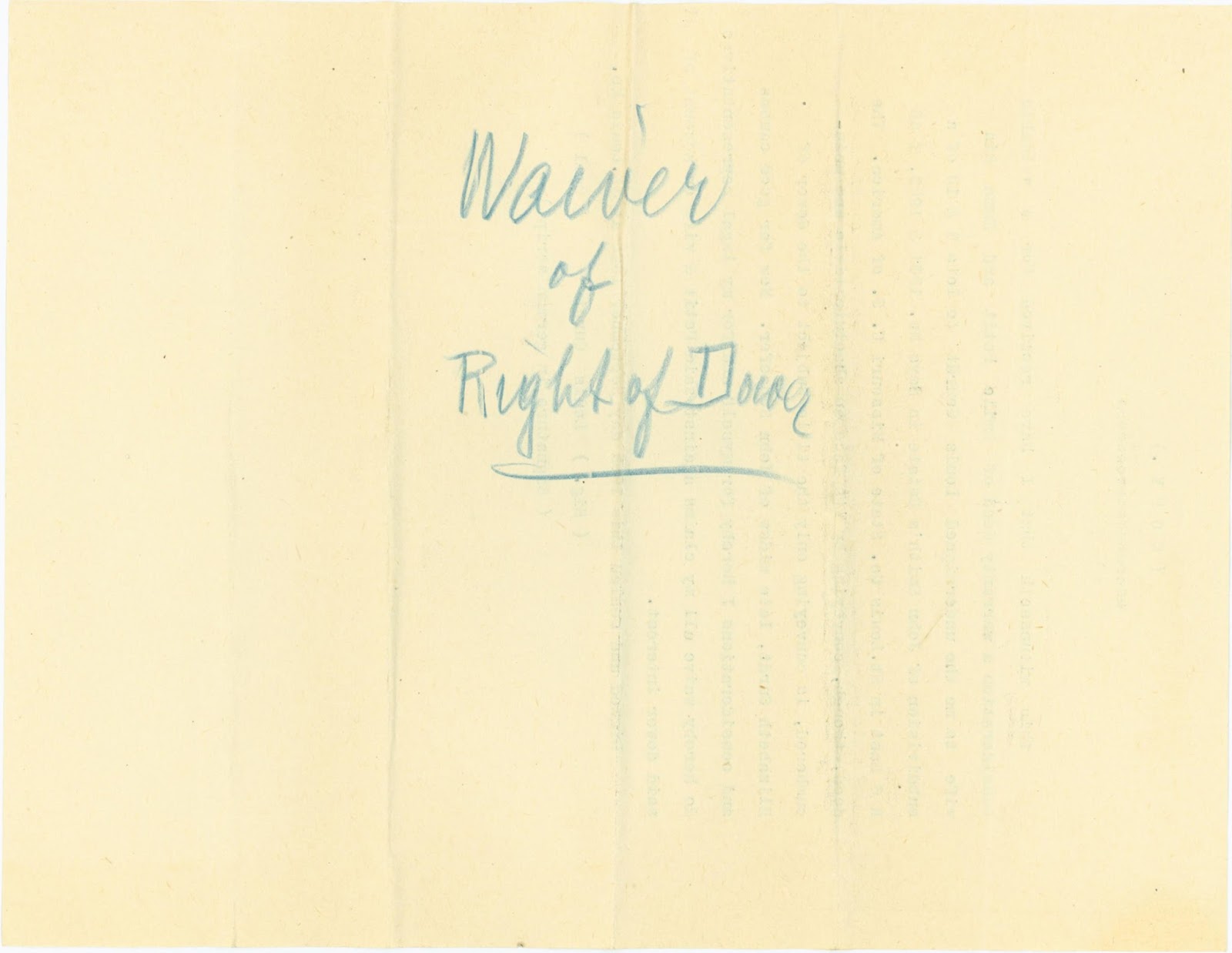
This sheet of paper is 7 1/2" x 12 1/2".  It's about 20# weight.  It has an embossed logo of some sort in the upper left, but I can't read it.  (I'm going to scan it at 600 DPI and see if that helps.  If not, I'll go for 1200.)  The embossing was so strong that it cut through the paper in one place.  The sheet has been folded multiple times, in different places.  On the main text side, the only ones that seem to be visible in the scan are the two horizontal lines that divide the page into approximate thirds.  On the reverse side, which has only "Waiver of Dower rights" in blue pencil, the folds framing the text and one that bisects that section can be seen clearly.


These are copies of two of the three transcriptions I posted in March.  The upper one is the original typed version of the third transcription from March (which now that I have this one in hand I've looked at again, and it is a carbon copy).  This sheet also has a "DEPOSIT BOND" watermark and is the same size and color as the March item.  The page has two more folds than the carbon copy does.  The only difference between the two transcriptions is that the name "Louis" in the signature line is slightly lower in the carbon copy.  The name was typed directly with the typewriter.  It looks as though the carbon copy name was erased first, but I'm not totally sure.  One other difference is that this page has "Waiver of Right of Dower" in blue pencil on the reverse side.

The lower image is a carbon copy of the second transcription posted in March.  This sheet is the same size, 8 1/2" x 12 1/2", appears to be the same weight and color, and has folds in the same places.  The differences between these two documents are the handwritten word "Sections" in blue pencil on the original typed page (the March copy) and slightly different placement of the words "all my" in the next to last line of the long paragraph.  Now that I have the two pages next to each other, I can see that the original typed version had something else typed there that was removed and then "all my" typed in.  On the carbon copy, it appears that whatever was typed with the carbon paper was erased and "all my" typed in its place.

So altogether I have an original handwritten copy of the waiver from Louis Curdt, three typed transcriptions (all differing slightly in wording), and carbon copies of two of the transcriptions.  Someone in this family (I'm still guessing Jean) was just a little obsessive about having extra copies.  Of course, now that I have a handwritten copy, I just have to transcribe it and compare it to Jean's work.

-- >< -- >< -- >< -- >< --

This witnesseth that I have received for a valuable consideration a warranty deed of of Louis Emile Petit and Emma his wife to me the undersigned Louis Curdt to lots 9 & 10 of a Subdivision of John Smith's Estate in Seys[?] No 1901 & 1902, T 46 R 6 East in StLouis [sic] County State of Missouri U. S. of America.  The deed, though, convoying [sic] by its face an absolute title and unincumbered [sic], is conveying only the title subject to the dower of Elizabeth Curdt, late widow of John Schaefer  Now for good causes & considerations I hereby for myself and for my ligal [sic] representatives do hereby waive all my claims against said Petit & wife on account of said dower interest

Signed and sealed this 19th day September 1885 at StLouis [sic] Mo

[signed] Louis Curdt [seal]

-- >< -- >< -- >< -- >< --

Even though this might be Louis Curdt's original signature (it does seem to be different handwriting from that on the rest of the page, although I don't know if it's "German" script or writing, as Jean typed in his transcriptions), this does not appear to be the original document.  The word "seal" surrounded in curlicues suggests that this is a handwritten copy of an original that had a seal on it.  Unfortunately, this copy is not dated, so there's no way to tell if it was made around the time of the 1885 waiver or when Elizabeth Curdt died in 1919.

At least now we know why Jean had "Seys" in one of his transcriptions — that is certainly what it looks like to me in this original.  At first I thought that the "y" didn't look like other "y"s in the document, but then I found a couple that looked at least similar.  And if it isn't a y, I have no idea what it could be.  Maybe there is yet another "original", which might be more legible.

Overall Jean's transcriptions are all very close to the handwritten copy, although he did correct the spelling of "legal" every time.  Certainly no significant deviation was made, and the meaning is the same across all three.  The only major difference is still Seys versus Sections versus Surveys.

Thursday, April 27, 2017

Treasure Chest Thursday: General "Informations" Concerning the Estate of John Schafer


This is the "cover page" for a grouping of three pieces of paper.  It is 8" x 9 7/8" and a yellowish off-white.  This cover page is the back of page 3 (see below) and is a fairly heavy weight, more similar to a cover stock than a letter.  The sheet has a watermark:  "Symphony Lawn" in a script font.  It was folded in thirds, and the fold lines are visible in the scanned image.


Pages 1 and 2 are also 8" x 9 7/8" and yellowish off-white.  They are lighter in weight, have no watermark, have lines running horizontally across, and are of moderate quality.  The three sheets are attached to each other by some sort of glue or paste in the upper left corner.  The images of pages 2 and 3 show a diagonal line in the upper left where I folded the preceding page(s) over to make the scans.  Everything on these pages is typed with the exception of a few items on page 2, which appear to be in Jean La Forêt's handwriting.

I found it interesting that Charles Frederick Schaefer was called "the moving spirit in all the transactions" on the cover.  His name first appeared last July, on the page that had the names, addresses, and spouses of Emma's three half-siblings.  He was Louisa's husband.

As I wrote above, almost everything here is typed, and it's easy to read.  The only handwritten items are on page 2, in the section that starts with "DEDUCTION."  For clarity, the lines with writing are:

What he bought for................ " 4475.00  4475–

Benefit..........$.– 6475.00  6475

Made out of transactions a Net benefice..of........$.18475.00  18475

The documents are written from Emma's point of view:  "Brother August", "sister Alvina", "my sisters and brother", "my father's Property."  That said, I'm not sure if she actually typed them or if Jean did.  Based on the papers I've looked at, this seems more his style than hers, and "informations" is something I've seen before from a native French speaker writing in English.  Maybe Emma dictated it to him.

The document begins with a nice timeline of various events from John, Elizabeth, and Emma Schafer's lives.  One date not included is the actual day that John Schafer died, but it was no later than September 3, 1867, which is when Elizabeth was granted papers of administration to handle his estate.  It took two and a half years to settle his estate, so it apparently was not totally straightforward.

The next few dates in the timeline agree with documents I've posted previously:  Elizabeth Schafer did marry Louis Curdt, who was a widower, on January 22, 1874.  Emma Schafer did marry Emile Petit on November 10, 1883.  I don't seem to have a copy of the document that Emile and Emma signed when they sold Emma's interest in her father's estate, but on July 19, 1885 Louis Curdt signed a waiver attesting to that, so the date of July 9 sounds reasonable.  Now I have a date for Elizabeth's divorce from Louis Curdt.  It's interesting to see that the deeds for the land John Schafer had bought were back in Elizabeth's name right after the divorce.

Then we get into the sales and purchases of the land that was in John Schafer's estate.  I have to admit, I'm confused by all the back and forth that occurred.  I suspect I will need to plat all this out to figure out what happened.  But it does appear at first glance that the Curdt siblings bought a lot of land from their mother at fairly low prices and then turned around and sold a lot of that land for much higher prices.  So it seems that Emma was not the only person shortchanged in this series of transactions.  Maybe Elizabeth understood what was going on, maybe she didn't.  It certainly doesn't cast the Curdt children in the best light.

The Midland Golf Club referred to here must be the same one that Jean mentioned in last week's document.  I'm not sure how the acreage in these pages correlates with the measurements from the previous one.  Perhaps platting will help clear that up also.

As for the accusation that Charles Frederick Schaefer benefited the most — well, it's hard to argue that conclusion based on the information on these pages, but I don't know if this is all the information or if it has been presented fairly.  Obviously something else I will need to look into after I've processed all of the documents I do have.  I don't know how easily I'll be able to check on whether Schaefer really bought "automobiles and other commodities to his heart's desire" or "soak[ed] himself with whiskey", but it should be interesting to try.

And I'm still wondering whether Charles Frederick Schaefer was related to John Schafer, and whether Louisa married a (perhaps distant) cousin of her half-sister.

Thursday, April 20, 2017

Treasure Chest Thursday: Who Has How Much Land?


These scans are of both sides of one sheet of 5" x 8" lined paper.  The paper seems to be of moderate to poor quality.  It has no watermark but does have a distinct texture, and I can see lines running vertically down the sheet.  It was folded lengthwise.  The writing is all in pencil.  This looks like Jean La Forêt's handwriting to me.

-- >< -- >< -- >< -- >< --

(Page 1)

E. Curdt to Alvina =
  ———
825.38' long - South side
452.53' wide – East side
827.84' – North side
450.83' – West side
          8.569 Acres
          8.571 acres

  —————

Louisa Schaeffer's lot =
south side
East side 461.52'
North Side 528.42'          5 1/2 acres
West Side 460.22'
South side 517.50'

  —————

From Ashby Road to Mid. Golf Club.
distance 825.38 + 517.50 = 1342.88
For 5 acres it would take a slice
162 1/5 feet wide, from Ashby Road
to Midland Golf Club. –

  —————

-- >< -- >< -- >< -- >< --

(Page 2)

Four acres = 174240 sq. ft
One acre  = 43560 sq. feet
two  —   = 87120  ——"——
Five —   = 217800  ——"——

  ———

If length 825 1/3 feet, it would
take a little over 105 feet in width.

 ——————————

5 acres South of Lot No. 10
from Ashby Road to Golf Club.

<drawing>

-- >< -- >< -- >< -- >< --

The first two sections of page 1 appear to be measurements of the land of Alvina Curdt (married Schulte) and Louisa Curdt (married Schaefer).  Similar to some of the account figures I posted a few weeks ago, Jean came up with two different results for Alvina's acreage.  Granted, there isn't much difference between the two — a mere .002 acres — but I have begun to question how good Jean really was with numbers.  I admit I don't know how to compute the amount of land based on the figures he's given.

The distance from Ashby Road, which is where the family members lived, to the Midland Golf Club is the sum of the lengths of the south side of Alvina's lot and the south side of Louisa's lot, assuming that the unit of measurement here is feet.  That's what he noted for Alvina and Louisa's lots, but I wish he had stated it here.  Does that mean that Alvina's and Louisa's lots were adjacent to each other and ran between the road and the golf club?  And what does it mean to say that it would take a piece 162 1/2 wide to make 5 acres?  Why would he need or want to make 5 acres?

The top of the second page is nothing more than how many square feet are in one, two, four, and five acres, although not in that order.  Maybe Jean wrote that as a reference for himself, as he worked out how many acres Alvina and Louisa had.

As for his next item, when I multiply 825.33333 by 105 feet, the result is 86,659.9997, just a little less than the 87,120 square feet Jean listed for two acres.  Taking that from the other perspective, 87,120 feet divided by 825.33333 equals 105.557351, which is not what I would call "a little over" 105 feet; it's more than halfway to 106 feet.  But it appears that Jean was thinking about 2 acres.  On the other side of the page he noted the south side of Alvina's lot as being 825.38 feet.  That 825.38 is almost the same as 825 1/3.  When I multiply 825.38 by 105 feet, the result is 86,664.9, a little more than the previous number but still significantly short of 2 acres.  Starting with the acreage, 87,120 feet divided by 825.38 is 105.551382, which is still closer to 106 than 105.  Maybe he was trying to figure out 2 acres for Emma?

In the next section, with the simple drawing, Jean refers to 5 acres.  Is this the same 5 acres he wrote about on the other side of the page?  None of the numbers written by the drawing — 80, 25, 30 — match the figures he's used previously.

If I'm really lucky, something else in this folder will explain what all of this means.

Thursday, March 23, 2017

Treasure Chest Thursday: Discussion of the John Schafer Estate Dispute Begins

Beginning this week, I'll be making a departure from how I've presented items previously in my ongoing investigation and analysis of the "treasure chest" of documents that relate to Emma Margaret (Schafer) Petit La Forêt and the people in her life.  Until now I've grouped documents by the person they primarily focused on.  Now I'm getting into the dispute over the estate of Emma's father, John Schafer, and whether Emma's mother, Elizabeth, and Curdt half-siblings stole what was rightfully Emma's inheritance.  These items mostly don't appear to be dated, and several documents have multiple copies, so it should be interesting to wade through them.


These two cards measure 4 1/2" x 2 1/2".  They are brown and are made out of a fairly substantial card stock, heavier than the average business card.  They are copies of the same card.  The bottom image is the reverse of the top card.

Both cards have names underlined in pencil.  The top card has a heavy pencil line under D. C. Taylor, the bottom name under "Officers and Directors."  Lighter lines can be seen under Geo. W. Wolff, President; Henry Kirchner, Sec'y; and William Elbring.  In addition, the word "not" follows Wolff's name.  The second card has only Geo. W. Wolff's name underlined.

On the back of the second card, four words that appear to be names have been printed in red ink:
Obst
Gruelner
Kipp
Russell

None of these names appears on the front of the card.  There is no context for who they are or how they are connected to the company, if at all.

This card back also has part of a newspaper page stuck to it.  I have not determined if I have the matching newspaper.

So far these cards are a mystery as far as their relationship to Emma.  Possibly (probably?) they were consulted in conjunction with Jean La Forêt's research into the history of the land that was part of John Schafer's estate.  Maybe some other document in this large file will have the company's name on it.

The St. Louis County Land Title Company was established in 1880, according to this card.  The cards have "35 Years in Business" on the lower left, so they were presumably printed in 1915.  I like the claim that they were "compilers and owners of the only complete and perfect set of records in St. Louis County."  (I wonder if that set of records still exists somewhere.)  Maybe Jean contacted them because of those records?

I searched to see if the St. Louis County Land Title Company still exists.  It does, but now under another name.

An examination report states on page 4 that "Land Title Insurance Company of St. Louis was incorporated in the state of Missouri on December 7, 1901, as the Chomeau and Dosenbach Land Title Company and was capitalized with 1,000 shares of common stock with a par value of $100 per share.  On May 1, 1905, the name was changed to the St. Louis County Land Title Company and on April 11, 1928, the name was changed to its present name of Land Title Insurance Company of St. Louis."

The name of the company is in agreement for the year the business cards were designed and/or printed.  The capitalization amount matches the $100,000 that's on the business cards, although that would mean it had not changed in the intervening fourteen years.  This report says that the original company was incorporated in 1901, whereas the cards say the company was established in 1880.  That isn't necessarily a contradiction, but it would mean that the company incorporated 21 years after it began.  I don't know how common (or not) that might have been.

In the case of Stevens v. Stevens (309 Mo. 130, 138 [Mo. 125]), Henry C. Kirchner is identified as the former secretary of the St. Louis County Land Title Company, so that's obviously the right company.  He was testifying as a witness in, of all things, a property dispute.

The case of Roth et al. v. Hoffman et al.  (234 Mo. App. 114, 124 [Mo. Ct. App. 1938]) includes a statement that a letter was sent by the St. Louis County Land Title Company on July 26, 1929, more than one year after the examination report states the company had changed its name.  Maybe someone was still using old letterhead a year later?

This little historical squib on the site of First American Financial Corporation (the company which bought Land Title Insurance Company of St. Louis) seems to confirm that all of this information is about the same company.  What's nice to read is that "Land Title maintains its own title plant, the oldest title facility in Missouri, containing documents dating back to the1840's."  Hey, maybe they do still have that "perfect set of records"!  Better yet, maybe they still have correspondence relating to the Schafer land dispute . . . .

Thursday, March 2, 2017

Treasure Chest Thursday: A Legal Waiver from Louis Curdt


This piece of paper is 8 1/2" x 12 1/2", which seems an odd size now but which might have been a standard early in the 20th century.  The paper is yellowed with age but was probably white or off-white originally.  It feels about 20# in weight but not of great quality.  There is no watermark.  The sheet was folded somewhat in thirds and then had one additional fold about an inch in depth.  The images above are of the two sides of the page.  The main body of text is typed.  The reverse has three handwritten words.

This appears to be a transcription of a document.  The location of the original document is not noted, but it might have been something that was held by the family.  It's possible that it was filed with the county clerk in St. Louis County, Missouri.

The transcription states that Louis Curdt paid a "valuable consideration" for a deed from Emile and Emma (Schafer) Petit but does not give the amount.  If it were filed with the county, I would expect the amount to be listed.  The focus in this is really the statement that Elizabeth Curdt's dower is being conveyed.

The words "Waiver of Dower" on the reverse of the page remind me of Jean La Forêt's handwriting.


The first of these two documents is also 8 1/2" x 12 1/2".  The paper appears similar in color and in weight to that in the first document described above.  This page also has no watermark.  The sheet was also folded somewhat in thirds and then had one additional fold about an inch in depth.  Unlike the first document, no handwriting appears on the back.

The second document is on a standard 8 1/2" x 11" piece of paper.  This sheet is grayer in color than the other two.  It was folded in thirds.  It's about 20# in weight, but this has a watermark:  DEPOSIT BOND.  It also has no handwriting.

Both of these are typed.  The text is almost exactly the same as that on the first document.  One difference is that the first and second have a long intro paragraph explaining that the typing is a true copy of a waiver, whereas the third document has only the word "COPY" at the top.

The other significant difference is the term used to describe the parts of John Smith's estate being conveyed.  The first document has "Surveys", the second "Sections", and the third "Seys."  The rest of the description of the property is the same.  Other differences are minor, such as a period being dropped.

I'm not sure, but I think this waiver is related to Emile Petit's visit to the United States in 1885.  In the first part of her handwritten narrative, Emma wrote that Emile left Lorraine for Missouri on June 10, 1885.  She didn't state when he returned but did mention that he brought $3,000 with him.  She also wrote that she signed a document which she did not know the purpose of.  It seems to me that Emma and Emile each having signed a document could have created the conveyance of dower which Curdt acknowledged.  If that is the case, then these three copies of the waiver were probably part of the research that Jean La Forêt conducted while investigating what happened to Emma's inheritance.  Wasn't it nice of Louis Curdt to waive his claims against Emile and Emma, now that he'd apparently gotten control of the land.

I don't understand the reference to John Smith's estate.  Why is it John Smith and not John Schaefer?


This is the envelope in which the three copies of the waiver were found by me. It is 9 1/2" x 4 1/8".  As the image shows, it is yellowish and darker around the edges.  It's fairly sturdy, heavier than 20# in weight.  Considering the fancy "f" in "of" and the flourishes and underlines, I suspect this might be Jean La Forêt's printing.

Monday, November 23, 2015

The 1838 Census of Indian Key, Florida

You can find the most interesting things online these days.  Buried in The Senate of the United States, Third Session of the Twenty-fifth Congress, Begun and Held at the City of Washington, December 3, 1838, and in the Sixty-third Year of the Independence of the United States, Volume II, Containing Documents from No. 18 to No. 146 (printed by Blair and Rives, Washington: 1839), is the petition of Thomas Jefferson Smith to have Indian Key, Florida (when Florida was still but a territory) become an official port of entry for the United States (Volume 2, number 71, page 1).  Among the various claims and pieces of information Mr. Smith put forth to support his desire to have Indian Key made an official port of entry is a census of the island as of March 1838 (page 12).  And in that census, along with 98 white inhabitants, were enumerated 29 slaves and 14 free colored persons.


Slaves on Indian Key (in the order presented in the book)
Benjamin Housman
Bazal Housman
James Housman
Billy Housman
Lydia Housman
Dolly Housman
Chenia Housman
Rebecah Housman
Mary Housman
Quashia Housman
David Housman
Paul Fuiler
Peggy Cold
Lucy English
Chasy English
Isaac Spencer
Sophia Spencer
Binah English
Mary English
Ellen English
Alexander English
Betsey Smith
William Howe
March Howe
Samuel Howe
David Howe
Jenny Howe
Hannay Howe
Wm. Henry Howe

All the enumerated slaves save one carry last names that match white inhabitants of the island.  The name of Paul Fuiler, the one slave who does not, is similar to that of George Fowler.  Perhaps the name as published was in error, or perhaps Paul had his own name and was permitted to use it?

I am happy to recover these names and add them to the Slave Name Roll Project.  I hope that sharing these names and making them easier to find will help someone find an ancestor.

In addition to the census, the petition included a list of the landowners of Indian Key.  That list can be found on page 11, right before the census.


Many thanks to Linda Jack for telling me about this census.

Sunday, September 6, 2015

"Who Do You Think You Are?" - Alfre Woodard

I'm still trying to catch up on commentary for this season of Who Do You Think You Are?  The third episode this season (the second new one) was the first one TLC has aired with a celebrity with non-European ancestry (about time!).

The teaser for this episode told us that Alfre Woodard would trace the lost path of her father's family and discover an ancestor born in chains.  She would follow his courageous footsteps to freedom and beyond.

Alfre Woodard is an accomplished actress with a 35-year career.  She has won four Emmys and one Golden Globe and has been nominated once for an Oscar.  Some of her best known work is HBO's Mandela, Spike Lee's film Crooklyn, and the recent movie 12 Years a Slave.  She is a philanthropist and an activist, working for positive social change through the arts in the United States and globally. Woodard lives in Santa Monica with her two children, Mavis and Duncan, and her husband, writer/producer Roderick Spencer.

Woodard starts out very existential.  To her, family is life and the way we learn to be in the world, and we are the manifestations of our fathers' and mothers' dreams.  Her mother was Constance Elizabeth Roberson.  Constance's mother was Big Momma Ada, who had seventeen siblings, and her mother's father had twenty siblings.  When they held family reunions they couldn't invite everyone, because there wasn't enough room.

Woodard's father was Marion Hugh Woodard, who was born in Lincoln County, Oklahoma.  His parents were Minnie Minerva, from Tennessee, and Alexander Woodard, from Texas.  Her grandfather died when her father was only 3, so she doesn't know about anything earlier than that.  She's taking this genealogical journey for her father, a self-made entrepreneur and a family man.  She believes she got her daring from her father.  She has no expectations of what she is going to learn and says, "Surprise me!"

Woodard begins her journey in her own home.  She says she has asked genealogist Joseph Shumway (AG; we've seen him on five episodes previously) to help her.  She tells him that her roots are wide but not deep and that she wants to learn about her father's family history.  She knows that her grandfather was Alex and that her father was born June 3, 1920 in Lincoln County, Oklahoma.

Shumway tells her they should start with the U.S. census so they can identify her father's parents.  Her has her go to Ancestry.com (of course) and click on the U.S. census collection link, then look for Alexander Woodard (with exact spelling) from the main census search page.  The top two hits, for 1920 and 1930, seem to be for the right family.  Shumway directs her to look at the 1920 census.  When she brings up the image, she finds the head of household was her grandfather, Alex A. Woodard, and his wife was Minnie H.  (Alexander was one of the children).  She recognizes the names of an aunts and an uncle, but her father isn't there.  The official enumeration date for the 1920 census was January 1, and her father wasn't born until June, so he missed being counted (which is why I would have started with the 1930 census, to try to find the family with her father there, and that way I would know it was the right family).  Shumway states that January 1 tells us the date the family was visited, which is incorrect; per the information on the census page, they were actually visited on January 16.


Alex Woodard was listed as 40 years old and born in Louisiana, Woodard's first surprise, as she thought he was born in Texas. Now Shumway tells Woodard to do something no one should ever do:  go straight from 1920 to the 1880 census to find Alex with his parents.  Under normal circumstances, jumping 40 years at once is a great way to make a mistake and follow the wrong person, who superficially seems to be the relative you're looking for.  By going from one census to the next chronologically, you minimize the chances of picking up the trail of the wrong guy.  So they should have looked at 1910 and 1900 before 1880.  But, of course, they've done all the research ahead of time, so Shumway already knows what they're going to find.

This time Shumway has Woodard search for Alex Woodard born in 1880, and what do you know, there he is.  Woodard's grandfather Alex was 5 months old, born in December 1879, and living with his parents, Alex and Lizzie Woodard, in Jackson Parish, Louisiana.  Alex the father was 39 years old, a farmer, and born in Georgia.  After a few seconds, the meaning of this registers with Woodard, and she looks shocked.  If Alex Sr. was born about 1841 in Georgia, "Mother of God, he was enslaved!"  So when she said, "Surprise me!", she wasn't kidding, even though it shouldn't have come as a surprise that her family had roots in slavery if they were from the South.


The program cuts to a commercial break here, and when it returns, the narrator tells us that Woodard is at her home in Los Angeles.  In the introduction, however, we were told that Woodard lives in Santa Monica.  Sorry, Mr. Narrator, Santa Monica is NOT Los Angeles.

Returning to the revelation that her great-grandfather was born in Georgia, Woodard asks if it's possible to find out where in Georgia he was from.  Shumway says he can do some "extra digging" to "try to narrow down" a more specific place (I despise this pretense that the information hasn't already been found) and that he will get back to her.

In an interlude apparently meant to suggest that Woodard is waiting to learn what Shumway might find out with his "extra digging", she talks about how her people, and all enslaved people, came out of slavery with nothing.  She wants to trace how her family got out, if the footprints are still there.

Shumway reappears with his "new" additional information about where Alex was likely from.  He suggests that Woodard meet with a historian in Houston County, Georgia.

And off to Houston County she goes, to Perry specifically, which is the county seat.  At the courthouse she finds Dr. Daina Ramey Berry, a historian of American slavery.  Berry starts off by telling Woodard, "You know that he would be listed under a white Woodard family," and "Enslaved people often kept the surnames of their owners."  I'm getting really tired of this trope.  Modern scholarship has shown that the majority of former slaves did not take the names of their former owners.  The two most common surnames after Emancipation were Washington (for George Washington) and Freeman (which should be self-explanatory).  Tony Burroughs, probably the preeminent black researcher in this country, has stated that in his many, many years of research, he has found only about 15% of former slaves that took prior owners' names.  It's convenient for WDYTYA to trot it out because it's a lot easier to explain, and it's nice that it's worked for them in the limited amount of research on black celebrities they've done, but from everything I have learned, it just isn't accurate.

Ok, off the soapbox.  After saying this, Berry says they should be able to find some information in white slaveholder records, particularly the annual returns.  Those are for the taxes that were collected on property, including slaves.  As slaves were not taxed by name until they turned about 5, and Alex was born about 1841, Berry suggests Woodard look for a book in the late 1840's.  She chooses 1849, which seems to be the only book in that section that has a big white label on the spine (coincidence?).  (Why not 1846 or 1847, which would have been right about the time Alex would have been listed by name?  Or did they look at those years, and they didn't make it to the final program because there was nothing exciting?)

Woodard searches the index of W names and finds John Woodard, who "could be" Alex's owner.  She goes to page 42, which isn't an annual return after all, but an estate appraisal taken after John Woodard died.  It is titled "Appraisement of the Estate of John Woodward Deceased", which throws Woodard off because of the different spelling of the name.  Berry explains that spelling could change depending on who was writing (which is at least accurate, if not a complete explanation).  Woodard reads the beginning of the inventory, which starts with the names of slaves and their values.  She soon comes to Alec, valued at $400, which Berry tells her is her great-grandfather.  And starting at this point, she calls him Alec instead of Alex.

Woodard asks, "Who is his mom?", to which Berry replies, "We don't know."  The reason she gives for this is that slaves didn't have birth certificates.  Well, that isn't a complete answer either, because in Georgia in the 1840's, I don't think anyone had birth certificates.  And many slave owners actually did keep track of when their slaves were born (such as with Lionel Richie's ancestor), but that information was in their personal papers, which aren't always available.  Again, WDYTYA goes for the quick, oversimplified answer, rather than accuracy and educating viewers.  Yes, I know the program is entertainment, not educational, but it's still annoying.

Ok, back off the soapbox.  Berry explains that the mother role in Alex's life would have been filled by "fictive kin", the family that slaves created for themselves.

We hear from the narrator at this point, who explains that beginning in the early 1600's, 10 million Africans were forced into slavery in North and South America and in the Caribbean.  About 400,000 of them were brought to North America.  As property, they had no legal rights and were often separated from their actual famly members.  To preserve their humanity, they created their own families and kinship networks, which provided support.

Woodard goes back to reading from the estate appraisal and finds that after the slaves the livestock were listed, which justifiably offends her.  She comments that Mr. Woodard didn't seem to own many slaves, and Berry classifies him as a typical small slaveholder.  But now that their owner had died, the slaves would have been waiting to find out what would happen to them and where they would go.  Berry says that they lived in fear of separation.  To learn what did happen, Woodard next goes to page 426 (even though pages 341, 342, and 397 appeared in the index also).  There she finds "Distributing of the Estate of John Woodard Decd" and says, "This shit [which was bleeped out] is making me anxious!"


The narrator tells us, "Alec faced being separated from the other slaves he had grown up with when his owner, John Woodard, died."  We don't actually know that Alex grew up with any of the other slaves listed in the inventory, at least not from what was shown on the program.  We know only that they were all owned by John Woodard when he died, and we don't even know when that was, although this page says it was 1846.  We are given no information about how long any of them have been there or been together.  Now, if John Woodward did die in 1846, it is possible that the slaves listed in the inventory had stayed together in the five years between his death and the appraisal.

Returning to Woodard, she reads that Martha Blount, formerly Woodard, was to receive the Negro Milly, valued at $1,000, and that Laura Woodard was to receive Harriett, valued at $500.  Then she reads that William Woodard would receive one Negro boy, Elic, valued at $700.  This, we are told, is Alec/Alex.  Woodard suddenly remembers that some of her older aunts and uncles referred to their father as Elic; the younger ones had called him Alec.  (This was actually a great example of how hearing something can trigger a memory.)

The distribution of the estate was signed off on September 14, 1856, at which time Alec would have been about 15 years old.  Woodard comments that he would have been entering the period of his prime value as a slave, and Berry says the $700 is comparable to the cost of a car today.  They also talk about how Alec would most likely have been separated from his fictive kin at this point.  (But the complete distribution shows that, in addition to Alec, five more of John Woodard's slaves went to William, who inherited more than half of his father's slaves.  So most of these fictive kin actually seem to have stayed together, at least for a time.)

Woodard asks whether Alec stayed in Georgia.  Berry says, "I'm going to do some digging" (just like Shumway, right?) to try to find more information.  She'll look for records closer to the Civil War.  Before she leaves, Woodard gives Berry a big hug and tells her they're kin now.

Woodard feels she is on the cusp of something, like waiting for the arrival of a child.  She's chasing a spirit and wants to learn who Alec is, and she hopes Alec will speak to them.

We next see Woodard driving along a country road in Houston County.  She tells us that "last night" Berry looked at records for John Woodard (sure she did!) and found a deed for his land when he owned Alec.  Berry told her she should go look, and now she's following that lead to track Alec.  The GPS in the car (which I noticed had the brand name and license plate blurred out; I don't know if they've done this on previous episodes) says, "Turn right onto Woodard Road," which brings a happy little scream from Woodard.  At the intersection of Moody and Woodard roads she turns left and finds a big stand of trees.  She gets out of the car, takes off her shoes, and pours a libation of water to her ancestors, saying that it is a way of connecting with Alec on the ground he worked and sweated into.  The ceremony is an acknowledgment that you didn't invent yourself and a way of humbling yourself to your ancestors.  Before she leaves, she picks up several pine cones and takes them with her.

William Woodard's slaves listed in
the 1860 census slave schedule
Woodard returns to see Berry and proudly shows her some of the pine cones from Woodard Road, then asks what happened to Alec after he went to William Woodard.  Berry looked for William in censuses and found him in Jackson Parish, Louisiana.  He had migrated west, probably because of the availability of land.  Berry does not show him and his family, however, but has the 1860 census slave schedule, dated December 13.  The slave schedules listed slave owners by name but enumerated slaves only by age, sex, and color.  William had three slaves, a 32-year-old female, a 16-year-old male, and an 8-year-old male.  Berry talks only about the 16-year-old, whom she says was likely Woodard's great-grandfather.  He should be about 19, but Berry says that any time a slave was listed with an age it could vary, because they didn't have birth certificates.  (What she doesn't say is that was also the case with people who were not enslaved.  Very few people in the 19th century in the U.S. had birth certificates, and most had no need to know how old they were, so many people's ages varied from census to census.)  They talk about how Alec has been separated from his family (but the woman and the boy are likely two of the slaves from John Woodard's estate, so they would have been part of that family).  Often one can turn to annual tax lists to learn the names of slaves in a household, but perhaps they were not available for this time and location, or the producers wanted to emphasize Alec's isolation rather than the complete story.

Berry now says that Woodard should go to Louisiana to continue her research, at the Louisiana State Archives.  It is difficult to trace blacks due to fires and burnt records (which affect everyone's research, not just that of blacks; just ask anyone researching ancestors from the South), but maybe she will be able to pick up Alec's trail after the Civil War.  (Translation:  We will be picking up Alec's trail after the Civil War.)

Woodard adapts a quote from one of Maya Angelou's poems, "Still I Rise":
     I come, bringing the gifts that my ancestors gave,
     I am the dream and the hope of the slave.

She then says that Alec has gone from being an ancestor to a relative, which is a wonderful way of personalizing the research process.  And off she heads to Louisiana.

In Baton Rouge Woodard goes to the Louisiana State Archives.  As she walks in the building, she talks about how it is June 19, or Juneteenth (did the producers actually plan that?), the day that slaves "in the Southwest" learned that they had been freed by the Emancipation Proclamation.  (Well, close:  It's the day that slaves in Texas learned they were free.  It is celebrated in many Southern states, however.)  Inside she meets Dr. Mark Schultz and promptly points out to him that it's Juneteenth.  The two of them seem to have a natural chemistry as they work together, which was really fun to watch.

They begin by talking about Alec's move from Georgia to Louisiana, and Schultz says that probably the "most horrific experience" a slave could have was to have your family torn apart (though I tend to believe that being a slave in and of itself would be the most horrific experience).  That said, he tells Woodard that for research during Reconstruction the best source for information is the Freedmen's Bureau records (I'm so glad they discussed these extremely important records!).  He says that they are held at the National Archives in Washington, D.C. (but doesn't mention that they are also available at all regional branches of the National Archives, and online on several sites, including Ancestry).  Woodard knows that the bureau was when the federal government assisted former slaves, and Schultz points out that it also settled issues between former slaves and their former owners.  (It did a lot more than that, but that's apparently what's going to be relevant here.)

Schultz says that he did a "digital search" (but doesn't say where, which suggests it was not on Ancestry) and found a record relating to Alec.  The record is from Verna(?), Louisiana and is dated January 18, 1868.  B. D. Blount, who we are given to assume was Martha (Woodard) Blount's husband, said he was willing to give up the three children claimed by "Elic" if they were willing to leave.  Woodard immediately asks if the children were Alec's, but the record doesn't state whose children they were.  Then she wants to know why Alec even had to ask, because B. D. shouldn't have had any claim on the children, and Schultz says that the children might not have been "free" yet, which leads to a discussion of how people might not be free if they hadn't heard the news yet.  (They did not bring up the fact that the children might have been legally bound to Blount by a contract, a matter that the Freedmen's Bureau also supervised, which would have given him a claim.)  Unfortunately, the children's names were not mentioned, and they don't know if Alec got the children (i.e., they couldn't find any further records).  Not all records of the Freedmen's Bureau have survived.

Next Schultz says they should look at tax rolls, and they move to a microfilm reader.  They start off in 1867 in Jackson Parish.  Alec (this time as Allen, but we have to hope they know it's the right person) paid $1.00 as a poll tax, which was to register to vote.  Schultz explains that this is the period of the largest wave of black voters in American history.  The narrator steps in say that after the Civil War and the abolishment of slavery, resistance to emancipation continued in the South.  Laws were created that blocked blacks from being elected to office, owning land, and working in certain jobs.  Poll taxes were deliberately expensive to try to prevent the impoverished former slaves from being able to pay.  Even when they did pay, they faced intimidation and violence if they tried to exercise their right to vote.

Schultz says that Alec would have given up a day's wages to pay that poll tax.  The expense notwithstanding, 90% of black men registered to vote in Louisiana.  Beyond the problem of paying the money, it was dangerous to do so, because this was when the KKK was first organized, and they practiced political terrorism.  Families who challenged white supremacy were prepared to die when they did so.  Woodard is inspired to sing part of "Lift Every Voice and Sing" (lucky Dr. Schultz!):
     Facing the rising sun of our new day begun,
     Let us march on till victory is won.

Schultz asks whether Alec had a family.  Woodard remembers the 1880 census she looked at with Shumway and tells Schultz about Alec's wife, Lizzie, and the nine children, including that the youngest was her own grandfather.  Schultz suggests they skip to the year after the census to search for Alec again.  This is again bad practice, skipping years, so the only logical reason is because they already know something "interesting" shows up that year, and indeed, in 1881 the tax list shows that "Alex" is taxed on 80 acres of land.  He owns land!  He is a farmer, which we saw in the 1880 census, but now we know it's his own property.  (In theory, he could have owned land earlier than this, but since they didn't show us those tax lists, my guess is probably not.)  Woodard comments that he had plenty of kids to help him, and Schultz points out that a single man couldn't afford to be a landowner on his own at this time; it took a family effort.

As a landowner, Alex has moved up to a higher class.  At Schultz's suggestion, they now jump a decade ahead to 1891, and we discover that Alex "Woodward" has 240 acres.  Woodard is very excited and says that her grandfather would have been 9 years old, the "same age where we met Elic!"  (Except that we know from the 1880 census that her grandfather was born about December 1879, which means in 1891 he would have been 11.  I know, I am such a party pooper.)

Moving ahead one more year, in 1892 Alex is back down to 80 acres, valued at $106.  Unfortunately for Alex, he bought additional land right before the agricultural depression of the 1890's (hindsight is great, isn't it?).  This depression hit the entire country and affected many other people.  Woodard wants to find out where the land went; Schultz tells her they don't have any records of Alex after 1892 but doesn't say why (possibilities:  he didn't pay the property taxes after 1892; he wasn't in Jackson Parish anymore; he left the state; the records no longer exist).  He says, "Fortunately, this isn't the last hole to dig in" (what a great expression!) and that Woodard should go to Jackson Parish, where deed records might have more information for her.  Before Woodard leaves, she tells Schultz that he is now officially her "brother from another mother" and gives him a sincere hug.

Outside, Woodard talks about her great-grandfather's ingenuity (huh?), persistence, and work ethic, and how freedom is the ability to go as far as you can go.  After the Emancipation Proclamation, Alex made a substantial life for himself.  He passed on the knowledge of how to build a life as a gift to his descendants.

In Jackson Parish, Woodard goes to the courthouse in Jonesboro, the parish seat.  Historian Dr. Beverly Bond is there to greet her.  She has found a record from 1896 pertaining to Alex.  J. G. Barbee and J. C. Gifford of Wharton County, Texas made a loan to Alex, $1,375 to be repaid in one to five years at 10% interest.  Woodard comments that it was a "big deal to be able to get a loan, even now."  Alex was buying 95 acres in Wharton County.  Woodard is happy he finally made it to Texas (though we don't actually know that he was in Texas, only that he bought land in Texas).  Bond tells Woodard that Wharton County is in southeast Texas, an area of good farmland.  She adds that after the Civil War many former slaves established Wharton (which is inaccurate, because the county existed in the United States at least as early as 1850, as it was enumerated in the census that year).

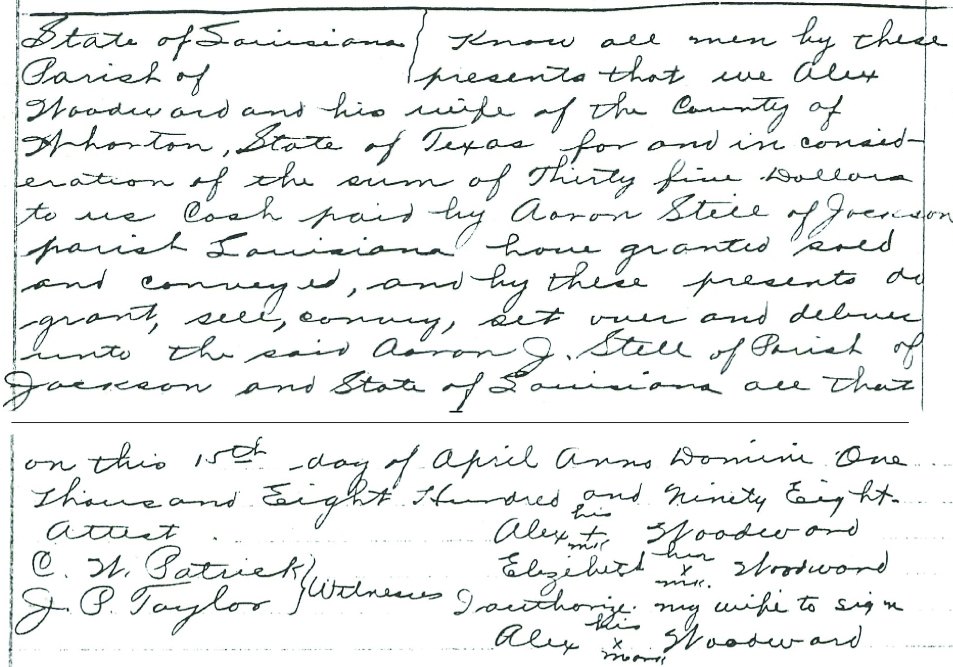
Bond asks Woodard, "Can I show you another record?" (I keep waiting for someone to say no) and pulls out a conveyance record (deed) from 1898.  At this point Alex was about 57 years old and had been in Texas for (presumably) two years.  The deed shows that Alex and his wife sold 80 acres in Jackson Parish for $35 to Aaron J. Stell, also of Jackson Parish.  It takes a few seconds, but then Woodard realizes how little Alex was selling the land for, and she gets very indignant.  She apologizes to Bond but admits she's outraged at the small amount.  Bond explains that land was going up and down in value and then adds that Aaron Stell was Lizzie's brother.  Though Bond seems to be emphasizing the relationship more than the name, Woodard latches onto the name, because now she has a last name for Lizzie (which would seem to be a big deal, considering that the floating family tree shown at the beginning of the episode did not show last names for either her mother or her grandmother).  Alex might have been able to get more money, but this way he kept the land in the family.


Alex and Lizzie both "made their marks" (they were illiterate) at the bottom of the deed.  Woodard is struck at how Lizzie has now become a full human being to her, because she was legally recognized in the document as Alex's partner.  (I'm sorry that her appearance in the census wasn't sufficient.)

Bond has one more item for Woodard:  a map showing the 240 acres that Alex had owned.  It lies off of R. F. Stell Road (but no comment is made about that also being the last name of Aaron and Lizzie).  I wanted to know which were the 80 acres he originally had and then sold to Aaron Stell.

As she drives to Alex's former property, Woodard says she is happy that he kept the land in the family.  Alex had the wherewithal and wits to be a businessman in a system where he was on the buttom rung.  Woodard considers Lizzie to have been his equal.

As Woodard turns onto the property, a clearly visible sign says "Posted No Trespassing Keep Out", but she figures that technically she isn't trespassing because she is the great-great-granddaughter of Elizabeth Stell.  (Besides, the camera crew is with her, so I figure they must have gotten permission from someone to be there.)  This land is grown over, and it's obvious that no one has farmed it in a long time.  She pours a libation here also but does not remove her shoes, which kind of surprised me.

Woodard closes by talking about how her roots are still wide but they've taken hold.  Alex and Lizzie kept on living, doing, and working, with an eye on the horizon and thinking ahead to the next step.  Alex is now a fleshed-out character, and she's proud of his business dealings.  She plans to tell her family the story and to keep on telling it, to make sure it isn't forgotten (hooray!).