Showing posts with label court records. Show all posts

Thursday, December 17, 2015

Treasure Chest Thursday: The History of Emma M. Schafer


I finally was able to make some time to start plowing through the documents I received when another Bay Area genealogist gave (read:  foisted off on) me a collection of materials (my "treasure chest") she had decided she was never going to be able to focus on.  The collection, which had been donated to a local genealogical society, apparently was begun by a woman who thought that someone had been murdered for an inheritance, way back in 1919.  There's no information on how she fell into the story to begin with, but she had done some research of her own to add to the original documents that were there.

The first thing I did was sort out all the documents to see who I'm dealing with.  As I mentioned previously, it's apparent that these items have changed hands a few times.  While I have made a note of how everything was grouped when I received it, there didn't seem to be much logic to it, and obviously related items were often nowhere near each other.  I therefore created my own groupings based on the individuals involved.  I've decided to work on one person at a time and go through the documents for each person in chronological order.  I figure by the time I work my way through the entire package, we might have an idea of what actually happened!

I'm starting with Emma Schafer, as everything seems to revolve around her.  The first document describes the beginning of her life.  Unfortunately, the first page does not appear to be in evidence, but pages 2 and 3 have survived.  The document is typed and the paper is at least somewhat aged, though I can't tell how old it is.  The paper is some type of bond with no watermark.  It was typed in triplicate, with the second and third copies being accomplished with carbon paper (does anyone besides me remember typing with that?).  There is no indication of who typed it or when.  My transcription follows:

-- >< -- >< -- >< -- >< --

(2)

She was hardly ever sent to school but kept at home were [sic] she had to work all day long.  The poor, unlucky child became a little slave on her own property, a little unhappy drudge in the household.  She received neither education nor instruction, went around in dirty rags and later, when other children were born to her mother, she had to take care of them instead of going to school.  Three children were born to Curdt and his wife from the time of their marriage and 1883.

When little Emma Schafer arrived at between thirteen and fourteen years of age, LOUIS CURDT began to assault her whenever he could find her alone in the house, the outbuildings or in the fields, and went farther and farther, even to abuse and rape, using his superior strenght [sic] and his brutally satyric instincts.  The child complained to her mother who would then take her to a friend's house, a Mrs. Kraemer, and leave her there for a while, but needing her to take care of the children, and believing in the protestations of her husband that hereafter he would behave, she would take her home again, not because of her love for her but to use her as a drudge, a servant.  Thus Emma SCHAFER remained ignorant and uncultivated in the extreme.

It is during these times that Elizabeth Curdt, ably assisted by her husband, impressed upon the mind of little Emma, that one half of the property belonged to her,- the mother -, and that she has the use of the other half during her natural life.  In this manner Emma was informed that she could not get anything of her father's estate until after the death of her mother.

From this time on, there existed a Conspiracy to defraud and despoil EMMA M. SCHAFER of her property.

1883, OCTOBER 31st to NOVEMBER 1st, 1883

During the night of October 31st and November 1st, 1883, LOUIS CURDT entered the bed-room of Emma Schafer and compelled her, by threats and physical and brutish force, to submit to his filthy contact.  Emma called for help and her mother then called in a neighbor, a Mr. Becker, still living in Overland, Mo., who took EMMA to his house.  The following morning he took her to Clayton to have a complaint entered against Curdt, who was arrested the same day and later released under bonds.  From that time on until her marriage, which took place on the tenth day of November, that is only a few days after these happenings, Emma Schafer lived with the Kraemers, near Clayton.

Immediately after the arrest of CURDT, his friends, especially a saloon-keeper of Clayton, FORTIN, and others, tried to find the means to get EMMA out of the way, out of reach of the Court as a witness for the prosecution.  They were lucky enough to meet a young alien, from Lorraine, then Germany, who consented to marry the young girl and to take her out of the country, to Lorraine, in Europe, out of reach of the Court.  ELIZABETH CURDT paid all expenses and promised to help them to start a bakery business in Lorraine.  Thus Elizabeth Curdt disclosed her partnership in the CONSPIRACY, and stuck to her criminal husband against her first child.

(3)

NOVEMBER TENTH, 1883, Marriage of EMMA M. SCHAFER and EMILE PETIT, of Lorraine, Europe, were made man and wife in the presence of witnesses and the mother of the bride, who had to be present on account of the age of the bride, SIXTEEN YEARS & ELEVEN MONTHS.  The ceremony was performed by Judge Jeremiah RYAN, Justice of the Peace at CLAYTON, Mo..

During all these proceedings EMMA SCHAFER acted as an automaton, having nothing to say and nothing to do but obey her mother's wishes.  For years she was trained to obey and never to complain.  She was led before the Justice of the Peace as an inoffensive victiim would be led to the butcher-shop.

A few days later EMMA SCHAFER, now Mrs. PETIT, and her young husband were bundled up and sent to Europe, at Mrs. Elizabeth CURDT's expense, and this fine fellow Curdt was saved and the Penitentiary cheated out of a boarder and human justice baffled.

____________________

XXXXXXXXXX
**************

READ CAREFULLY " CHAPTER 34, Section 3529, (Final Settlement),
Revised Statutes of the States of Missouri:-

)     Guardians and Curators shall make final settlement of their Guardian-
( ship or curatorship upon cessation of their authority, whether by......
( ........................................... or the marriage of female Wards; and for the
( purpose of such settlement, such Guardian or Curator shall make a just
( and true exhibit of the account between himself and his ward, and file
( the same in the Court having juristiction thereof, and cause a copy of
( such exhibit, together with a written notice stating the day on which
( and the Court in which he will make such a settlement, to be delivered to
( his ward, or in case of the MARRIAGE OF A FEMALE WARD, to the ward
( and her husband,.........................................................................................

N. B. Nothing has been done concerning the obligations above mentioned.  There has been no settlement whatsoever from Guardian or Curator.

***************************************************************************

-- >< -- >< -- >< -- >< --

Well!  How's that for an introduction to the situation?  Because I have glanced through the other documents, I can hypothesize that the missing page 1 might discuss Emma's parents' marriage, her birth, the death of her father, the disposition of her father's property, and her mother's subsequent second marriage to Louis Curdt.  Considering the final paragraph about guardians and curators, there might also have been mention of a guardianship.  From where we come in, however, it's a rather lurid tale.

No documents pertaining to the court complaint were in the collection I was given, but theoretically it would be possible to obtain copies of them from St. Louis County (the location of Clayton) or possibly the Missouri State Archives—unless, of course, the CONSPIRACY mentioned above took the time to destroy all paperwork associated with the case so as to cleanse the reputation of Louis Curdt.  I suppose that even if they had done that, court dockets should still show the complaint having been recorded.  A situation such as this probably was in the newspaper, also.  And there are several other individuals mentioned who could be researched to verify their existence in the area at the time.  So even though the story seems as though it could be overly dramatized, it can probably be checked for accuracy against documentation from the period.

They say the first step is the hardest.  More documents to come!

Monday, August 17, 2015

"Who Do You Think You Are?" - Ginnifer Goodwin

I am finally out of Comcast limbo!  I realize few people will be shocked that my Comcast problem was not resolved with the first technician's visit.  A tech did come on August 7 as promised, and he actually fixed the problem — but the fix only lasted while he was here.  After he left, OnDemand and the program guide were screwed up again.  Because I spent last week in Washington at the Northwest Genealogy Conference, the next day I could schedule a follow-up appointment was today, August 17.  My programming is working and I was able to watch the Ginnifer Goodwin episode again, but now I'm afraid to turn the TV off.

Seasons for series on cable television don't work the same as those for regular networks.  Season 3 of Who Do You Think You Are? wrapped up at the end of April, and only three months later Season 4 began.  In addition to these two seasons being so close together, the number of episodes varies quite a bit.  Season 3 had eight episodes; the original announced schedule for Season 4 had only five, and one of those is a recut of a British original.  Since then a "highlights and outtakes" episode was added, which aired August 16.  I'm sure some factors in the scheduling are how long research takes for a given celebrity and what they are able to find, but it's hard to plan ahead for watching.

Season 4 opened with Ginnifer Goodwin.  The teaser told us she would investigate dark family mysteries, uncover a shocking truth, and learn about her great-grandparents who had been shunned for generations.  Fun stuff, huh?

Goodwin is an actress whose breakout role was playing Margene in the cable series Big Love.  She is also known for the movies Walk the Line and He's Just Not That into You, and the Disney/ABC television series Once Upon a Time, in which she works with her husband, Josh Dallas.  (Once Upon a Time started in October 2011, less than a week before Grimm.  Both sounded fun, but after two episodes I gave up on Once Upon a Time.  It was just too sappy and "Disneyish" for me.  Grimm, however, is awesome.)

Goodwin has a one-year-old son named Oliver (born one month after his parents married, by the way).  After having a child, it became important to her to be able to give him his family story.  She knows three branches of her family well, but not her paternal grandfather's side.  John Barton Goodwin died when she was only a year old.  She knows he left home at the age of 11 to get away from his family, but that's it.  One photo of John Goodwin shows him in a Navy uniform, but his military service isn't discussed.  Goodwin is very close to her father and wants to let him know about his father's family.

Goodwin starts her research with a visit from her father, Tim, who comes to her home and brings a few things with him.  He tells her to find "whatever", even if it's dark (foreshadowing!  and they really expect us to believe they don't know ahead of time what the research results are?).  Tim didn't really start to wonder about his father until after he died.  Tim knows John was born about 1905 in Arkansas and that by age 11 he was living in Memphis, abandoned.  His parents were apparently around the area, but he was alone.  He spent some time in a juvenile home, but those homes at that time often functioned as orphanages as well as homes for kids in trouble.  Tim learned this information from his mother, not his father.

Tim has his grandparents' names, John A. Goodwin and Nellie Barton.  Tim's father, John, built his mother a home after he was successful but refused to allow her to be part of the family (which sounds very harsh).  Tim has a photo of three women; he says Nellie is in the center, but he doesn't know who the other two are.  Nellie looks elderly, and the other women are younger (rough age estimates could possibly make them Nellie's daughter and granddaughter).

Batesville Ward 1, Independence County, Arkansas, ED 41, sheet 4B
Tim had already started digging and has a copy of the 1910 census for Batesville, Arkansas (on an oversized piece of paper, no less).  Al was 29, Nellie 28, a daughter named Pearl was 8, and John was 4.  Goodwin notes that Al and Nellie had been married 6 years, but Pearl was 8.  Either Nellie was married previously, or the baby came before the marriage ceremony.  (She's pretty good with that census, isn't she?  Has she done this before?  She didn't mention, however, that the census indicates it was a first marriage for each of them.)  All of them were born in Arkansas, as were their parents, so Goodwin says she should probably go to get records in Arkansas.  (Seriously?)  Tim says there are "so many things I could have asked him that I regret not asking him", which should serve as a great reminder to everyone else to ask your older relatives questions now, while they are alive.

In the interlude, Goodwin says that as a mother, she wouldn't let her 11-year-old child out of her sight, so she wonders what happened.  Now she's heading to Batesville, where her grandfather lived with his parents, to look for some answers.

In Batesville Goodwin goes to the Mabee-Simpson Library at Lyon College, where she meets with professional genealogist Thea Walden Baker (who lives in Arizona and has no stated expertise in Arkansas research, so I'm confused as to why she ended up doing this; she does seem to have a Southern accent, however).  Baker tells Goodwin that she was unable to find any records for Nellie Barton but ordered the Social Security account application (SS-5) for John Barton Goodwin to see what names he gave for his parents.  The SS-5 was shown clearly, and it was easy to read multiple times that Nellie's maiden name was given as Haynes, but for some reason the two women talk about several other things on the application first — John applied on June 8, 1942, he was born October 14, 1905, and he was 36 years old.  (I don't think they mentioned that he was living in Memphis when he applied.)  When they finally do get around to discussing the different maiden name for Nellie, Baker declares that "finding the correct maiden name is a great step" (without mentioning that many people get their mothers' maiden names wrong on SS-5's) and then says, "Now you can look for records on Ancestry!" (Groan!)

John Goodwin and (Nellie) May Haynes
1906 marriage record,
courtesy of FamilySearch.org
Baker has Goodwin search specifically for a marriage record in Arkansas for Nellie Haynes, born about 1881–1882.  (Subtle, really subtle, guys.)  Of course, Goodwin does find an index entry for a marriage record.  (Are you surprised?)  Nellie married J. D. Williams October 4, 1900 in Independence County, Arkansas.  (They don't mention that the same database shows John Goodwin's marriage on April 2, 1906 to May Haynes, who is Nellie, in Jackson County, Arkansas.  Interesting that they married in a different county.  The image of the second record, much better than just the transcribed information, can be found on FamilySearch.org.)  But from the 1910 census, we know that Nellie married Al roughly around 1904.  So did Williams die, or did they get a divorce?  Baker says that death records are "not easily found" in Arkansas and were not consistently kept, so it "might be easier" to look for a divorce (as far as I'm concerned, that doesn't mean you shouldn't look for a death record — unless, of course, you already know that he didn't die and that there was a divorce).  She recommends going to the Independence County courthouse and checking the books there.  (That's right, lead them by the nose . . . .)

Goodwin is now baffled and overwhelmed.  She wonders if there was a "gross, extensive misunderstanding" or if her grandfather didn't want people to know who Nellie was and told family members an incorrect maiden name to make her untraceable (which didn't work anyway, as we can see).  But now she's on Nellie's trail and wants to learn all she can, whether it's good or bad.  Will the divorce decree shed some light on this?

At the Independence County courthouse, Melissa Murray, a law professor at the University of California at Berkeley who specializes in family law, greets Goodwin.  She has found Nellie Williams' divorce case against Duff J. Williams, which was filed on October 19, 1903.  Nellie stated that she and Williams were married on October 3, 1900 (only three years later, and she's already off by one day!) and that Williams had deserted her December 17, 1900, leaving her with a baby girl who was 8 months old (which means born before the marriage, at least by my calculations).  The baby was probably Pearl.  The fact that Nellie didn't file until 1903 prompts Goodwin to ask why she would wait that long.  Murray explains that in that era women's economic support and security depended on marriage or parents.  She says that maybe Nellie wanted to stay married but finally decided Williams wasn't coming back, or maybe she had met a new man, e.g., Al Goodwin, and needed the divorce to be able to marry again.

The two women don't discuss the resolution of the divorce suit, but the front of the docket shows that the case was "disposed of" on May 11, 1904.  Other tidbits from Nellie's claim that weren't talked about on air but were easy to read in the screen shots of the documents were that Nellie and Williams were married by Judge J. D. Fulkerson, circuit judge, at the courthouse, and the words "arrested", "penitentiary", and "18 months imprisoned", presumably referring to Williams (which suggest that perhaps part of the reason he "deserted" her was because he was in prison?).  Perhaps the latter weren't considered relevant to the discussion because they were trying to surprise viewers with what was to come later?

Goodwin asks where she should go now.  Murray suggests the Arkansas History Commission, where her colleague, Brooks Blevins, can help her with the wonderful archive there.

Goodwin says she now has a more neutral view of Nellie, after learning that she was abandoned and poor.  She doesn't know yet how her great-grandfather fits in; she assumes he was Nellie's knight in shining armor.

The Arkansas History Commission is in Little Rock.  Brooks Blevins, Ph.D., is there with a stack of legal records to show Goodwin.  All appear to be indictments against Al for selling liquor without a license; he was a bootlegger.  The first one shown is from June 1906 for an infraction in spring of 1906, so Goodwin's grandfather would have been only about one year old.  All were filed by 1910.  The two discuss that Nellie would have known that this was happening.  It was a way to make a good living, however, and she might have supported it.

Blevins has a newspaper article from the December 23, 1910 Batesville Guard showing that Al was in jail and waiting for trial.  This was well before Prohibition, so he wasn't being prosecuted for selling alcohol, but for failure to pay taxes on controlled items.  Goodwin jumps to the conclusion that he wasn't paying taxes on his income, but the government apparently was not collecting taxes from 1906–1910, since the Income Tax of 1894 was apparently ruled unconstitutional, and the 16th Amendment wasn't ratified until 1913.  (Oh, and the name IRS, which Blevins uses, didn't come about until 1918.)  Blevins apologizes for not being able to find Al's federal trial records but tells Goodwin that some National Archives branches have records from federal prisons.

Al Goodwin's mugshot
Blevins mentioned the federal prison records because he found Al's, of course.  He hands Goodwin a file folder.  When she opens it and looks inside, she says, "Oh, wow," and pauses, then adds, "That's wild."  (That is such an odd comment, but maybe that means it was her honest reaction?)  She holds her head and has a pained, pensive look on her face.  She then holds up a mugshot of Al, who was apparently prisoner #3261.  Goodwin wonders if anyone in her family would have seen a photo of Al.

The file is dated January 11, 1907, though Al appears to have entered prison ("date of reception") on January 17, 1911.  He was 29 years old.  Goodwin pages through the file and picks up a sheet of paper labeled "Evidence of Previous or Present Disease."  Listed are pneumonia in 1901, syphilis in 1906, measles in 1907, mumps in 1910, and "Gonorrhea twice last 1910" (a charming fellow).  At the bottom is a note that Al's paternal grandparents and his father died of consumption (tuberculosis).  The only disease Goodwin mentions is the syphilis (which ends up being foreshadowing, but any others mentioned may have been cut in editing).

The file includes a letter from Nellie to the warden dated March 9, 1911, asking whether a 5'-tall woman with dark hair had been visiting Al.  Nellie wrote that the woman was trying to cause problems for her with Al.  We don't learn whether any information about this woman was used in Nellie's divorce case versus Al, but the next document Goodwin reads from is dated March 28, 1911 from Atlanta, Georgia and was sent by a lawyer.  Goodwin notes Al was being served with divorce papers. (Some of the text shown on screen is "please serve copy of Complaint herein."  Two lines down from that is "return to Geo. L. Bevens, clerk", and I had to look again at the researcher's name, Blevins, because they were similar.  At first I thought they might have been related.)

Goodwin asks what happened to Nellie after the divorce.  Blevins refers her to his colleague, Brian Schellenberg, in Little Rock and says that Schellenberg can "walk [her] through some of the genealogy trails."  Gee, it sounds like they're going camping!  (And just like Duff Williams, nothing else is mentioned about Al or his fate for the rest of the episode.)  As Goodwin leaves, she talks about how emotional she was when she saw the photograph of Al but sounds frustrated about the "endlessly bad choices" that Nellie made.

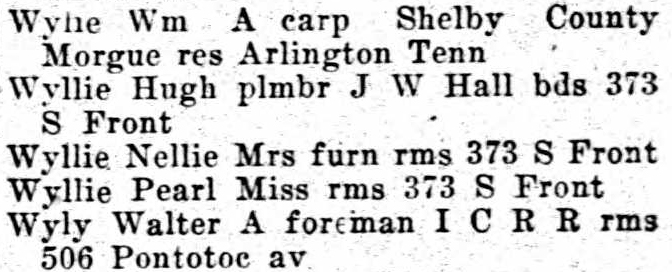
1918 Memphis City Directory,
R. L. Polk & Co., page 1340
Brian Béla Schellenberg is part of Ancestry.com's ProGenealogists division.  He meets Goodwin at the Arkansas Studies Institute, Butler Center Galleries.  He tells her that he did not find Nellie Haynes or Goodwin in any Arkansas or Memphis city directories (Ddid he really search for the entire state of Arkansas?  How many years did he check?  Did he look offline?  Or did he just do a global search through all the directories on Ancestry for "Nellie Haynes" and "Nellie Goodwin?"), and that "we know that she had her daughter Pearl", so he searched for instances of a Nellie and Pearl at the same address (even though Pearl could have been living on her own at this point, it's a clever search technique).  He finally found what looked to be them in 1918 in the Memphis, Tennessee city directory with the last name of Wyllie.  Also listed at the same address was Hugh Wyllie, Nellie's apparent next husband.  Goodwin comments that her grandfather John was about 13 years old and already on his own, according to what he had told family members.  (On the other hand, minors are not normally listed in city directories, so the absence of his name doesn't actually indicate he isn't living with his mother.)

Schellenberg admits that the city directory on its own is not enough to prove it's the right Nellie, so he looked for a death certificate.  He started in Tennessee but didn't find anything there, so he searched in the states around Tennessee.  He discovered that Nellie died in Minden, Louisiana as Nellie May Wyllie.  Goodwin is now thoroughly confused.  All the stories she was told were about Memphis, but she is figuring out that she has to let go of stories, because stories aren't always true.  The death certificate says Nellie's husband was Hugh and that she was born in Batesville; it also lists her father's name as Will Haynes.  (Additional information on the certificate is that she was widowed, she had lived in Louisiana for 20 years, her regular address was 511 Myers Street, and she died at the Minden Sanit. Inc., which appears to have been a regular hospital, not one of those "other" sanitariums.  I really wish they had shown us who the informant was, however!)

Schellenberg tells Goodwin that Minden is in northern Louisiana, near Shreveport.  From that, somehow Goodwin comes up with the question of whether there might be more information in Shreveport.  (Why not ask if there's more information in Minden?  Because she did that and he told her no, and they edited that out?)  Yup, that's the next stop on the Nellie Haynes research tour.  Schellenberg wishes Goodwin good luck as she leaves.  Louisiana has come as a huge surprise to Goodwin, but she definitely wants to find out what was going on.

As she arrives in Shreveport, Goodwin has much less sympathy for Nellie.  She doesn't understand why Nellie was in Louisiana when her son was in another state.  Earlier she had assumed that Nellie just had bad taste in men, but now she's beginning to believe that Nellie was a bad seed herself.

At the Shreveport Memorial Library, Goodwin meets Joseph Spillane, a professor of social history at the University of Florida whom she says she asked to research the family's life in Louisiana, what brought them there, and what kind of man Hugh Wylllie was.  (Spillane seems to specialize in drugs, the history of drug addiction, and related topics.)  He looked for Hugh Wyllie in newspapers and found an item in an October 1925 issue of the Shreveport Times:  "12 Alleged Dope Law Violators" (not a happy start).  Hugh "Wiley" was accused of violating the "Harrison anti-narcotic act", which was passed in 1914.  (The Harrison Narcotics Tax Act didn't make opium and cocaine illegal, it just made them controlled and taxable.)

The narrator, who didn't have much of substance to add during this episode, explains that during the early 20th century several drugs that are now controlled — morphine, cocaine, heroine — were legal and accessible, used for many everyday ailments, and hundreds of thousands of people became addicted.  The Harrison Act placed some of these drugs under federal supervision, which meant that doctors were restricted in what they could prescribe, but drug dealers still sold stuff to desperate addicts.

But is this Hugh truly linked to Goodwin's Nellie?  Spillane says while looking in the newspapers for Hugh Wyllie he found one reference to Mrs. Hugh Wyllie.  Goodwin says, "Excellent," and then Spillane gives her a copy of the article.  Goodwin doesn't say anything but appears to be holding back tears, because this article is titled "Woman to Be Tried on Morphine Charge" (we are not told the date of the article or what newspaper it was published in).  Not surprisingly, Goodwin says, "Somehow this is not what I expected."  Nellie was 54 years old and had been caught with 1 1/2 ounces of morphine.  Spillane says that the amount would be significant even today and is a good indication that she probably had it to sell, not to use herself.

Goodwin assumes there were not a lot of female drug dealers.  Spillane responds that women were overrepresented as addicts, particularly in the South, and he wouldn't be surprised if some of them also distributed the drugs.  Goodwin wants to know if Spillane found any of Nellie's indictments after she was arrested, and indeed Spillane has more documents.  The first is a letter from Nellie addressed to the U.S. Attorney's office in Shreveport and dated May 8, 1934.  Nellie requested a transfer from the Shreveport to the Lake Charles Division so that she could enter a guilty plea and begin serving her sentence.  She signed as Mrs. H. Wyllie.  The second document was from the United States District Court, Western District of Louisiana.  Mrs. Hugh Wyllie was sentenced to two years at the Federal Industrial Institution for Women in Alderson, West Virginia, starting from May 21, 1934.  I found it interesting that in the newspaper article and in both legal documents, Nellie's given name did not appear.

Goodwin wisely notes, "No wonder he didn't want us to know her name."  But why did Nellie go back to Shreveport?  Spillane says that in the early 1920's Shreveport was home to the nation's most significant clinic for narcotics addiction, and that records for the clinic still exist.  Those documents are held at Louisiana State University, not too far from where they currently are in Shreveport.  Spillane says that he can arrange for Goodwin to meet with Jim Baumohl, who can help her look through the material.  Goodwin is silent for several seconds and looks as though she is thinking it over, then grudgingly says, "Well, I should go see them."  I wonder if she would have gone if this hadn't been for a TV program.

In this interlude, Goodwin looks serious and contemplative.  She says she needs to learn if Nellie was an addict.  She considers addiction to be a disease.  If Nellie was an addict, maybe Goodwin's family won't be able to, but she can forgive Nellie.  She doesn't want to say that she feels sorry for Nellie and doesn't think she should be pitied, but views her as someone to be understood.

Still in Shreveport, Goodwin now goes to the Noel Memorial Library archives at LSU, where Jim Baumohl is waiting to help her.  (Baumohl specializes in research into urban poverty, homelessness, and social welfare.  We saw him previously on the Kelsey Grammer episode.)  For obvious dramatic effect, he has her take a heavy book down instead of having it on a table already.  It has the applications that people filled out when they wanted to come to the drug treatment clinic.

Baumohl has Goodwin look through all the W's instead of having marked a page (vicarious research?), until she reaches Mrs. Hugh Wylie.  The application is dated March 8, 1922.  Nellie (patient #710) was 43 years old and said she had been addicted to morphine for 11 years, which Goodwin notes means she started when John was 6 years old; Pearl would have been about 9 or 10 years old (actually about 11, if she's the baby mentioned in Nellie's divorce case against Duff Williams).  She originally took morphine to treat a heart condition and syphilis, which Goodwin says (and I agree) that she probably got from Al.  (When she submitted the application she was taking 10 grains of morphine each day.)

Baumohl explains that Nellie was likely prescribed morphine during the first stage of syphilis for the pain.  Baumohl adds that syphilis could not be cured until after World War II, when penicillin became available; during Nellie's time, doctors couldn't cure much but they could relieve pain.  Nellie stated that she was married and had three children (we haven't heard about a third child; where did this one come from?), and that she did want to be cured.  Her address was 210 Baker.

Goodwin pages through the book and comments on how many other women's applications are in it.  Many of them apparently said they started taking the drugs after surgery.  Baumohl says that medication addiction was ubiquitous in the South, particularly among women.

Speaking of Pearl, Goodwin finds her application in the book also, as Pearl Williams (Goodwin has to pause and remember that Williams was Pearl's father's name), dated the same day as her mother's, March 8, 1922.  She was 21 years old and lived with her mother at 210 Baker.  Goodwin and Baumohl comment on her coming in the same day as Nellie and say that they probably came together, but I think the more telling evidence is that Pearl was patient #711 and Nellie was #710.  Pearl said she had been an addict for three years and that she started when taking medication for bronchial asthma.  (She stated she began at 6 grams of morphine per day and in 1922 was taking 10 grams each day.)

Baumohl then tells Goodwin that the clinic for which these applications had been submitted closed in 1923.  Nellie and Pearl would have been patients for less than a year.  Goodwin notes that they really had no chance and wonders what would have happened if the clinic hadn't closed.  Nellie probably would not have gone to federal prison.

Baumohl also has an obituary for Nellie.  The Minden Press reported on the funeral service for Mrs. Nellie Wyllie, who had died at the age of 82.  Survivors included two sons, J. P. Wyllie (who must be that third child mentioned previously) and John B. Goodwin, and seven grandchildren, one of whom was Goodwin's father.  (The complete text of the funeral notice appears on Nellie's FindAGrave page, which is linked below.  I wonder who gave the information to the newspaper, since John was included.)  Pearl apparently died before Nellie, but nothing was said about her death during the program.  Maybe the researchers didn't find her?  Maybe they didn't look?

Goodwin talks about what Nellie faced was insurmountable.  She was prescribed drugs then struggled with them, and that's probably why she was cut off by family.  It was all a tragedy.  Goodwin is excited to tell her father what she has learned but also (understandably) anxious about how he will deal with the information.   Now that she's gone on this journey, she feels closer to Nellie.  She's amazed that at the age of 37 she has "inherited" great-grandparents (though she never refers to Al as her great-grandfather).

In the final scene, Goodwin visits Nellie's grave at the Minden cemetery and brings flowers.  The gravestone has Nellie's and Hugh's names on it.  (An interesting note per the FindAGrave page:  Nellie outlived all three of her husbands.  Also, her father's name is listed as Isaac Bart Haynes, not Will.)  Goodwin tells Nellie, "You aren't Jewish, but I am" (Goodwin's mother is Jewish, and she was raised in both of her parents' religions), and she leaves a small rock on the gravestone, explaining that the Jewish custom is so that the deceased knows a loved one has visited.

Goodwin regrets that there was no reconciliation between Nellie and John.  She concedes that it was his right to feel the way he did, but it's still sad.  She can't imagine facing everything Nellie did and not having a relationship with her own son because of it.

Questions left unresolved in this episode:  Who were the two women in the photo with Nellie?  (Was the middle-aged woman Pearl?  Maybe J. P. Wyllie's wife?)  What happened to Duff Williams, Al Goodwin, and Pearl?  You can find Duff's and Al's death dates on their FindAGrave pages, and Al's death certificate is posted, but Pearl isn't even listed as a child on Nellie's page.  Inquiring minds want to know!  As a side note, did you notice that all three of Nellie's husbands had trouble with the law?  What does that say about Nellie?  Whether deliberately or subconsciously, she appeared to make the same mistakes over and over.

This was rather a downer of a story, and Goodwin is more than a little teary throughout.  The research sources were interesting, but I was surprised that this was the lead episode for the summer season.  It made me wonder what would follow in the ensuing episodes.

New Orleans Times-Picayune,
October 29, 1930, page 4
While this episode focused on the the negative aspects of Nellie's life, I did find two newspaper articles from her time in Minden, when she served on the annual Presbyterian synodical conference committee in 1930 and 1931.  Apparently things weren't all bad all the time.  In addition, both articles referred to her as Mrs. Hugh Wyllie, so apparently Spillane didn't do a very thorough search?
Saturday, August 15, 2015

DNA and Legal Records and Jewish Records, Oh My!

Days 2 and 3 of the Northwest Genealogy Conference continued to be interesting and educational.  On Friday the featured speaker was CeCe Moore, and the theme for the day was therefore DNA, of course.  The session I attended was "Autosomal DNA and Chromosome Mapping:  Discovering Your Ancestors in You" (as I already have a good handle on the basics and ethnicity estimates, and really didn't want to hear about Henry Louis Gates, Jr. and his program).  While I recently attended a one-day seminar by Dr. Tim Janzen on this topic, I have to say that Moore explained it a little more clearly, and now I almost feel prepared to try using these techniques on my own family research.  She was very open about warning everyone that this is time-consuming stuff, however, so I have to figure out a way to fit it into my schedule (ha!).

I also went to Elissa Scalise Powell's third offering at the conference, "Baker's Dozen Steps to Writing Research Reports."  She has created a great template that looks like it will make writing reports much easier.  I'm definitely going to implement ideas from this session in my regular work.

Saturday's featured guest was Judy Russell, the Legal Genealogist, and most of the day's sessions were related to legal records and courthouse research.  I managed to get up early enough to make it to the first presentation of the day, "That First Trip to the Courthouse", by Judy.  Yes, I have done a lot of courthouse research already, but she's just so entertaining that it was worthwhile to listen to.  Some of the points she made really resonated with my own experience, such as "Don't be afraid to ask."  Once I couldn't find a record in the computer index that I really, really thought should be there, so I asked if any other index was available.  The clerk took me across the hall to the original docket books, from which the computerized index had been created.  The case I wanted was listed in the book!  I don't know why it was missing from the computer database, but I found what I needed.

As a follow-up to "Don't be afraid to ask", Judy had in her handout, "Almost every courthouse has someone who really knows the old records.  It's worth trying to find that person and find a convenient time to chat."  When I was trying to determine in which courts and prisons or jails a particular man might have records, the clerk told me that this one guy upstairs in the D.A.'s office knew all about how the courts were set up "in the old days."  You know that I immediately went up there to see if that man was available.  Lucky me, he was!, and he had a few spare minutes.  He explained how the old municipal (city) court and jail used to function and what probably happened to their old records.  I still didn't find the records (the consensus was that they had probably been destroyed decades before), but I had a much better understanding of the process the man I was researching had gone through in the judicial system.

After Judy's morning session I taught my class, "Looking for Non-Jews in Jewish Records."  This talk originated as a keynote at a local family history day.  The main point is that those of us researching Jewish family history can be obsessive (very obsessive) about finding any and all records and resources that might be helpful and then often sharing the information online.  Though the sites on which the information is shared are usually focused on Jewish research, the resources themselves often aren't.  So if, for example, someone who isn't Jewish has ancestors who were in Belarus, the Belarus Special Interest Group's page on JewishGen has links to lots of great information that can help that person.  About twenty-five people came to my class, which went very well.  Several people stopped me later to say that they learned a lot, which is always great to hear.

The next session was Judy's second class of the day, "Where There Is — Or Isn't — a Will."  I learned a few new things here, such as the fact that a "holographic" will (one handwritten in its entirety by the person making it) is called "olographic" in areas that use civil law (as opposed to English common law), such as Louisiana, Puerto Rico, and Québec.  In Florida you might find a "curator" listed as one of the people involved.  He was a temporary caretaker of property after someone's death, before an administrator was appointed.  The example that Judy discussed was when a man who sold perishable foods died; the curator stepped in to make sure that the food was handled properly and saved during the time it took the court to find and appoint an administrator.  I found it interesting to learn that, while minors are not considered competent to bequeath real estate, they can leave personal property:  boys at 14 and girls at 17.

The afternoon began with Judy's last presentation of the conference, "Order in the Court:  Using Court Records in Genealogical Research."  This was a different kind of class.  She gave a brief overview of courts but then switched gears and suggested that researchers take the time to simply read through cases that occurred in the same time and place as where their ancestors lived, even if those ancestors themselves had not been involved in the cases.  The information in the write-ups of cases can give you a lot of details about what life was like at that time and place.  She read from several cases.  The most detailed example was an 1844 Virginia appellate case relating to a murder, in which we learned about the types of houses people lived in, family living arrangements in those houses, when people normally went to bed, the styles of shoes men wore, and what types of guns were commonly used, among many other things.  While it's always recommended to read about the history of an area, this was the first time I've heard a recommendation to read the court cases of an area to learn more background information.

The final session of the day really surprised me.  The title, "Field Dependency:  A Way to Evaluate Genealogical Sources", and the handout sounded very academic and stuffy, but Jean Wilcox Hibben turned it into a lively talk about looking at records and thinking about for what purpose a record was created, who gave the information, ways in which the information could have been misunderstood, reasons for which someone might have lied or made a mistake, and generally just looking at each record critically and analyzing it.  It was a great way to end a conference at which I learned a good amount of new things and made several new genealogy friends.  I had a wonderful time in Arlington and hope the conference continues to grow and improve in the years to come.

Thursday, August 13, 2015

Northwest Genealogy Conference and a Visit to the Cemetery

Today was the first full day of the Northwest Genealogy Conference, which had a very busy and impressive schedule.  I unfortunately did not make it to the opening welcome and prize drawing, because I missed a turn on the way to the conference and went ten minutes out of my way (which I then had to repeat on my back to the correct turn).  But that allowed me to discover the Arlington cemetery, which I visited on my way back in the afternoon (more about that soon).

Today's featured speaker was Angela Packer McGhie.  I attended two of her sessions, "Mining for Family History in Federal Land Records" and "Read All about Your Ancestors by Locating Historic Newspapers."  The land records class was by far the best I have had on the subject.  She provided a very clear timeline of what types of federal land records were created during which timeframes and also gave great instructions on how to find and obtain copies of those records.  These are obviously records she is passionate about.  I am very motivated now to try to find these records for as many of my relatives as possible!

Because I teach so many classes about newspapers myself, I did not expect to learn much new in her class on that subject, but I still picked up some information.  One gem was a list at the University of Minnesota's Immigration History Research Center & Archives of its periodicals sorted by ethnic group.  These periodicals are not online, but it's a great resource to know about.

I had been looking forward to going to the classes that Luana Darby was going to teach (on tax records and online archives), but she unfortunately fell ill and had to cancel her sessions.  The conference organizers arranged for Elissa Scalise Powell to teach her Saturday classes today instead, to fill the gaps.  In one way this worked to my advantage, because one of her sessions was originally scheduled at the same time as mine, so I was going to miss it.

"Bridging the Decades:  Little-used Clues from the Census" (the class I would have missed on Saturday) emphasized all those columns to the right of the names, ages, and birthplaces that many people stop at.  A lot of information there is often overlooked by researchers.  And "What's a Prothonotary?:  Pennsylvania's Courthouse Records" was important for my personal research, because about half of my father's ancestors were in Pennsylvania.  Elissa explained which offices have which types of records, the . . . interesting indexing method used by county offices in the state of Pennsylvania (Randy Seaver wrote about his adventures with the Russell Index System a few years ago), and showed some examples of using the index system to find records.  I also learned that FamilySearch.org has digitized the microfilms of Pennsylvania probate records (more research I need to make time for!).  Oh, and "prothonotary" comes from the first or most important notary; it's now used to denote the chief clerk.  Apparently a title used in commonwealth states (Kentucky, Massachusetts, and Virginia in addition to Pennsylvania), only Pennsylvania still uses the term.

Speaking of my talk on Saturday ("Looking for Non-Jews in Jewish Records"), I just discovered that it was featured in a post about the ethnic genealogy track at the conference.  I hope Val comes to my class; I think it would help her a lot with researching her husband's mother.

Several ProGen alumni had lunch together today at the conference.  I'm happy to say that we got a photograph of the group (the first time I've managed that in the four get-togethers I've coordinated!).  Thank you to Michelle Goodrum, Cyndi Ingle, Mary Kathryn Kozy, Janice Lovelace, Angela Packer McGhie, Linda Okazaki, Elissa Scalise Powell, and Cari Taplin for a very pleasant lunch break, and to Reed Powell for taking our photograph!

On my way back to the hotel from the conference, I stopped at the Arlington Municipal Cemetery.  It's a very pretty cemetery, with well kept grounds and easy access from multiple entrances.  I spent some time walking around and took photos of a few of the gravestones that particularly caught my attention.

Frank L. Greeno's tombstone was made in the shape of a tree trunk cut off at the top, and since he was only 34 years old when he died (1869–August 13, 1903), I thought the shape might be to emphasize that he died relatively young.  The information about him on FindAGrave suggests that the tree trunk form might be because he was a member of the Woodmen of the World.  (If I knew more about the Woodmen, I might have recognized the "Dum Tacet Clamat" phrase on the stone.)  Sadly, when he died in a work accident he left behind a widow and five children.

I found the stone for William Spoerhase to be very graceful.  When I read the birth and death dates — April 8, 1876 to June 18, 1918 — I wondered if he had died in the influenza pandemic.  The transcribed obituary on FindAGrave doesn't say that directly, but it seems to imply it.

By far the most impressive grave I saw was that of Mariano Soltero.  Mr. Soltero lived a full life (April 17, 1925–October 15, 2001), and he must have been well loved by his family.  His stone, which says, "Brother • Son • Husband • Father" and "He is remembered by his wife, children, and family" in Spanish, is beautifully carved with a natural scene.  The grave also has an elaborate Catholic shrine at the head of the stone.  The flowers were fresh and had to have been put there recently, probably this morning.

I thank the "residents" of the Arlington cemetery for sharing their afternoon with me.  I hope they all are resting in peace.

Saturday, February 14, 2015

FGS and RootsTech: Thursday and Friday

On Thursday, the RootsTech part of the joint conference with FGS began.  This meant that the exhibitor hall opened!  I was ready and waiting at the entrance for the 10:00 a.m. opening because I wanted to go straight to the E-Z Photo Scan booth.  There had been lots of announcements prior to the conference about their free scanning opportunity, with the company having a goal of 100,000 photographs preserved the course of the conference.  The purpose of the promotion was to show off the capabilities of the Kodak Picture Saver Scanning System (I think I was using the PS50).  I have to say, I was extremely impressed.  Arnold Hutagalung, one of the company reps at the booth, was very helpful.  He showed me how to get started, and it was pretty smooth sailing.  I scanned almost 350 photos in half an hour!  That's all it took!  It took a little while longer to copy the files to my flash drive, and I was done.  I can't afford one of these, but I was told that a big focus of the company's marketing is FamilySearch Centers and Libraries.  I'm hoping we'll get one in Oakland.

After I retrieved my flash drive, I ran off to the far reaches of the Salt Palace for more FGS learnin'.  The outstanding session of the day was Craig Scott's talk on Civil War medical records.  When I wrote about my great-great-grandfather Cornelius Godshalk Sellers, I mentioned that he had been in the hospital twice, and I'm very interested in finding more records related to those incidents.  Craig started off his talk by warning everyone that if they would be uncomfortable seeing information about STD's, they shouldn't go anywhere near Civil War medical records.  Apparently STD's were the leading cause of men needing to go to the hospital during the war.  Craig mentioned that even George Armstrong Custer (then only a lieutenant) was treated for gonorrhea!  Craig explained things such as the levels of care men might have received, which records might mention medical information, the top two medical reasons for which men received pensions (diarrhea and dysentery), and several of the National Archives Record Groups in which records might be found.  I felt inspired, but now I need to go to Washington to do research!

The other great talk of the day was by Judy Russell, the Legal Genealogist, who spoke about federal court records and how they can be useful in family history research.  (This was scheduled as a RootsTech session, though the only discernible "tech" connection I could find was the seven URL's she listed in her resource list.)  This was the first time I have heard Judy in person, and it was fun.  She discussed which types of cases could be heard in federal courts (and which couldn't), where records are held (almost nothing is online), and who might appear in records.  Beyond the expected plaintiffs, defendants, and judges, maybe you have a relative who was a court officer, investigator, attorney, witness, juror, bondsman, or someone in Customs, the Treasury, or the FBI?  Judy also talked about how you could follow people or an issue through a case and showed some interesting examples.  One man was prosecuted for running a still, and the file had lovely photographs of the still, from several different angles no less.  An inheritance dispute between some family members (which went through the federal court because it involved people in one state and land in a second state) included photographs from childhood to old age of the deceased man who had bequeathed the land, and fantastic family information about who was related to whom and questions of the paternity of a putative grandchild.  The cases she chose to showcase issues were on polygamy in the Utah Territory, and the famous Dred Scott case.  The decisions in those cases had lasting effects and are obviously relevant to families affected by them.

The best talk I attended on Friday was also by Judy, this one on justices of the peace.  After pointing out that, while originally the position was held almost exclusively by men of high social standing, not-so-prominent men could be JP's, Judy gave several examples of historical JP's, such as George Washington, Thomas Jefferson, and Benjamin Franklin.  A couple of unexpected justices were Henry Fielding, author of Tom Jones (no, not about the genealogist), and the famed Judge Roy Bean.  We heard about the first known black American JP, Macon Bolling Allen, who was appointed in 1848 in Middlesex County, Massachusetts, and the first female American justice, Esther Hobart Morris, appointed in 1870 in Sweetwater County, Wyoming.  Judy covered the varying responsibilities of JP's, what kinds of records might exist, and tips on finding the records.  Again, most of these are not online.

The other session I found particularly useful on Friday was a computer lab on finding and using online newspapers.  Yes, I know, I am the genealogy newspaper queen of the Bay Area :), but there is always more to learn.  The focus of the class was on telling attendees about large free online newspaper collections.  (They included the Wikipedia newspaper archive page I contribute to regularly.)  A short slide presentation showed the basic process of how newspapers are digitized.  Then everyone was instructed to go to the Indiana Digital Historic Newspaper Program site, create an account, and sign in.  After that we were told to do a basic search. None of that is too exciting, right?  The useful part was when the presenters explained in detail how the system to correct mistakes in the OCR worked.  This correction system is valid in almost all Veridian newspaper databases, so I tried it with the California Digital Newspaper Collection, which I use as an example in several of my newspaper talks, so I know of some specific mistakes there.  It was interesting to see the search results change after making a correction.  The search engine no longer finds the incorrect word, but when you search for the corrected text, the results still display the incorrect OCR reading.  I'm going to be adding this to my talks.

Other cool things on Friday were scanning another batch of photos at E-Z Photo Scan (thanks again, Arnold!), meeting Eric and Karen Stroschein of the Northwest Genealogy Conference (where I am scheduled to be a speaker), doing a group photo of California Genealogical Society members here at the conference, helping at the Association of Professional Genealogists booth during lunch, getting my photo taken with Randy Seaver (because I won my RootsTech registration through his contest), and talking with Schelly Talalay Dardashti, Thomas MacEntee, and Dear Myrtle.  The only real downer was the people at the GenealogyWallCharts.com booth.  They paid to have a promotional card inserted in the registration packets, saying that there would be free blank charts and free black and white charts available.  It seems that they didn't plan adequately for the number of attendees, whether ones asking for the promised charts or printing out color charts at the booth, and the booth people got grumpy and snappish and told me there weren't going to be any more free charts.  Sorry, guys, not a good impression to make on a (former) potential customer.

The other negative was that FGS' position as red-headed stepchild meant that less attention was given to that end of the conference hall.  Not only did the containers of ice water run out and were not refilled, even the attention to maintaining the women's room was minimal, and trash overflows were common.

==

My other comments about the conference are here for Tuesday and Wednesday, and here for Saturday and my overall impressions.

Tuesday, December 3, 2013

Genealogy Research in the East Bay via BART

A death certificate from
the Oakland History Room
I've previously written about using BART to travel to genealogical research locations in San Francisco.  It's time to give equal attention to the East Bay.  Since I live in Oakland I often drive to these places, but parking in downtown Oakland and Berkeley is comparable to San Francisco, so being able to take BART lets you avoid that mess.

The first stop on our East Bay research tour is Lake Merritt station.  Follow the exit signs toward 9th Street, and you'll see a very large sign that says "Superior Court."  Exit at that corner, and when you come up above ground, you'll be at the corner of 9th Street and Oak Street.  That puts you five blocks from the main branch of the Oakland Public Library, four blocks from the Alameda County Administration Building and Superior Court, and three blocks from the Alameda County Clerk-Recorder.

If you're taking a train from Pittsburg/Bay Point, Millbrae, or SFO, you need to transfer to a Fremont or Dublin/Pleasanton train get to the Lake Merritt station.  Instead of waiting for a connecting train, you might want to get off at the 12th Street/Convention Center station, though it's a longer walk.

Similar to the San Francisco Public Library, the Oakland Public Library has two important resources for genealogists:  the Oakland History Room and the Newspaper and Magazine Room.  The History Room is on the second floor of the library and has information and records primarily about Oakland, but also for other cities in Alameda County.  Probably the most significant items are original Oakland birth and death certificates from 1870–1904, before the state of California began collecting vital records, but you can also look at a complete collection of Oakland city directories (1869–1943); Alameda County voter registers (1867–1944); Tax Assessor's block books for Oakland (1877–1925); various Sanborn fire insurance map books from between 1882–1951; photographs of Oakland, Piedmont, and Emeryville; vertical files of newspaper clippings; several local high school yearbooks; information on the origins of street names for Oakland and Berkeley; and more.  There are indices to several local newspapers and to articles in books and magazines.  Staff will do free look-ups and will mail you copies of items for a small fee.  The Newspaper and Magazine Room, which is at the other end of the second floor from the History Room, has the complete historical run of the Oakland Tribune on microfilm, along with many other local newspapers, including a significant number of black newspapers.

The Alameda County Administration Building houses the Superior Court records office and the Tax Assessor.  The records office, on the basement level, holds probate and civil indices and microfilms.  If the records you want to look at have not been microfilmed, they'll have to be retrieved from storage, which can take several days.  Unlike San Francisco, there is no charge to request records from storage.  Also, some records may be housed at different courts.  Criminal records apparently are treated similarly.  The Tax Assessor's office is on the first floor.  You can walk in and ask the nice people there to look up who owns a property.  I've been told it's possible to get complete tax records for a property, but I haven't done that myself (yet).

The Alameda County Clerk-Recorder holds birth, marriage, and death records from 1905 to the present and land records dating back to the 19th century.  There are no restrictions on who can order an informational copy of vital records in California, but more recent records may have some names, such as the medical examiner on a death record, redacted (privacy laws).  The Recorder section has computerized and microfilm indices and records for land transactions and fictitious business name registrations.  A computer with an in-house index for vital records includes records that occurred after the published indices end.

The 12th Street station is the closest one to the African American Museum and Library at Oakland (AAMLO).  Exit toward Ogawa Plaza and then head west on 14th Street.  AAMLO is about four blocks away.  AAMLO is a great resource for researching the black communities of the Bay Area and California.  It has diaries, oral histories, videos, newspapers, and other materials relating to local people and organizations.  It also has general resources relating to black history in the United States and important historical individuals.

Our next stop is the 19th Street station in Oakland, the closest station to the California Genealogical Society and Library (CGS), as Kathryn Doyle pointed out in my post about San Francisco genealogy locations.  You can follow the exit toward Broadway and 20th or the one toward 20th; either way you'll have to cross a street (20th for the former, Broadway for the latter) to get to the corner with the beautiful green I. Magnin building.  Then walk up Broadway two blocks, cross one more intersection, and turn left to enter the old Breuner Building, where you will find CGS on the lower level.  CGS has resources not only for California but for the entire United States, as so many people came to California from other places.  Its extensive library includes books, manuscripts, and microfilm.  It also offers genealogy classes throughout the year, including an introduction to genealogy the first Saturday of the month.  Several databases are available on the Web site and in the library.  The library is open to all, but nonmembers must pay a $5 user fee, except for the first Saturday of the month.

Continuing further up the Richmond line (but passing MacArthur and Ashby stations), the Berkeley station puts you not too far from Bancroft Library on the University of California campus and in easy walking distance of the Berkeley Public Library and the Berkeley Historical Society.  If you're going to Bancroft, exit the station via the plaza escalator.  Go east on Center Street, cross Oxford, and enter the campus on Grinnell Pathway.  Turn left on Campanile Way.  After about three "blocks" distance, you'll come to Doe Library; Bancroft is on the east end of the building, with the entrance on South Hall Road.  Bancroft is primarily an archive, with collections of Western Americana, Mark Twain papers, the Magnes Collection of Jewish Art and Life, and the university archives, among others.  It also has a significant photograph collection, much of which is being digitized.  Generally, you need to page materials ahead of time (which is a whole separate post!), but some reference materials are on the shelves.

To go to the Berkeley Public Library, follow the signs at the Berkeley station to exit at Shattuck and Allston on the west side of the station.  When you come up above ground, walk south one more block and you'll be at the library.  The big attraction for researchers here is the Berkeley History Room, which has city directories and phone books, Berkeley High and University of California yearbooks, Sanborn insurance maps, the Berkeley Daily Gazette from 1894–1983, oral histories, photographs, maps, and more.

For the Berkeley Historical Society, exit the Berkeley station through the plaza escalator and head west two blocks on Center Street.   The society's History Center has a library and an archive.  I've been told it has Berkeley High School yearbooks (including some years that the Berkeley History Room doesn't have) and a photograph collection, but I haven't actually made it there yet to see for myself.

One very important genealogical location that BART doesn't reach directly is the Oakland FamilySearch Library.  The closest station is Fruitvale.  When you exit the station, to the right is a large board listing the AC Transit buses that leave from the station.  The board also has a handy map showing the bays from which each bus departs.  Currently the #39 bus will take you to the corner of Lincoln Avenue and Monterey Boulevard (but AC Transit has changed this route several times, so the specific bus line might be different when you go).  From there walk back down the hill a little to the entrance of the LDS temple campus and follow the signs to the Visitors' Center/Family History Center (the former name of the FamilySearch Library).  The library is on the lower level of the building.  Before you walk in, make sure you enjoy the beautiful view of the bay.

The Oakland FamilySearch Library is a branch of the LDS Family History Library in Salt Lake City, Utah (the mother lode of genealogy libraries).  It is a noncirculating genealogy library with almost 10,000 print items, 38,000 microfilm reels, and 10,000 microfiche.  The collection has a strong regional focus, so you will find lots of records about California (particularly the Bay Area Portuguese community), but there is something for almost everyone here.  The San Francisco Bay Area Jewish Genealogical Society (SFBAJGS) regularly donates publications and microfilm, so the library has a significant number of Jewish research resources.  The 75 computers have access to more than a dozen subscription genealogy Web sites, including Ancestry.com, FindMyPast.co.uk, NewspaperArchive.com, and Fold3.com.  Classes are offered regularly, and several genealogical groups, including SFBAJGS and CGS, hold meetings, classes, and events in the library.

A really interesting set of records is at another location that requires you to take an extra step after getting to the BART station.  Go to the Hawyard station and take the shuttle to California State University of the East Bay.  In the university library's special collections is a set of original Alameda County voter registration forms from 1875–1925.  Most of this type of record around the country were destroyed, so these are unusual survivors.  This particular set includes a record for author Jack London.  The library also has collections of historical slavery documents and World War II Japanese relocation materials.

So far I've only discussed Alameda County locations, but Contra Costa County is also in the East Bay.  I don't know of anything you can get to directly by BART, but some core repositories are reachable by BART and a bus connection.  The Contra Costa County Clerk, Superior Court, and Historical Society are all in downtown Martinez.  The best way to get there by BART is to go to the Walnut Creek station and take the County Connection #98X (express) line to the Amtrak station, which is only a short walk from the three locations.  You can also take a bus to Amtrak from Pleasant Hill (#18), Concord (#16, #19), and North Concord (#28/627), but the bus lines from those stations take significantly longer.

The Contra Costa County Clerk's office has birth, marriage, and death records, land records, and fictitious business name filings.  Searchable indices are online and on computers in the clerk's building.  The Superior Court records office holds records for closed cases, which are what genealogists usually deal with.  The Contra Costa County Historical Society's History Center is an archive with photographs and original documents relating to the history of the county.

I realize it seems as though I'm giving Contra Costa County short shrift, but I don't know of other genealogy research locations that are easily BARTable.  For example, the Plesasant Hill branch of the Contra Costa County Library has a genealogy collection, and members of the Contra Costa County Genealogical Society volunteer at the library and help people with their research—but the closest station is a mile away on the other side of the freeway, and I didn't see a direct bus connection.  If you know of other BART connections, feel free to post a message letting us know!